 ← Grupo Aprecisa · Connecting those who know with those who need
Resilience
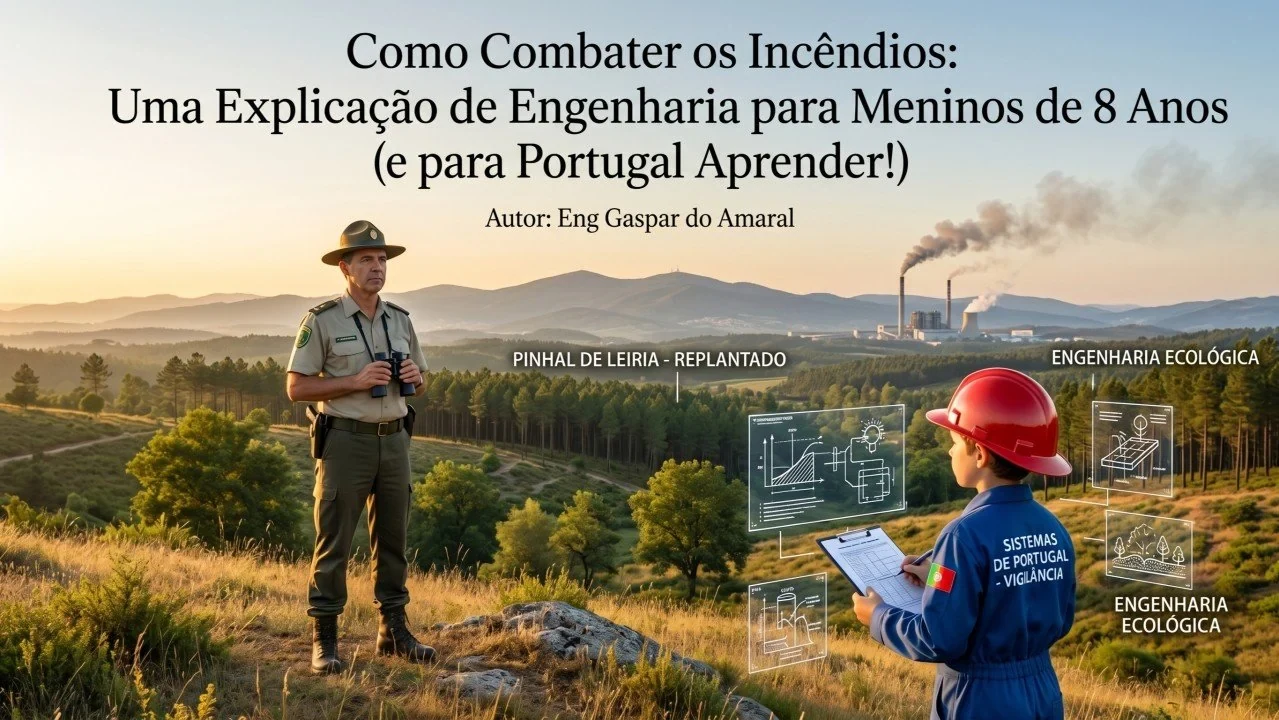
How to Fight Wildfires: An Engineering Explanation for 8-Year-Olds (and for Portugal to Learn!)
How to fight wildfires, explained to an 8-year-old child: command, control and communications against fire
Gaspar do Amaral · 1 June 2026
Translated from the Portuguese original. This version was issued on 27 October 2026.
On this site, this article has been
Note on technical and systemic rigour: This document rejects any political, party-political or ideological statement. It is a strict analysis of Systems Engineering, of Communications Network Architecture and of Command and Control (C4I). The laws of thermodynamics, of cybernetics and of information theory (latency, redundancy, entropy) do not obey decrees or electoral cycles. What is set out here is not a criticism of governments, but the structural foundation needed for the survival of critical infrastructure. Fire does not debate politics; fire simply consumes systems that lack the architecture and the verticalidade (verticality) needed to put it out.
If we think of our country as a giant assembly board, we quickly understand the mechanics of our annual collapse. With more than 35 years of experience in communications engineering and in the joint integration of complex systems in the land, sea and air domains, technical and scientific rigour has taught me an unchangeable rule: the laws of engineering resolve chaos.
I am going to translate the technical architecture of the European response so clearly that an 8-year-old child will understand it, without ever giving up the scientific depth that supports it.
1. The Team Captain and the Walkie-Talkie (Command and Control – C2)
The simple explanation: Imagine you are playing football, but nobody knows who the captain is and the walkie-talkies are broken. Everybody shouts and nobody understands anybody! In Europe (as in Spain and France), they call in the Military to help. Why? Because they have the best radios, they train together every day and they know how to obey the same voice of command without confusion.
The science of the wise: This is the basis of Cybernetics and of Command. Wiener (information without noise) and Boyd (acting fast in the OODA loop) explain the tactical advantage. Authors such as Ashby, Beer and Perrow prove that disorganised systems always fail. Woods, Rasmussen, Schelling, Bar-Yam and Hollnagel confirm that only a team with military coordination and resilience can absorb the chaos of a fire.
Theoretical, European and global grounding:
- The theory: The central premise is that fragmented systems fail under stress. Norbert Wiener (Cybernetics) showed mathematically that any control system depends on the absence of “noise” in communication; if the feedback is corrupted, the system loses its course. In addition, Colonel John Boyd (OODA Loop) proved that whoever goes round the cycle of Observe, Orient, Decide and Act fastest gains the tactical advantage. Without unified command and an immaculate signals network, the forces on the ground always react too late.
- In the EU-27: The Member States of the Mediterranean basin have absorbed this cybernetic mathematics. Spain, with its Unidad Militar de Emergencias (UME), and France, with the Formations Militaires de la Sécurité Civile (FMSC), ensure that operational communications (radio and data) and the discipline of action rest on a military framework that is impervious to civilian disorganisation. Under the command of these units, decision-making latency approaches zero.
- The global vanguard: World excellence in this area belongs to the United States and Australia, through the Incident Command System (ICS). Designed in California to fight forest fires, the ICS is a masterpiece of organisational engineering. It requires dozens of different agencies (fire services, army, police) to operate under a single tactical mesh communications network, regardless of their own hierarchies.
2. Our Own Fire Engine (Sovereignty in the Air)
The simple explanation: If your Lego house is on fire, would you rather have your own fire engine kept in the garage, or will you try to hire a fire engine from the neighbour at that very moment? We, in Portugal, hire, and it costs a great deal! In Italy or Spain, the State owns the aircraft and it is the military who look after them so that they are always ready.
The science of the wise: In engineering, this means not depending on third parties. Taleb calls it having “skin in the game”. Mazzucato, Stiglitz and Ostrom argue that the State has to own what is essential to security. Specialists such as Williamson, Clausewitz, Mintzberg, Deming, Mahan and Porter teach that hiring critical infrastructure in an emergency brings gigantic costs and guaranteed failures.
Theoretical, European and global grounding:
- The theory: Depending on private actors to provide critical air platforms violates the principles of systemic robustness. Nassim Nicholas Taleb (Skin in the Game) argues that entities without their own territory at risk optimise their operations for their profit margin. Mariana Mazzucato (The Entrepreneurial State) adds that the State cannot be a mere tenant in situations of extreme market failure. Having air sovereignty is the equivalent of keeping the “core routers” of the infrastructure under direct administration.
- In the EU-27: Countries with mature security architectures internalise this capability. In Italy and in Spain, the State is the sovereign owner of the fleet of heavy air assets. In Spain, the 43 Grupo of the Fuerzas Aéreas flies the missions and guarantees the strict aeronautical maintenance specifications. The European Union, through the rescEU mechanism, has also understood this risk and has begun buying a shared fleet, reducing vulnerability to the fluctuations of the private market.
- The global vanguard: The California Department of Forestry and Fire Protection (CAL FIRE) runs the best state civil aviation programme in the world. The State of California designed and owns its own massive fleet of helicopters and air tankers. They manage their own preventive aircraft maintenance during the winter, guaranteeing launch readiness within a few minutes in the summer and eliminating the complexity of annual public tenders.
3. The Magic Eyes in the Forest (Sensors and Surveillance)
The simple explanation: How do you know the milk is boiling so you can take it off the hob? You keep looking at it! In Portugal, we dismissed the people who looked at the forest every day (the Forest Guards). We were left “blind”. Without these guardians, fire is born and grows without anyone noticing.
The science of the wise: In communications, if the sensor fails, the network goes down. Shannon demands fast, clean signals. Lovelock, Maturana, Capra and Meadows see the forest as a living system that needs a “nervous system”. Researchers such as Latour, Dörner, Weick, Senge and Holling show that without specialists on the ground watching and “reading” the forest, the State loses the ability to foresee danger.
Theoretical, European and global grounding:
- The theory: The abolition of the Forest Guard represents disconnecting the primary sensors from the territorial network. From the point of view of Claude Shannon (A Mathematical Theory of Communication), the absence of an observer on the ground is equivalent to losing vital data packets before the disaster. James Lovelock (Gaia Hypothesis) treated ecosystems as interconnected networks; removing the guard is anaesthetising the State’s ability to feel the first signs of physical danger, turning a predictive system into a reactive one.
- In the EU-27: The most resilient ecosystems keep these “human sensors” active and technically trained. In Italy, merging the forest guards into the militarised structure of the Carabinieri raised the power of surveillance. In Spain, the Agentes Forestales form an omnipresent mesh, with jurisdiction to act preventively. In Germany or Austria, the Förster (forestry engineers) are revered and work as managers of small risk catchments.
- The global vanguard: Canada takes surveillance to a higher state of the art, combining the human factor with space telemetry. The country has joined the knowledge of its Forest Rangers to missions such as WildFireSat (satellites dedicated to thermal detection) and to integrated networks of remote weather sensors (IoT). This is true systems integration: the algorithmic correlation of data from physical sensors with the intuition of people on the ground.
4. Tidying Your Room Before Playing (Forest Maintenance)
The simple explanation: If you leave all your toys scattered on the floor, at night someone will trip over them and get hurt, right? It is the same in the forest. If we do not clear away the dry branches and plant the right trees, the fire “trips” there and burns everything. Other countries look after their “garden” every day, not just when it smells of smoke.
The science of the wise: Looking after the forest is systems maintenance. Hardin and Diamond warn that abandoning what belongs to everyone leads to tragedy and collapse. The views of Leopold, Daly, Juran, Prigogine, Stern, Dasgupta, Feynman and Schumacher prove, physically and economically, that planning, continuous clearing and structural reforestation are infinitely cheaper and more stable than putting out chaotic fires.
Theoretical, European and global grounding:
- The theory: Ecological engineering teaches us that unmanaged woodland is an “entropy bomb” waiting for ignition. Garrett Hardin (The Tragedy of the Commons) warned that the lack of state oversight of private or common land invariably leads to abandonment and combustion. Elinor Ostrom (Governing the Commons) proved that, without strict rules of conduct and actively managed metrics (planned reforestation and compartmentalisation), natural capital collapses.
- In the EU-27: In Sweden and Finland, the forest is not seen as landscape, but as national critical infrastructure that sustains part of GDP. The standards for clearing and replanting are severe. In Austria, the terrain requires the protection forest (Schutzwald) to be methodically maintained to prevent avalanches and fire. There is no tolerance for “structural abandonment” or for gaps in the land register.
- The global vanguard: After the devastation of the Korean War, South Korea implemented one of the most rigorous forest recovery programmes on the planet (Saemaul Undong). State planning did not allow planting at random; the mountains were designed with geometric firebreaks and interconnected water infrastructure. In present-day Japan, the management of the Satoyama (the borderlands between villages and mountains) fuses cutting-edge technology with daily maintenance, proving that long-term reforestation is the most effective thermal barrier that humankind can build.
The Collapse over Time and the Current Architecture: An Audit of Portugal
The transition of the emergency response infrastructure in Portugal follows a legislative history that reflects the State’s successive attempts at systemic re-engineering. To understand the degradation, and the subsequent attempt at recovery, of the Command, Control, Communications and Intelligence (C4I) architecture and of forest maintenance, it is essential to analyse the laws that worked as the “source code” of this evolution.
Below is the legislative mapping and the technical analysis of the operational model in force, written with the systemic rigour that applies to the management of critical infrastructure.
Part I: Legislative and Architectural Chronology (1938–2021)
The legal evolution shows the transition from a model of direct state sensing and maintenance to a phase of operational fragmentation, culminating in the current attempt at integrated recentralisation.
1. The “Closed System” Phase and Active Sensing (Estado Novo)
- The base plan: Lei n.º 1971, de 15 de junho de 1938 (Law No. 1971 of 15 June 1938). This law approved the Forest Settlement Plan, treating the forest (particularly the common lands, the baldios) as State infrastructure, managed on strict principles of forestry engineering to guarantee thermal isolation and profitability.
- The human sensor: The organisation of the Forest Guard was consolidated by Decreto-Lei n.º 39931, de 24 de novembro de 1954 (Decree-Law No. 39931 of 24 November 1954). The State guaranteed the permanent presence of people with topographical knowledge for immediate detection (early warning) and the local suppression of ignitions.
2. The Phase of Fragmentation and Outsourcing (post-1980)
- Decentralisation of command: Lei n.º 113/91, de 29 de agosto (Law No. 113/91 of 29 August, the Basic Law on Civil Protection), and the later creation of the SNBPC, diluted tactical responsibility in a civilian model, dependent on the coordination of dozens of independent fire brigades.
- Abolition of the specific sensors: Decreto-Lei n.º 22/2006, de 2 de fevereiro (Decree-Law No. 22/2006 of 2 February). This was the law of “systemic rupture” that abolished the Corpo Nacional da Guarda Florestal (the national Forest Guard), transferring its staff to the Guarda Nacional Republicana (GNR/SEPNA). Technical specialisation in forest maintenance was absorbed into a broad-spectrum security force.
3. The Phase of Systemic Re-engineering (post-2017) After the collapse of the system in 2017, the State was forced to design a new integration architecture:
- The new planning engine: Decreto-Lei n.º 12/2018, de 16 de fevereiro (Decree-Law No. 12/2018 of 16 February). It creates AGIF (Agência para a Gestão Integrada de Fogos Rurais, the Agency for the Integrated Management of Rural Fires), centralising strategic planning (“cold” planning).
- Air sovereignty: Resolução do Conselho de Ministros n.º 139/2018 (Council of Ministers Resolution No. 139/2018). It provides for the transfer of the Command, Management, Maintenance and Operation of the State’s air assets to the Portuguese Air Force, seeking to eliminate dependence on privatisation.
- The “motherboard” of the current system: Decreto-Lei n.º 82/2021, de 13 de outubro (Decree-Law No. 82/2021 of 13 October). It establishes the Integrated Rural Fire Management System on the mainland (SGIFR), clarifying the role of each node of the operational network.
Part II: How the System Works Today (the Current C4I Architecture)
Today, the ecosystem operates on a framework that separates Planning (Prevention) from Operations (Suppression), aiming to integrate civilian and military components.
1. Strategic level: “cold” planning
- AGIF: It works as the architect of the system. It has no operational command. It plans the guidelines for preventive forestry and ensures that the forest infrastructure has thermal discontinuities.
- ICNF: It manages the national forests and coordinates the Corpo de Sapadores Florestais (forest sapper teams), working on the maintenance of the biological network and on mopping-up operations.
2. Tactical-operational level: “hot” command
- ANEPC: It is the central node (C2). As soon as an ignition is detected, it takes over management through the Sub-regional Commands, routing the forces on the ground and bringing fire brigades, GNR and air assets into a single radio communications mesh (SIRESP).
3. Projection of suppression forces
- Initial attack and sensing (ground): The GNR’s Unidade de Emergência de Proteção e Socorro (UEPS, emergency protection and rescue unit) acts as a militarised rapid-attack force. SEPNA takes on the functions of inspection and of investigating causes.
- Extended attack (ground): The Volunteer Firefighters and the Sapadores (professional firefighters) make up the critical muscle mass (more than 90% of the personnel), providing the massive water flow and the perimeter defence of infrastructure.
- Control of the airspace: The Portuguese Air Force (FAP) currently operates the State’s own assets (such as the AW119 Koala helicopters and the UH-60 Black Hawks) and coordinates the Tactical Air Command, guaranteeing logistical rigour and air-ground interoperability.
Operational summary: The 2021 law (SGIFR) sought to make up for the fragmentation. The system acts under a decentralised civilian command (ANEPC), but depends on the logistical proficiency and the tactical execution of militarised forces (FAP and GNR) combined with the widespread civic network, requiring strict integration protocols to avoid delays in the response.
The Systemic Action Plan
To stabilise and shield the country against periodic collapse, the approach has to be strictly based on joint integration architectures. The best action plan requires rigour to be imposed immediately on four axes:
- Imposing a C4I architecture on a military framework: Preventive planning remains civilian (AGIF), but at the moment of crisis the projection of forces and the routing of assets must pass automatically to the tactical command of the Armed Forces, eliminating decision latency and unifying the communications mesh.
- Air sovereignty and integrated logistics: Speed up and shield the full integration of the fleet into the Air Force (FAP). The State must hold the complete life cycle of its air assets, guaranteeing aeronautical maintenance (MRO) under military discipline and ensuring 99.9% readiness in the critical seasons.
- Reactivating the sensing mesh: Rebuilding a technical forest surveillance corps focused solely on land management, patrol and suppression in the first 15 minutes, integrated with advanced telemetry (drones, satellites) to produce an instant OODA loop.
- Enforced maintenance of the infrastructure: Forced completion of the digital land register. The forest must be legally managed with the same demands as a telecommunications network: if the owner fails to clear their section, the State carries out the work compulsorily and charges the cost. Reforestation must be designed as blocks of structural thermal insulation.
Conclusion for Children and Grown-ups
Systems Engineering does not allow improvisation. Observing the most advanced response ecosystems in the world — from the integrated command framework in Southern Europe and the ICS model (Incident Command System) in California and Australia, through non-negotiable air sovereignty, to the meticulous preventive forest engineering of South Korea and Japan — demonstrates a universal law: resilience is built with exactness, not with hope.
A system only survives if its foundation has an unbreakable verticalidade, where the command nodes are unquestionable, the sensors are permanently active and the means of projection (Sovereignty) do not depend on third parties at moments of rupture.
Joint and scientific integration (in the Land and Air domains) is the only way to mitigate the risk for good. The solution to this national emergency does not lie in rhetoric of the moment, but in the non-negotiable demand for architectural rigour to align our infrastructure with the European and global vanguards.
What is your technical view on the urgency of this structural reorganisation? Leave your analysis in the comments.
#EngenhariaDeSistemas #ComandoEControlo #C4I #IntegraçãoSistémica #ProteçãoCivil #SegurançaNacional #Portugal #UniãoEuropeia #Inovação #Telecomunicações
Methodological note
What this page is. A translation of the article the author published on LinkedIn on 1 June 2026; the full Portuguese version is on this site. The text has no calculations or figures of its own; the sources are linked in the text, as in the original.
Names of laws and bodies. Portuguese laws keep their official Portuguese names, with a translation in brackets; the links go to the official gazette (Diário da República, in Portuguese). Portuguese bodies keep their acronyms (AGIF, ICNF, ANEPC, GNR, SEPNA, UEPS, FAP, SIRESP, SGIFR, SNBPC); Spanish, French, German and Japanese names are kept as in the original. The author’s own concept verticalidade (verticality) is kept in Portuguese.
Changes of form, not of content. The decorative symbols (emoji) of the LinkedIn version were left out. The section headings, which the original sets at a single level, are shown as headings and sub-headings. The hashtags at the end are kept in Portuguese, as they are labels of the LinkedIn publication. The original illustration is reproduced with its texts in Portuguese and a translated caption.
The discussion is on LinkedIn (in Portuguese)
Comments on this text are made on LinkedIn, where the article was shared in Portuguese. You are welcome to write in English. Agree, disagree or add data: every well-founded objection receives a reply.
Gaspar do Amaral · Original in Portuguese of 1 June 2026, published on this site; translation issued on 27 October 2026 · Figures and tables © Aprecisa.com · AI-assisted