 ← Grupo Aprecisa · Connecting those who know with those who need
Energy and the electricity system · Article first published on LinkedIn on 19 March 2026
The Blackout of Logical Thinking: The Collision between Bureaucracy and the Physics of Renewables
The collision between the world of physics, where watts rule, and the world of paper, where sub-paragraphs rule: the first diagnosis of the Abismo do Rigor (the Abyss of Rigour)
Gaspar do Amaral · 19 March 2026
Translated from the Portuguese original. This version was issued on 27 October 2026.
On this site, this article has been
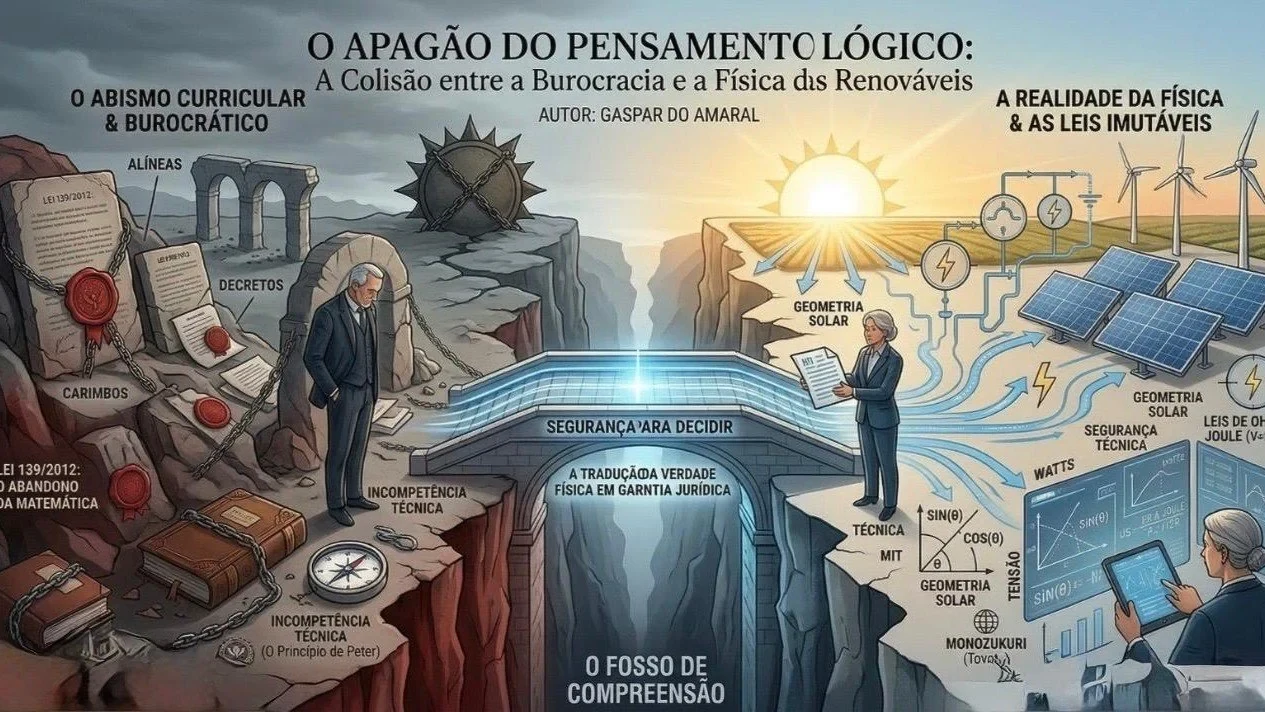
1. Summary of the problem: the administrative Tower of Babel
Today we face the collision of two worlds that have lost their common language:
- The world of physics: where reality is dictated by watts, voltage and the geometry of the solar angle.
- The world of paper: where reality is simulated by sub-paragraphs, decrees and stamps.
The “blackout” is born of this breakdown in communication: the decision-maker does not master physics, and the engineer, shut away in a technical silo, rarely manages to convert the rigour of a calculation into the “comfort” that paper demands.
The solution lies in a collaborative Engineering of Translation: the ability to convert the Laws of Nature into Legal Guarantees.
With this system, the engineer reports the complex numbers (which the administrator fears) and, in a multidisciplinary team, turns them into institutional confidence. The engineer is the one who holds the irrefutable technical knowledge to prove reality, allowing the whole system to assure the final decision-maker: “The mathematics of this project respects the laws of physics, so that the law never ignores nature.”
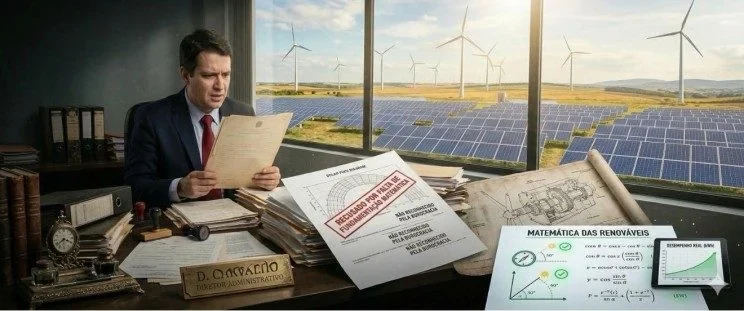
2. Introduction: physics does not read the Diário da República (Portugal’s official gazette)
2.1. The dystopia of incompetence
Imagine a scenario in which the viability of a critical energy infrastructure — the engine of our economy — is decided by someone who does not know the basic trigonometry needed to validate the azimuth of an installation or the tilt of a photovoltaic roof. This is not an academic hypothesis; it is the daily reality of licensing renewable energy (EMER). Projects of energy sovereignty wither on the desks of decision-makers whom the education system deprived of the most elementary logical tools.
2.2. The cry of technical survival
While the sun emits radiation and the wind moves masses of air under immutable thermodynamic laws, administrative licensing operates in a voluntary “blindness”. This article is not an ideological manifesto, but a cry of technical survival in the face of ignorance about the physical nature of phenomena. When failure to understand reality becomes the administrative standard, bureaucracy ceases to be a process and becomes a catastrophic risk to Portugal’s progress.
3. The curricular gap: the genealogy of incompetence
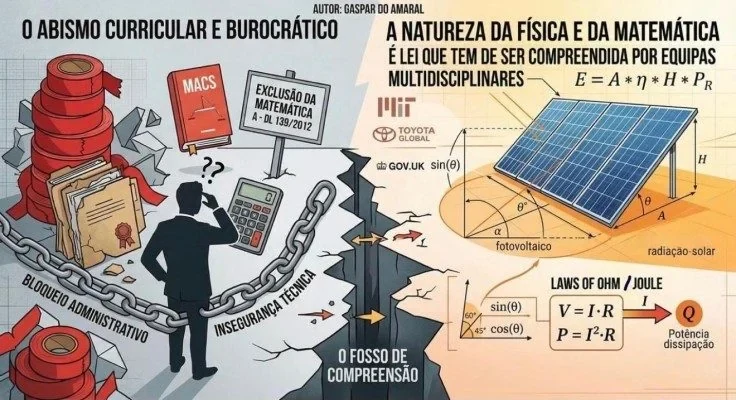
3.1. The origin of the separation
Successive curricular reforms in Portugal created an abyss of quantitative literacy. The 1993 reform (Decreto-Lei n.º 286/89, Decree-Law No. 286/89) began the watertight separation between “Humanities” and “Sciences”, allowing candidates for the Civil Service and lawyers to abandon mathematical reasoning at the age of 15.
This is the point of historical rupture in education in Portugal.
By setting out the curricular reorganisation of secondary education, this law introduced the separation into groupings that allowed, for the first time, pupils on the Humanities tracks to give up the study of Mathematics.
The root of the problem is not circumstantial but structural: it was here that the Portuguese State created the legal basis for the future public decision-maker — the lawyer or the administrator — to disconnect from logical-quantitative reasoning at the age of 15, beginning the process of “technical blindness” that today blocks the licensing of renewable energy (EMER).
The separation begun by DL 286/89 was not merely a pedagogical choice; it was a surgical fracture. By approving Map No. 7 (Grouping 4 – Humanities), the State removed Mathematics from the compulsory common core and banished it completely from the track that would go on to train future lawyers and public administrators. It was in this very annex of 1989 that the legal authorisation for quantitative illiteracy in the Civil Service was signed.
3.2. The crystallisation of the error
This separation was consolidated by the 2012 reform (Decreto-Lei n.º 139/2012, Decree-Law No. 139/2012), which eliminated Mathematics A from the social tracks. The result in 2026 is a paradox: the State demands extreme rigour from engineers, but hands oversight to decision-makers who suffer from an institutionalised “technical incapacity”.
3.2.1. This law consolidated the definitive exclusion of Mathematics A from the Languages and Humanities courses, replacing the rigour of infinitesimal calculus and trigonometry with subjects of lower quantitative demand or with the total absence of the subject. This decree crystallises the strategic error and proves that the system in 2026 is “flawed” at its origin: when licensing infrastructure that depends on immutable physical laws, the State relies on a class of decision-makers who, by force of this 2012 law, were legally authorised to ignore the mathematical tools needed to validate the reality they now have in their hands.
3.2.2. The Peter Principle in bureaucracy
The root of this administrative paralysis can be diagnosed through the Theory of Hierarchies, specifically the Peter Principle. As Laurence J. Peter postulates, in a hierarchical structure individuals tend to be promoted until they reach their “level of incompetence”. In the context of the Portuguese public administration, this shows when professionals with excellent legal or administrative training are placed in decision-making positions on energy infrastructure without having the necessary quantitative literacy. The reference organisational literature (Britannica) shows that bureaucratic blockage is not an occasional error but a predictable phenomenon: the decision-maker, unable to understand the “black box” of physics and mathematics, takes refuge in excessive procedural zeal to mask technical incompetence, holding back progress out of sheer functional insecurity.
4. The tyranny of nature vs. the refuge of bureaucracy
4.1. Ignored geometry and the spatial void
Nature does not accept regulatory conveniences. Calculating efficiency requires a command of spatial mathematics; ignoring the geometry of shadows condemns the investment to inefficiency. Candidates who reach the public administration without Mathematics A fail to understand concepts that are vital for the territory:
4.1.1. Trigonometry and geometry in space:
Without a command of the trigonometric circle (sines, cosines and tangents), the decision-maker is unable to understand the calculation of the azimuth and the ideal tilt of a photovoltaic panel. The administrative result is tragic: projects are approved or rejected on the basis of aesthetic or planning alignments (requiring panels parallel to the street), ignoring that a change of a few degrees in the geometry condemns the efficiency of solar capture. Nature obeys the sun, not the geometry of the roads.
4.1.2. Analytic geometry and vectors:
The analysis of structural loads — such as the force of the wind beneath a solar-panel structure (the “sail” effect) — depends on the sum of vectors and moments of force. The decision-maker who never studied vectors sees a solar panel only as “glass on a roof”, without understanding the aerodynamics and the calculation of mechanical stresses submitted by the engineer. Their insecurity leads to demands for absurd structural redundancies, or to the approval of physically unstable projects because the paperwork “had all the stamps”.
4.2. Immutable laws and bureaucratic risk
In the same way, the laws of Ohm (V = I × R) and Joule (P = I² × R) are immutable. As MIT’s Electromagnetism programme shows, electrical safety is purely mathematical, and this lifts the debate beyond domestic legislation, anchoring it in universal laws of nature. The exclusion of mathematics blinds the decision-maker to the following physical limits:
4.2.1. Non-linear proportionality (quadratic and cubic relationships):
A brain untrained in mathematics thinks only in linear terms. However, the physics of energy is not linear. The decision-maker does not understand Joule’s law, in which the heat dissipated in a cable grows with the square of the current. If the current doubles, the risk of overheating quadruples. In wind energy, the power generated grows with the cube of the wind speed. Without a command of polynomial functions, the bureaucrat cannot correctly assess the real risk or the technical viability, and takes refuge in excessive administrative zeal.
4.2.2. Differential calculus and rates of change:
The lack of a grounding in calculus produces the most common administrative confusion in the energy sector: the inability to distinguish between Power (watts — the instantaneous rate of energy transfer) and Energy (watt-hours — the total work accumulated over time). Without this grounding, the licensing officer treats peaks of injection into the grid and the stability of storage as if they were the same concept, demanding inappropriate conditions from engineers.
4.2.3. The abdication of technical responsibility:
The viability and safety of any renewable energy (EMER) project are governed by this mathematics. This evidence supports the central thesis: if the power dissipated (heat) grows with the square of the current, a decision-maker who ignores this basic algebra is, by omission, ignoring the risk of catastrophic failure or fire. MIT confirms that, while the Law can be interpreted, the Physics of the flow of electrons is absolute. Ignoring these laws in the act of licensing is not merely a bureaucratic error; it is an abdication of technical responsibility that puts the safety of critical infrastructure in Portugal at risk. The decision-maker focuses obsessively on the regulatory “comma” out of technical insecurity, blocking the progress of the process.
5. Benchmarking: mathematics as the language of management
The proof that the “logical blackout” I denounce is not an inevitability of modern government lies in the comparative analysis of international reference systems. In the nations that lead innovation and the energy transition, the watertight separation between Administration (or Law) and the Exact Sciences has been rejected. In these countries it has been understood that mathematics is not merely a calculation tool exclusive to the engineer, but the universal language of risk management and decision-making. The three models that follow show how integrating quantitative literacy into the training and action of the decision-maker is the proven path to ensuring that bureaucracy serves physical reality instead of blocking it.
5.1. The Japanese model (Monozukuri)
Management must be “technically informed”: understand the physical process before managing it. The Monozukuri philosophy (from Toyota Global) shows that excellence in management is not an abstract exercise in Law, but a consequence of a deep understanding of “making”. Unlike the bureaucratic model, in which the decision-maker isolates themselves in an office of sub-paragraphs, Monozukuri requires the administration to be technically informed. A public manager cannot validate a flow of energy without understanding the physical nature of that flow. The work of Takahiro Fujimoto corroborates that a nation’s efficiency depends on eliminating the gap between those who conceive the rule and those who carry out the work, turning the administrative act into an ethical commitment to technical perfection.
5.2. The Finnish model (Phenomenon-Based Learning)
This model focuses on integrating mathematics into real problems; the lawyer studies the physics of energy while studying its laws. Finland’s National Core Curriculum (2016) attests to the need for a structural reform in the training of our decision-makers. The concept of Phenomenon-Based Learning proves that it is possible — and necessary — for a future lawyer to study the physics and mathematics of energy while learning its laws. The approach of the Finnish National Agency for Education (OPH) shows that the “logical blackout” in Portugal is not a fatality but a reversible curricular choice. This reality underpins my thesis that quantitative literacy must cut across all fields: to license the future, the decision-maker needs to have been educated to understand the phenomenon before trying to regulate the paper.
5.3. The Anglo-Saxon model
Here there is an incentive for the “hybrid decision-maker”, combining Law and Mathematics to mitigate real risks. The Hybrid Pragmatism of the British system shows that it is feasible to create the “decision-maker of the future”. The A-Level Subject Content documented on the portal Gov.uk – A-Level Subject Content establishes that the separation between Humanities and the Exact Sciences is not a universal norm, but a pedagogical choice that limits the competence of the administrator. In the United Kingdom, the flexibility of A-Levels allows a student to choose Mathematics, Physics and Law at the same time, encouraging interdisciplinary profiles. This model proves that quantitative rigour and legal sensitivity can and must coexist in the same individual. The solution to the “logical blackout” lies in a system that does not force the decision-maker to choose between the rule and nature, but enables them to validate the law through an understanding of the physical phenomenon.
6. Final synthesis: Parametric Law and the Decision Triad
6.1. Parametric Law and the shared interface
The solution to the curricular gap does not lie in a conflict between professions, but in the creation of a collaborative Validation Interface. Licensing must evolve into Parametric Law, in which the laws of physics are not treated as mere opinions or obstacles, but as binding and transparent parameters, fully integrated into the regulatory process.
6.2. Teamwork: engineering, law and administration
The end of the “logical blackout” requires replacing work in isolated silos with the intelligence of a multidisciplinary team, in which each member plays their part to produce “Segurança para decidir” (confidence to decide):
- The engineer: takes on the technical advocacy of reality, solving the practical problem and providing the solution based on the irrefutable laws of physics and mathematics.
- The lawyer: acts as the regulatory architect, taking the engineer’s technical solution and writing it in the precise words of the Law. It is the lawyer who converts the truth of nature into the form of a legal guarantee.
- The civil servant: administers and processes the licence with full confidence. On receiving a file in which physics and law are already aligned, the decision-maker signs the document without the weight of technical insecurity.
6.3. A shared view of nature
True progress in the Portuguese-speaking world (the Lusofonia) materialises when the whole team can see the same reality: the force of nature written clearly into legal rules. When the engineer, the lawyer and the administrator work in harmony, together they build the “paper shield” needed to protect the work. Technical authority regains its place, the law fulfils its regulatory function, and blind bureaucracy finally gives way to efficiency and development.
7. The challenge to decision-making: questions for the Portuguese-speaking world
7.1. If the laws of physics are immutable and do not obey decrees, how can we hand the energy and economic security of our countries to those whom the law authorised to ignore Mathematics at the age of 15?
7.2. How many gigawatts of energy, essential to our sovereignty, are at this moment paralysed on bureaucratic desks only because the decision-maker is afraid to sign what the education system did not prepare them to understand?
7.3. Are we willing to replace professional silos with true “Segurança para decidir”, in which the Engineer, the Lawyer and the Administrator act as a single team to translate the force of nature into legal guarantees?
8. Grounds and references
8.1. The legislative gap (Portugal)
- 1993 reform: Decreto-Lei n.º 286/89 – the law that began the curricular separation, allowing mathematics to be abandoned on the Humanities tracks. DL 286/89 (Map 7) made the original cut, allowing mathematics to be abandoned; see Annex A.
- 2012 reform: Decreto-Lei n.º 139/2012 – the consolidation of the exclusion of Mathematics A from the Languages and Humanities courses. Under Annex VI of DL 139/2012, the teaching of mathematics ceased to be a pillar of civilisation and became a mere optional, watered-down subject (MACS) on the Humanities track, allowing decision-makers to be trained with zero hours of quantitative reasoning in secondary education; see Annex B.
8.2. International models (benchmarking)
- Monozukuri philosophy (Japan): Toyota Global – Monozukuri – the art of technically informed production.
- Phenomenon-based education (Finland): Finnish National Agency for Education (OPH) – the cross-curricular learning model that eliminates the gap between subjects.
- Hybrid Pragmatism (UK): Gov.uk – A-Level Subject Content – the structure that allows Law and Mathematics to be combined in secondary education.
8.3. Scientific and theoretical grounds
- Theory of Hierarchies: The Peter Principle (Britannica) – the explanation for rising to the level of technical incompetence.
- Laws of applied physics: MIT OpenCourseWare – Physics II: Electricity and Magnetism – the basis for the laws of Ohm (V = I × R) and Joule (P = I² × R) mentioned in this article.
9. About the author
Gaspar do Amaral is an Electrical and Computer Engineer, a graduate of the Instituto Superior Técnico; his roots are in Guimarães — the cradle of the Portuguese nation — and he currently lives in Dili, Timor-Leste, where about 40% of the population is under 20. With a career forged in military service, from Trainee Soldier to the rank of Lieutenant-Colonel of Signals, and in the technical leadership he continues to exercise, he is a member of the Associação dos Engenheiros Eletrotécnicos de Portugal (EEP, the Portuguese association of electrical engineers), focusing on its international representation through the technological vanguard. He is the mentor of “Segurança para decidir, na Lusofonia” (confidence to decide, in the Portuguese-speaking world), with the vision of an architecture of Authentic Generative Intelligence, native in the Portuguese language, to restore and preserve knowledge in Portuguese. He is devoted to the mission of “connecting those who need with those who know”, defending the primacy of technical evidence over bureaucratic opacity.
Annex A – The origin of the rupture: the principle of abandoning mathematics (DL 286/89)
In this foundational law (Decree-Law No. 286/89), the “rupture” is not written in an article with the word “it is prohibited”, but in the architecture of the Annexes, more specifically in Maps No. 4, 5, 6 and 7, which define the Curricular Plans of Secondary Education.
The proof of the “logical blackout” in this 1989 decree is found exactly here:
1. The creation of watertight “Groupings”: the law divided secondary education into four tracks (Groupings). The mathematical rupture is completed in Map No. 7 (Grouping 4 – Humanities). It was this map that created the legal basis for Portugal’s future administrative and legal class to let go of numbers at the age of 15.
2. Mathematics outside the common core (General Education): in all the secondary curricular maps approved by this decree, the “General Education Component” (what is compulsory for all citizens, whatever their field) includes only: Portuguese, Philosophy, a Foreign Language and Physical Education. Mathematics was legally removed from the common cultural foundation of the Portuguese citizen.
3. The void in Map No. 7 (Humanities): when we look at the “Specific Education Component” of the Humanities Grouping (Map No. 7), the core subjects imposed on the pupil are History, Literature, Latin or Foreign Languages. Mathematics A (or any other form of rigorous mathematics) simply does not exist in the timetable.
Annex B – The bureaucratic sentence: the definitive exclusion of logical thinking (DL 139/2012)
In Decreto-Lei n.º 139/2012, the legal proof of the “rupture” is not found in the running text of the opening articles, but in the final tables of the document, specifically in Annex VI.
If you scroll to the end of the page of the Diário da República and consult Annex VI (Curricular matrix of the scientific-humanistic courses), look specifically at the timetable of the Languages and Humanities Course.
It is in that table that the exclusion of mathematics (the “logical blackout”) materialises legally at three levels:
1. In the common core (General Education): Mathematics disappears completely from the subjects compulsory for all. The pupil has Portuguese, a Foreign Language, Philosophy and Physical Education. Quantitative literacy is no longer considered a general foundation of the citizen’s education.
2. The exclusion of Mathematics A: in the Specific Education component, the structuring (three-year) subject compulsory for these pupils is History A. Mathematics A (rigorous mathematics, with trigonometry and calculus, needed to understand physics and engineering) is completely closed to them. They cannot choose it even if they want to.
3. Total abandonment (the blind option): for the two two-year subjects (10th and 11th years), the State offers a range of options: Geography A, Latin A, Portuguese Literature, a Foreign Language or MACS (Mathematics Applied to the Social Sciences — a simplified version, focused on basic statistics and far from the rigour of physics). As MACS is only an option, the pupil (the future lawyer or public decision-maker) may perfectly well choose, for example, Geography A and Portuguese Literature.
The legal consequence of this Annex VI: Decree-Law No. 139/2012 established that it is perfectly legal and normal for a Portuguese pupil to complete the whole of secondary education (from 15 to 18) with zero hours of mathematics. It is this Annex VI that gives legal cover to systemic technical incompetence.
“If the laws of physics are immutable and do not obey decrees, how can we hand the energy and economic security of our countries to those whom the law authorised to ignore Mathematics at the age of 15?”
Methodological note
What this page is. A translation of the article the author published on LinkedIn on 19 March 2026; the full Portuguese version is on this site. Nothing has been summarised or added.
Names of laws and institutions. Portuguese laws have no official English translation and are cited by their official Portuguese names (Decreto-Lei n.º 286/89, Decreto-Lei n.º 139/2012), with an explanation in brackets. “Mathematics A” is the rigorous mathematics subject of Portuguese upper secondary school; “MACS” is Matemática Aplicada às Ciências Sociais (Mathematics Applied to the Social Sciences). EMER is the Portuguese abbreviation used in the original for renewable energy projects.
Changes of form, not of content. The bold lines that served as section titles became headings. Three slips in the Portuguese page were corrected only in this translation: a sentence in section 2.2 where a caption had been pasted into the middle of the text (“a burocracia deixa de ser um processo e torna-se…”); the multiplication signs in the laws of Ohm and Joule, lost in the conversion from LinkedIn (V = I × R; P = I² × R); and the numbering of the last group of references in section 8, which appeared as “7.3” and is 8.3. The three original illustrations are reproduced with their texts in Portuguese and a translated caption. The links to sources are those of the original.
The discussion is on LinkedIn (in Portuguese)
Comments on this text are made on LinkedIn, where the article was shared in Portuguese. You are welcome to write in English. Agree, disagree or add data: every well-founded objection receives a reply.
Gaspar do Amaral · Original in Portuguese of 19 March 2026, published on this site; translation issued on 27 October 2026 · Figures and tables © Aprecisa.com · AI-assisted