 ← Grupo Aprecisa · Connecting those who know with those who need
Energy and the power system
The Ocean of Rigour: Why the Atom Is the Legitimate Heir of the Sixteenth-Century Naus
Why nuclear power is the natural heir of the sixteenth-century Portuguese naus in large-scale maritime transport
Gaspar do Amaral · 21 April 2026
Translated from the Portuguese original. This version was issued on 27 October 2026.
On this site, this article has been
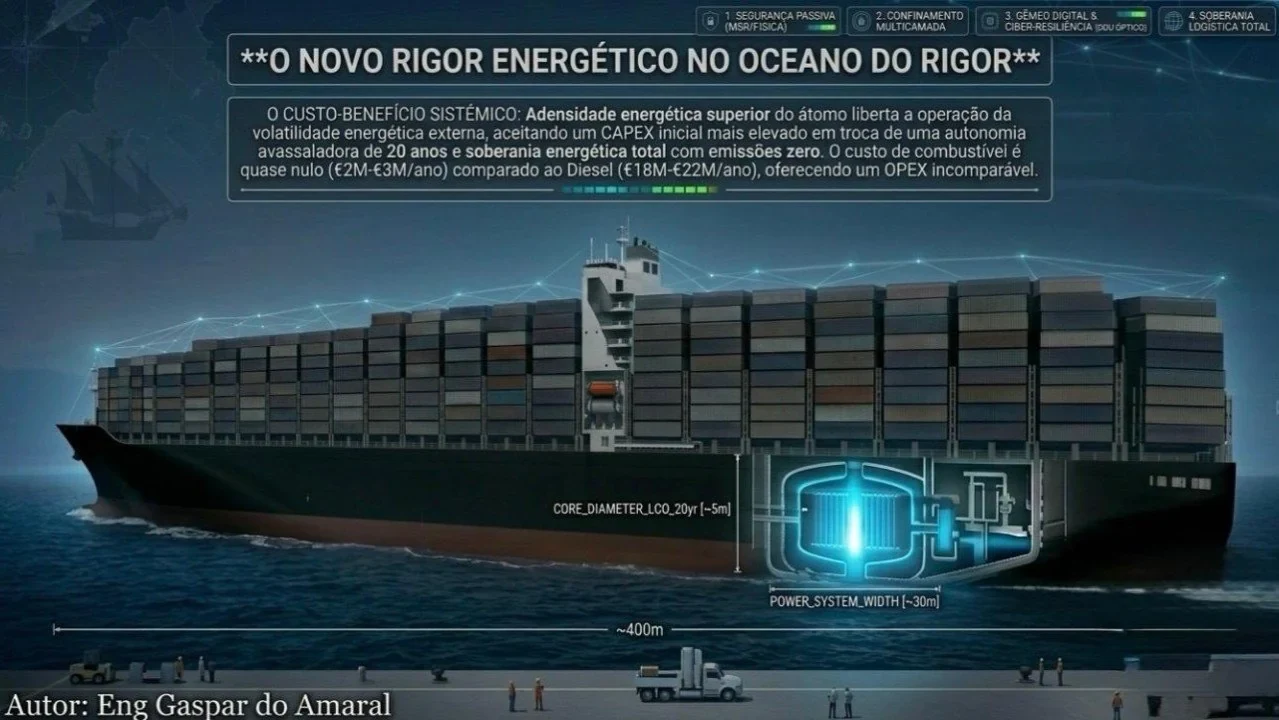
The global maritime sector is going through a historic change: we are leaving behind promises of sustainability to face the hard reality of physics and engineering. In the Abismo do Rigor (the “Abyss of Rigour”) of technical analysis, there is no room for optimism without data. For a 20,000 TEU giant to cross oceans carrying more than 200,000 tonnes of goods — the equivalent of the weight of a small town in constant motion — the energy source has to be extremely dense, uninterrupted and, above all, independent of frequent external refuelling. This is where safe, advanced nuclear power becomes the only solution with enough power density to sustain that titanic force.
In the complex cartography of global trade, if the 20,000 TEU ship embodies the scale of modern logistics, advanced nuclear propulsion embodies the energy density needed to move it with thermodynamic rigour and strategic sovereignty.
Whereas wind and solar demand gigawatts spread thinly over square kilometres of land and managed by asynchronous system services (Buongiorno, Smil), a 20,000 TEU ship demands dense, constant and synchronised gigawatts, concentrated in an SMR reactor of a few square metres (Shirvan, Grossi), thus establishing an unbridgeable Abismo de Rigor Termodinâmico (Thermodynamic Abyss of Rigour).
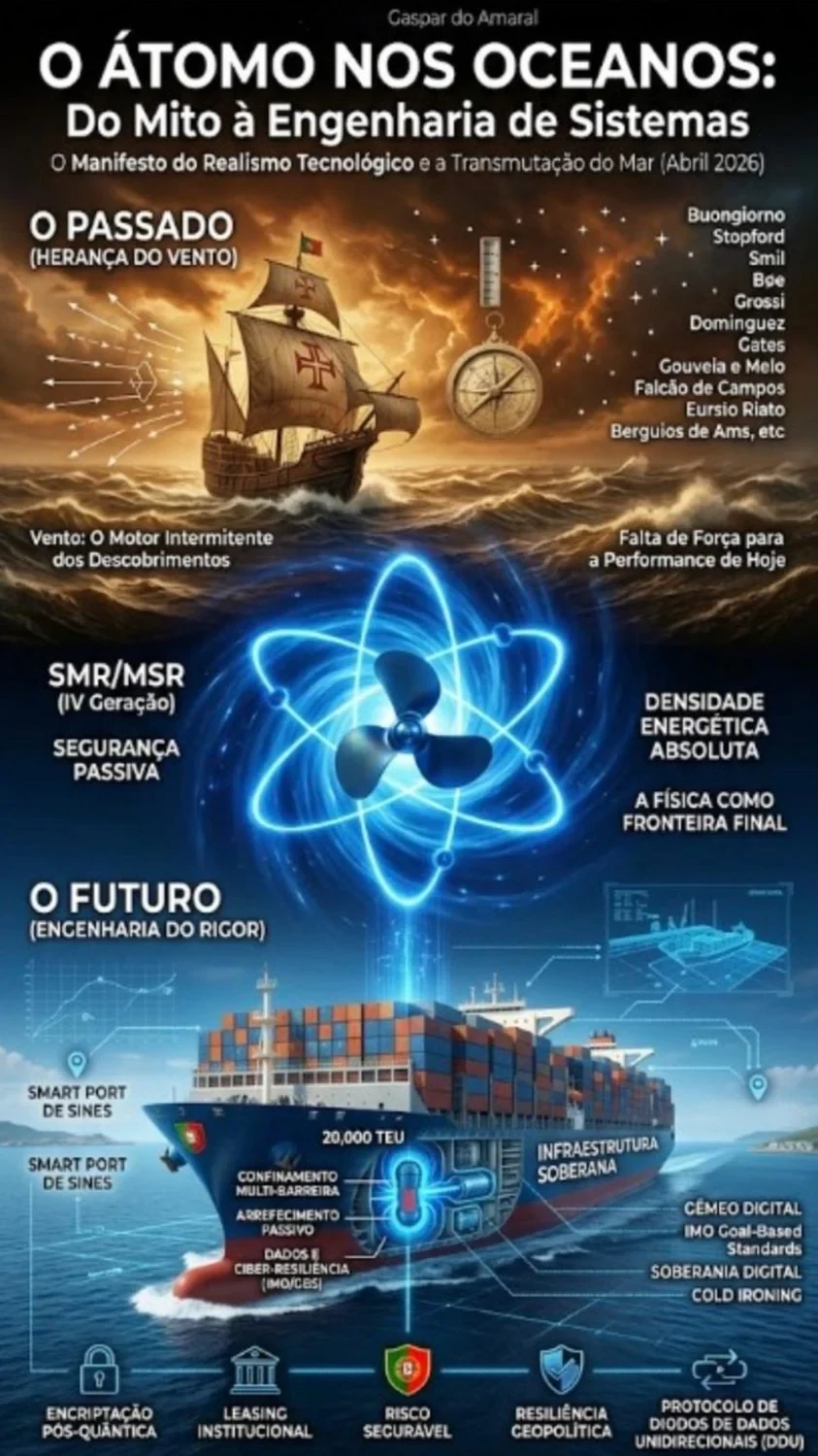
Why do large ships need safe nuclear power?
Think about the scale: a 20,000 TEU ship carries more than 200,000 tonnes of cargo. To push this colossal weight across the ocean at commercial speeds, a constant titanic force is needed.
- Energy density: Conventional fuel is bulky. To have transoceanic range, these ships would have to sacrifice half of their cargo space just for fuel tanks. A small amount of advanced nuclear fuel produces the same energy as thousands of tonnes of fuel oil, freeing up space for goods.
- Constant force: Unlike the wind or the sun, which are intermittent, a fourth-generation nuclear reactor delivers full power 24 hours a day, 7 days a week, whatever the weather.
- Energy sovereignty: Safe nuclear ships can operate for 20 years without refuelling, freeing the nation from geopolitical price swings and from dependence on foreign refuelling ports.
The Atom in the Arteries of Global Trade: Systems Engineering in the Abismo do Rigor
By: Gaspar do Amaral
National sovereignty and logistical efficiency cannot be held hostage to intermittent energy flows. The wind, which gave Portugal its primacy on the seas, is today an insufficient force for the scale of 20,000 TEU. As an engineer, my duty is to lay bare the anatomy of this challenge through the contributions of the leading figures of contemporary science and regulation.
1. The thermodynamic foundation: energy density
The thesis I defend — the inevitability of maritime nuclear power — rests on the work of Vaclav Smil (Energy and Civilization: A History). Smil shows that the progress of civilisation is dictated by energy density. Trying to move ultra-large cargo ships with solar or wind energy is, in Smil’s words, a step back to pre-industrial inefficiency. The area needed to capture enough solar energy to “pull the cart” of a ship of this size is physically impossible to fit on a 400-metre hull.
In this field, Prof. José Falcão de Campos (Instituto Superior Técnico - IST, Lisbon’s engineering school) contributes the rigour of hydrodynamics. His work on the resistance to motion of large vessels confirms that the 60 to 80 MW of power required cannot be guaranteed by batteries or low-density auxiliary systems without compromising the cargo space that is vital to economies of scale.
2. The economic compass: OPEX vs. volatility
The viability of a propulsion system is decided in OPEX (operating costs). Martin Stopford (Maritime Economics) establishes that fuel is the variable that decides whether a shipowner goes bankrupt or survives.
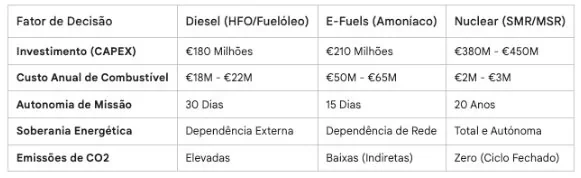
My thesis uses Stopford’s models to prove that, while e-fuels (synthetic fuels such as ammonia) suffer from a conversion inefficiency that triples costs, nuclear power offers an almost flat fuel cost for 20 years. Eric Ingersoll and Kirsty Gogan (LucidCatalyst) reinforce this thesis by showing that standardising SMR reactors drastically reduces the financial risk of construction.
Systemic Viability Matrix (April 2026)
3. The seal of safety: Generation IV reactors
For the layperson, the word “nuclear” evokes fear; for the engineer, it evokes passive safety. Jacopo Buongiorno (MIT - The Future of Nuclear Energy) is the pillar of this thesis. His contribution focuses on SMRs (Small Modular Reactors) and MSRs (Molten Salt Reactors).
Unlike pressurised water reactors, an MSR (such as those designed by Troels Schönfeldt at Seaborg) uses a liquid fuel that, if power is lost, cools and solidifies by gravity. It is the end of the possibility of a core meltdown accident on the open sea. Michael Corradini (University of Wisconsin) validates this concept by describing natural-convection cooling systems as infallible.
4. Digital sovereignty and IMO regulation
Integrating a reactor requires what Koroush Shirvan (MIT Nuclear Science) calls “robust monitoring”. Gaspar do Amaral’s thesis incorporates the need for digital twins for the remote management of critical systems.
This level of cybersecurity and resilience is now framed by the Goal-Based Standards (GBS) of the International Maritime Organization (IMO), under the leadership of Arsenio Dominguez. The regulatory framework, supported by the rigour of Rafael Mariano Grossi of the IAEA (International Atomic Energy Agency), defines the 5 levels of safety that the ship must guarantee:
- Physical: Reinforced hull and triple containment barriers.
- Thermal: Passive cooling by convection (a law of physics).
- Digital: Network isolation (air-gapping) and post-quantum encryption.
- Operational: Internationally harmonised SOP protocols.
- Strategic: Sovereignty and total autonomy in the face of external blockades.
This last point is reinforced in Portugal by the vision of Admiral Gouveia e Melo, who argues that maritime security requires ships that do not depend on foreign fuel supply chains in order to exercise national sovereignty.
Bibliographical references and curation of the state of the art
Curating knowledge is the first filter of systems engineering. In the Abismo do Rigor, we do not take part in ideological defences of industries — our commitment is solely to thermodynamics, structural calculation and the OPEX/CAPEX matrix. My thesis is not an apology for nuclear power; it is the mathematical demonstration that, if large-scale global logistics abandons hydrocarbons, physics rules out low-density solutions (wind, solar, e-fuels), leaving the atom as the only equation that balances.
Below, I set out how each of these 20 pillars contributes to the technical scrutiny of this inescapable reality, with the corresponding links for further reading:
I. Thermodynamics, hydrodynamics and systems economics
1. Vaclav Smil – Energy and Civilization: A History
- Contribution to the thesis: It provides the fundamental law of rigour: energy density sets the limit of industrial civilisation. Smil proves that trying to replace heavy fuel oil with diluted energies (wind/solar) on an ultra-large cargo ship is an entropic regression, ruling out the viability of synthetic fuels.
2. Martin Stopford – Maritime Economics (3ª Ed.)
- Contribution to the thesis: It establishes the financial model of maritime transport. Stopford shows that OPEX (especially fuel) is the variable that kills shipowners. This principle proves that the high CAPEX of an SMR is quickly paid back by the near-zero running cost of atomic fuel.
3. Prof. José Falcão de Campos – Instituto Superior Técnico: Hidrodinâmica e Projeto Naval (Instituto Superior Técnico: Hydrodynamics and Naval Design)
- Contribution to the thesis: The Portuguese anchor of fluid physics. His work on the resistance to motion and propulsion of large hulls quantifies the demanding MW needed to move 20,000 TEU at 20 knots, exposing the inadequacy of auxiliary sails and rotors to take over main propulsion.
4. Kirsty Gogan & Eric Ingersoll – LucidCatalyst: The Missing Link to Decarbonization
- Contribution to the thesis: They take apart the economics of e-fuels. Through LCOE (levelised cost of energy) analyses, they show that producing green hydrogen and ammonia will require colossal land-based infrastructure, making these fuels unaffordable for long-distance maritime logistics.
II. Passive safety, integration and materials science
5. Jacopo Buongiorno – The Future of Nuclear Energy in a Carbon-Constrained World
- Contribution to the thesis: The architect of Generation IV safety. His MIT study underpins the core of our systemic safety analysis: the move from active reactors (which require intervention) to modular reactors with passive safety, reducing human error in maritime operation to almost zero.
6. Troels Schönfeldt – Seaborg Molten Salt Reactor Technical Specs
- Contribution to the thesis: It validates the practical use of MSRs (molten salt reactors) at sea. His engineering proves that operating at atmospheric pressure with liquid fuel eliminates the risk of steam explosions, a non-negotiable criterion for ships entering civilian ports.
7. Michael Corradini – Nuclear Safety and Design Analysis
- Contribution to the thesis: The master of decay-heat management. Corradini provides the thermodynamic rigour that guarantees that, in the event of a sinking or total loss of power (blackout), maritime reactors dissipate residual heat by pure natural convection into the ocean, without the core melting.
8. David Petti – Advanced Materials for Extreme Nuclear Environments
- Contribution to the thesis: The basis of physical resilience. Petti studies the metal alloys (such as Hastelloy-N) that are essential to shield naval reactors against the extreme and simultaneous corrosion of the salty environment and the radioactive molten salts.
9. Chris Levesque – TerraPower Technology Overviews
- Contribution to the thesis: It brings the technology from the laboratory to the shipyard. Through the Natrium project, Levesque attests to the maturity (TRL - Technology Readiness Level) and viability of series production of SMRs, which is fundamental for integration into global shipbuilding chains.
III. Monitoring, cybersecurity and industrial implementation
10. Mikal Bøe – New Nuclear for Maritime - CORE POWER White Papers
- Contribution to the thesis: The commercial translation of physics. Bøe proposes the full life-cycle model of the maritime reactor (construction, operation, decommissioning), showing how a floating asset can last 25 years without refuelling.
11. Koroush Shirvan – Modeling and Simulation of Advanced Nuclear Reactors
- Contribution to the thesis: The pillar of digital sovereignty. Shirvan provides the computational validation for the concept of the “digital twin”, essential to our requirement that critical naval infrastructure transmit telemetry under strict encrypted protocols (air-gapping and data diodes).
12. John Parsons – MIT Center for Energy and Environmental Policy Research
- Contribution to the thesis: It underpins the financial engineering. Parsons models the economics of “New Nuclear”, explaining how the high CAPEX of naval propulsion can be managed through institutional leasing, separating the shipowner from the direct risk of owning the reactor.
13. Tim Stone – Nuclear Industry Association (NIA) Finance Reports
- Contribution to the thesis: Resolving the insurance deadlock. As an integrator of critical systems, I use Stone’s models to show that civilian maritime atomic risk can be made insurable through new syndicated frameworks and mutual guarantee funds.
IV. Regulation, sovereignty and geopolitical order
14. Arsenio Dominguez – IMO Maritime Safety Committee Updates
- Contribution to the thesis: The non-negotiable legal framework. Dominguez leads the drafting of the IMO’s Goal-Based Standards (GBS). Without these harmonised standards, engineering excellence is useless, because no SMR ship would be allowed to berth in a commercial port.
15. Rafael Mariano Grossi – IAEA Annual Reports on Nuclear Power
- Contribution to the thesis: The guarantor of non-proliferation. Grossi and the IAEA provide the inspection and safeguards protocol that assures the international community that the low-enriched uranium (HALEU) used in these ships cannot be diverted for military purposes.
16. Sama Bilbao y León – World Nuclear Association Strategic Reports
- Contribution to the thesis: Standardising the value chain. Bilbao y León argues for the harmonisation of industrial licences. For systems integration, this means that a component validated in Asia is acceptable in Europe, optimising the CAPEX of naval maintenance.
17. Henri Paillere – IAEA Energy Planning and Strategy
- Contribution to the thesis: The land–sea interface. His strategic planning supports our vision that nuclear ships will act as grid nodes in port (smart ports/cold ironing), supplying clean energy to the national grid instead of consuming it, changing the paradigm of critical infrastructure.
18. Maria Korsnick – Nuclear Energy Institute (NEI) Strategic Vision
- Contribution to the thesis: Aligning macro-policies. Korsnick shows how technical rigour must be turned into long-term public policies to attract investment, shielding systems engineering against the instability of four-year political cycles.
19. Daniel Yergin – The New Map: Energy, Climate, and the Clash of Nations
- Contribution to the thesis: Geostrategy. Yergin maps the chokepoints of oil, gas and critical minerals. His thesis reinforces our argument that propulsion with 20 years of autonomy frees logistics from conflict zones and from the piracy of energy chokepoints.
20. Admiral Gouveia e Melo – Estratégia do Mar de Portugal (Portugal’s Strategy for the Sea)
- Contribution to the thesis: The ultimate definition of sovereignty. The rigour of the Admiral’s naval vision enshrines the principle that the security and resilience of Portugal (a nation dependent on the sea) require logistical and force assets that are not vulnerable to the cutting-off of external supplies. The closed-cycle ship is the pinnacle of this strategic autonomy.
Epilogue
The transition to maritime nuclear power is proof that systems engineering, when applied with rigour, overcomes prejudice. The SMR-powered 20,000 TEU ship is the caravel of the twenty-first century: bold, unbreakable and technologically sovereign. At sea, as in life, the only compass that never fails is scientific rigour.
Methodological note
What this page is. A translation of the article the author published on LinkedIn on 21 April 2026; the full Portuguese version is on this site. The “naus” of the title are the large Portuguese sailing ships of the sixteenth century (in Portuguese, “Quinhentos”, the 1500s), the ships of the age of the Discoveries.
The author’s concepts. The Abismo do Rigor (Abyss of Rigour) is the name the author gives to the gap between promises and the mathematics of the system; it is also the title of one of his books. It is kept in Portuguese, with a translation in brackets at the first occurrence.
Images and figures. The opening illustration, Figure No. 3 and Table No. 1 are the original images, reproduced as they are, with their texts in Portuguese; each caption translates what they say. The numbering of the figure and the table is that of the original. The amounts in the table are the author’s estimates, as published in the original; no new calculation was made in this translation.
Changes of form, not of content. The horizontal separator lines of the LinkedIn version were left out. The titles of the works cited stay in their original language (those in Portuguese with a translation in brackets). The links to sources are those of the original.
The discussion is on LinkedIn (in Portuguese)
Comments on this text are made on LinkedIn, where the article was shared in Portuguese. You are welcome to write in English. Agree, disagree or add data: every well-founded objection receives a reply.
Gaspar do Amaral · Original in Portuguese of 21 April 2026, published on this site; translation issued on 27 October 2026 · Figures and tables © Aprecisa.com · AI-assisted