 ← Grupo Aprecisa · Connecting those who know with those who need
Energy and the electricity system · Article published on LinkedIn on 5 May 2026
Electromechanical Resilience in Critical Infrastructure: From the “System LCOE” to the Millisecond in Tender Specifications
From the total cost of the system to the millisecond: how to write electrical resilience into tender specifications
Gaspar do Amaral · 5 May 2026
Translated from the Portuguese original. This version was issued on 27 October 2026.
On this site, this article has been
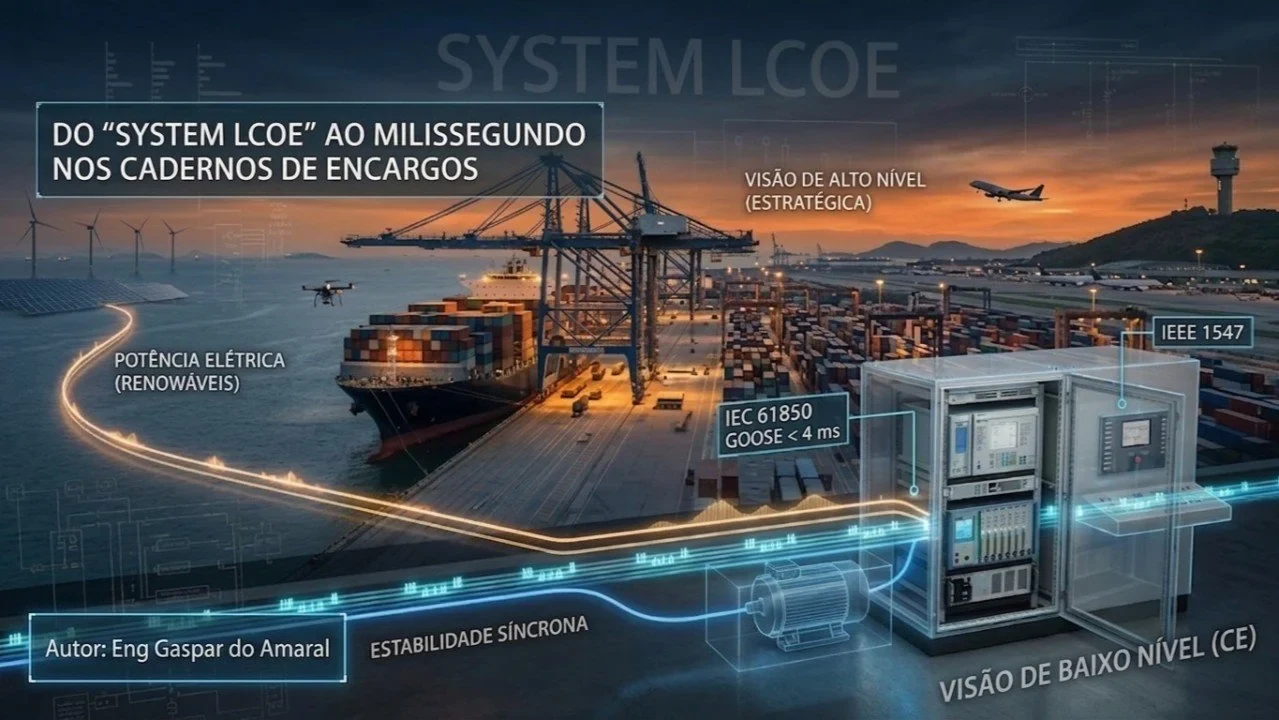
The energy transition and the mass adoption of power electronics have brought about a deep transformation of the Public Service Electricity Grid. Systemic security — vital for the continuous operation of port complexes, airports or submarine cable landing stations — is no longer guaranteed by the physical robustness of the grid itself. To safeguard the planning of critical systems, it is imperative to anchor technical specifications in uncompromising international standards.
1. The Cost of Stability: The System LCOE Paradigm
The international basis: Energy planning has traditionally been anchored in the LCOE (Levelized Cost of Energy) from the point of view of the individual generator. However, researchers at the Potsdam Institute for Climate Impact Research (Ueckerdt et al.) and reports by the Nuclear Energy Agency (NEA/OECD) [https://www.oecd-nea.org/jcms/pl_14915/system-costs-with-high-shares-of-nuclear-and-renewables] [1] have set out the need to calculate the System LCOE (Total System Costs). This concept proves that the real cost of energy must include the “profile costs”, “balancing costs” and “grid costs” that arise from the loss of synchronous inertia. When regulation exempts developers from installing Automatic Voltage Regulators (AVR), the System LCOE is masked and the burden of failure is shifted to the grid.
- High-level view (strategic): Contracting authorities cannot assume that the public grid is an infinite supplier of stability. The cost of integrating renewables is paid for by reduced resilience downstream.
- Low-level view (tender specifications): Tender specifications must internalise the System LCOE within the perimeter of the works themselves. They must prescribe Dynamic Regulation Systems (Synchronous Condensers or industrial UPS of online topology) able to hold the voltage autonomously.
2. Reactive Power and Self-Defence: The Requirement of the IEEE 1547 Standard
The international basis: Voltage control is a strictly dynamic phenomenon. The international standard IEEE Std 1547-2018 [https://ieeexplore.ieee.org/document/8332112] [2] (which governs the interconnection of distributed resources) makes the dynamic injection of reactive power in real time mandatory and sets strict Ride-Through requirements (the ability to withstand voltage dips and overvoltages without disconnecting). The practice of measuring “reactive energy” as hourly averages breaches the dynamic principles of IEEE 1547, giving rise to local temporary overvoltages (TOV).
- High-level view (strategic): The resilience of a maritime datacenter or of a radar is not managed with hourly averages. The grid’s inability to meet the dynamic requirements of IEEE 1547 means that the critical installation must compensate for anomalies locally.
- Low-level view (tender specifications): Tender specifications must require the installation of Class A power quality analysers (IEC 61000-4-30), coupled with compensation systems using solid-state switching (Active Power Filters), able to inject instantaneous reactive power (a fraction of a 50Hz cycle).
3. Synchronous Inertia, Inverse Time and the Speed of IEC 61850
The international basis: The IEEE C37.102 standard [https://ieeexplore.ieee.org/document/4106511] [3] documents that heavy (electromechanical) equipment follows an “inverse-time curve”, tolerating temporary overvoltages (e.g. 115% of rated voltage for 5 to 30 minutes). However, the power electronics of modern grids trip almost instantly (often <50 ms) for self-defence. To survive this asymmetry, critical infrastructure needs the rigour of the IEC 61850-5 standard [https://webstore.iec.ch/publication/6016] [4].
- High-level view (strategic): A transport complex must identify a fault in the public grid and isolate itself (“island” mode) before the cascade of grid inverters collapses within milliseconds.
- Low-level view (tender specifications): The use of traditional electromechanical protection in critical substations is strictly forbidden. Tender specifications must require the IEC 61850 architecture, using Type 1A GOOSE messages [4]. The standard guarantees that the trip command between relays takes place in <4 milliseconds, ensuring safe islanding and the transfer of load to the local inertia of the infrastructure long before the external collapse.
Bibliographical References and Standards Traceability
[1] The System LCOE Paradigm
- Authors/Bodies: Ueckerdt, F., Hirth, L., Luderer, G., & Edenhofer, O. (2013) / Nuclear Energy Agency (OECD-NEA).
- Documents: “System LCOE: What are the costs of variable renewables?” (journal Energy) and “System Costs of Generating Electricity” (NEA).
- Links: Scientific article | OECD-NEA reports
- Use in tender specifications: It shows funders and the Court of Auditors (Tribunal de Contas) that the CAPEX allocated to stabilisation is not redundancy, but the internalisation of scientifically proven system costs.
[2] The Requirement of Dynamic Reactive Power
- Standard: IEEE Std 1547-2018
- Link: IEEE Xplore
- Use in tender specifications: Legal anchoring to require operators to provide dynamic compensation (a fraction of a cycle), rejecting instrumentation based on hourly averages.
[3] Electromechanical Robustness and Inverse Time (TOV)
- Standard: IEEE C37.102-2006 (R2012)
- Link: IEEE Xplore
- Use in tender specifications: Mathematical proof that the equipment tolerates overvoltages, justifying the need for active isolation of critical infrastructure from the instantaneous trips imposed on the public grid.
[4] The Speed of Cyber and Electrical Isolation
- Standard: IEC 61850-5 (Edition 2.0)
- Link: IEC Webstore
- Use in tender specifications: The requirement of Type 1A GOOSE messages in <4 milliseconds ensures that port or airport automation orders islanding before the physical collapse of the voltages of the external grid.
Methodological note
What this page is. A translation of the article the author published on LinkedIn on 5 May 2026; the full Portuguese version is on this site, which is the reference version.
Terms. The Portuguese cadernos de encargos (abbreviated CE in the original) are the technical and contractual specifications of a public tender; they are translated here as “tender specifications”. Standards are cited by their official names (IEEE Std 1547-2018, IEEE C37.102-2006, IEC 61850-5, IEC 61000-4-30), and the titles of the sources are kept as in the original.
Changes of form, not of content. The section titles in bold of the LinkedIn version appear as headings. The original illustration is reproduced with its texts in Portuguese and a translated caption. Numbers and units are as in the original. The links to sources are those of the original.
The discussion is on LinkedIn (in Portuguese)
Comments on this text are made on LinkedIn, where the article was shared in Portuguese. You are welcome to write in English. Agree, disagree or add data: every well-founded objection receives a reply.
Gaspar do Amaral · Original in Portuguese of 5 May 2026, published on this site; translation issued on 27 October 2026 · Figures and tables © Aprecisa.com · AI-assisted