 ← Grupo Aprecisa · Connecting those who know with those who need
State, public works and governance · Article published on LinkedIn on 9 April 2026
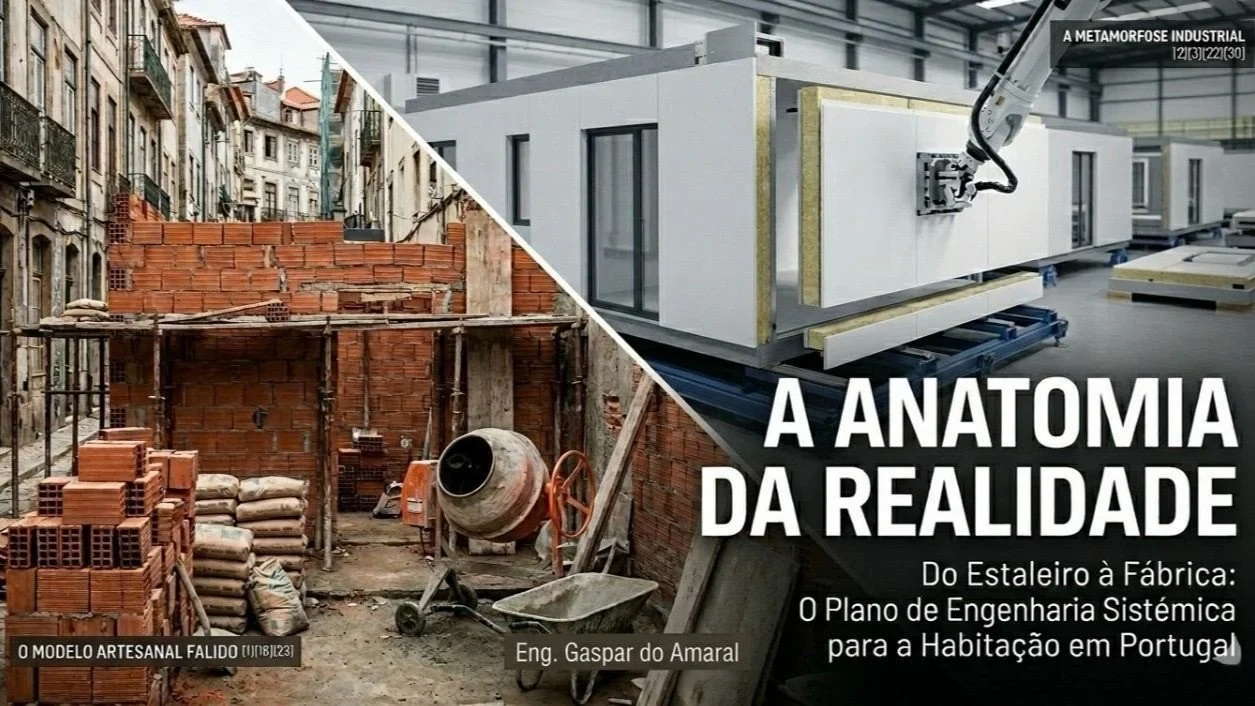
The Anatomy of Reality: A Systems Engineering Plan for Housing in Portugal
From building site to factory: escaping the productivity trap of craft construction
Gaspar do Amaral · 9 April 2026
Translated from the Portuguese original. This version was issued on 30 October 2026.
On this site, this article has been
By: Eng. Gaspar do Amaral
The housing crisis in Portugal is not an inevitable by-product of the market, but the result of the exhaustion of the sector’s development model. If “The Physics of Construction” reveals that the cost of labour and the collapse of the on-site craft model are the immediate mechanical brakes [1][23], applying Michael Porter’s theses on Competitive Advantage shows that Portugal is caught in a “productivity trap”.
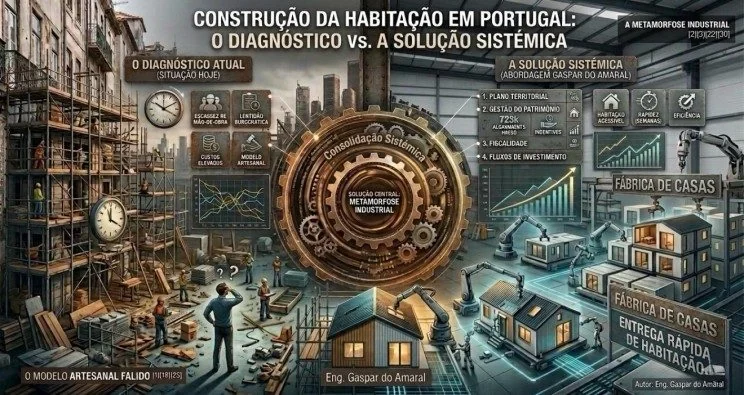
To reverse this scenario, it is imperative to adopt a systemic framework that moves from construction based on “factor costs” to construction based on innovation and technological industrialisation.
Axis 1: Territorial Plan — From Bureaucracy to Productive Density
Rehabilitating the territory requires a transition from rubber-stamp urban planning to active density planning.
- Strategic review: amendments to the municipal master plans (PDMs) must focus on creating integrated cities and not merely dormitory towns [5][6]. Decree-Law No. 117/2024 (the Land Law) is the tool for reclassifying rural land but, as David Pratas Brito warns, the risk of “fragmented urbanisation” is real if there is no systemic vision [7][8][21].
- Note on immediate applicability: if Decree-Law No. 117/2024 provides the legal fuel (the availability of land), this Systems Engineering Plan is its Operating Manual. Without applying these principles of industrialisation and active density, Law 117 risks becoming a dead letter or generating inefficient urbanisation. This framework turns legal permission into real housing output, ensuring that the land released is occupied with the speed and precision that the national emergency demands.
- Operational effectiveness: the Urban Planning Simplex, recognised by the World Bank as a driver of competitiveness [9], requires professionals to take personal responsibility for deadlines, ensuring that streamlining does not compromise spatial planning [10].
Axis 2: Management of the Housing Stock — The Paradox of the Vacant Stock
Portugal faces the absurdity of having far more empty homes than families without adequate housing.
- Metrics of the mismatch: the 2021 Census identifies 723,215 vacant dwellings, of which 348,097 were for sale or rent and 154,075 usable, that is, ready to live in [11][12]. This paradox proves that the problem is not a lack of “bricks”, but inefficiency in managing what has already been built [13].
- Demography of demand: the rise in single-person households requires the existing stock to be refurbished and adapted to the new shape of families, tackling thermal and functional obsolescence [14][15][16][17]. This paradox will not be resolved by slow, unpredictable craft refurbishment. Industrialisation (Axis 3) must be applied here through modular refurbishment kits — prefabricated climate-control systems and wet cores (kitchen and bathroom units) — that allow the vacant stock to be upgraded in weeks rather than months, making the recovery of existing buildings economically competitive with new construction.
This modularity implies neither aesthetic uniformity nor logistical rigidity; on the contrary, precision engineering allows components to be customised for the complex geometries of historic centres. By breaking the product down into systems that fit together, we resolve the friction of difficult urban access, carrying technological value to where a traditional building site is physically impossible.
Axis 3: The Industrial Metamorphosis — Porter’s Legacy and the “Brain Factor”
Applying Porter’s Diamond to the sector shows that our competitive advantage can no longer lie in the “arm” (cheap labour), but in technological differentiation.
- The collapse of the craft model: Fernando Santo proves that the cost of production is the great blocker [18][19]. In the craft model, every project is an inefficient prototype. In industrialised (off-site) construction, every project is a high-precision product.
- Inducing value: we must lighten the tax burden on the “brain factor” (engineering and R&D) to make up for the scarcity of the “arm factor” [22][23]. This transition is at the same time a talent-retention strategy. By moving construction into an advanced manufacturing environment, we offer young Portuguese engineers and architects an ecosystem of innovation and R&D, stemming the brain drain and turning housing into a sector that exports patents and high-value-added building systems. Industrialising makes it possible to integrate clusters of excellence (metalworking, ceramics, software) into an assembly line, exporting housing solutions and not merely components.
Industrialisation acts as a democratiser of the sector: by turning construction into an ecosystem of interoperable components (open standards), we allow small and medium-sized local firms to become specialised assemblers, instead of remaining trapped in the insolvency of the craft model. We are not creating a monopoly, but a technological infrastructure in which everyone can operate with higher margins and lower risk.
Axis 4: Investment and the Deconstruction of the Statistical Mirage
It is vital to regulate flows and correct the price narrative in order to attract capital to the middle segment.
- Evidence-based regulation: Garcia-López’s analysis of the impact of rental platforms shows the need for smart regulation that protects the family housing stock without destroying economic dynamism [26][27].
- The reality of prices: Fernando Santo’s deconstruction of the “2015 base effect” reveals that the real increase in prices since 2005 is 129%. Ignoring this figure leads to panic-driven public policies that do not solve the structural cost of production [28][29].
Strategic Robustness: The End of the “Cost of Inefficiency”
The argument against industrialisation fixes on the initial CAPEX, ignoring the financial haemorrhage of the current model. The Cost of Poor Quality — 30% of materials wasted and early defects — is an invisible subsidy to inefficiency that Portugal can no longer afford. The argument against technological industrialisation often fixes on the barrier of the initial CAPEX (capital expenditure). Yet, from Michael Porter’s standpoint, this is a reductive view that ignores the negative externalities of the current model. The true invisible burden on the Portuguese economy is the “Cost of Poor Quality”: the sum of wasted materials (reaching 30% on site), chronic delays caused by dependence on the weather, and the early defects of craft-built buildings.
Industrialisation is not a threat to the “soul” of Portuguese architecture; on the contrary, it is its life support. By transferring execution to an advanced manufacturing environment, we restore technical dignity to the design through millimetre tolerances, traceability of materials and a thermal performance impossible to replicate with rudimentary methods. Technology frees architects from managing execution errors and lets them focus on aesthetics and function, now with economic viability guaranteed by industrial scale and precision [30].
Industrial precision does not cancel Portuguese architectural identity; it protects it from degradation. By guaranteeing technical performance through manufacturing, we give architecture back the freedom to design form and soul, without these being held hostage by rudimentary execution errors that disfigure the original design over time.
Conclusion: Housing Sovereignty and “First Principles”
The housing crisis will not be solved by bigger budgets or political voluntarism, but by the rigour of Systems Engineering. Portugal does not need a plan of works; it needs a sovereign production system in which housing ceases to be a social liability and becomes the most urgent technological project of our decade.
To solve the housing problem, Portugal must abandon “solutions by analogy” and adopt First Principles [2][30]. Instead of trying to optimise a bankrupt craft system, we must deconstruct the problem down to its base: the need for high-quality shelter that is quick to assemble and affordable.
The solution requires simplifying complex processes — eliminating the frictions of the building site — and transferring value to a controlled factory environment. This Industrial Metamorphosis is the only sovereign path for Portugal to stop being a country that “tries to build” with difficulty and become a nation that produces housing with the rigour of an export industry. Housing will cease to be a social liability and become an asset of national competitiveness, securing the constitutional right through the supremacy of Systems Engineering.
Portugal does not need a plan of works; it needs a sovereign production system.
Gaspar do Amaral
References and Audit Sources (Final Consolidated Version)
- [1] AMARAL, Gaspar do (2026). A Física da Construção (The Physics of Construction). Analysis based on INE (Statistics Portugal) indicator 0007725. [INE link: Labour Cost Index]
- [2] MUSK, Elon (2021). First Principles Thinking applied to Industrialization. Technical conference on reducing complexity in industrial systems.
- [3] BRITO, David Pratas (2025). Habitação: uma encruzilhada sem caminho certo (Housing: a crossroads with no certain path). Iscte/UL. [Iscte repository link]
- [4] RODRIGUES, P. et al. (2023). A crise da habitação nas grandes cidades (The housing crisis in the big cities). Report on demographic dynamics.
- [5] DELLOYE, Greg / UCI Portugal (2026). Construir Casa: Motivações e experiências (Building a home: motivations and experiences). [UCI link: market insights]
- [6] UCI/SPIRITUC (2026). Empirical study on licensing and new construction methods. Supporting documentation for AEC industrialisation.
- [7] BRITO, David Pratas (2025). Legal analysis of Decree-Law No. 117/2024 (Land Law). [Iscte/UL link: legal publications]
- [8] CASANOVA, Patrícia (2024). Analysis of the Urban Planning Simplex (DL 10/2024) and spatial planning. Technical analysis on procedural streamlining.
- [9] WORLD BANK (2024). Business Ready (B-READY) Subnational in the European Union. [World Bank link: Portugal report]
- [10] CASANOVA, Patrícia (2024). New deadlines and technical self-responsibility in the Simplex. Practical guide for engineers and architects.
- [11] INE (2021 Census). A Habitação em Portugal: evolução na última década (Housing in Portugal: developments over the last decade). [INE link: final results]
- [12] 2021 CENSUS. Data on the paradox of vacant dwellings (723,215 units). Auditable statistical database.
- [13] INE (2021 Census). Report on the housing stock and its growth over the decade. Comparative analysis 2011–2021.
- [14] RODRIGUES, P. et al. (2023). Demographic and urban-demand contributions to housing. Study on single-person households.
- [15] INE (2021 Census). The shape of families and its impact on the typology of the housing stock.
- [16] INE (2021). Analysis of population concentration vs the geographical mismatch of the stock.
- [17] DELLOYE, Greg (2026). Proposal for refurbishment and loans to condominiums for efficiency. [UCI link: sustainable financing solutions]
- [18] SANTO, Fernando (2026). O Diagnóstico do Custo da Realidade (The diagnosis of the cost of reality). [LinkedIn link: technical article]
- [19] SANTO, Fernando (2026). Mathematical analysis of the cost of production as the blocker of new housing.
- [20] SANTO, Fernando (2026). Thesis on taxation focused on the economic viability of construction.
- [21] DIÁRIO DA REPÚBLICA (2024). Decree-Law No. 117/2024 (Land Law). [DRE link: official text]
- [22] AMARAL, Gaspar do (2026). Proposal for tax incentives focused on off-site construction and R&D. Framework for the Industrial Metamorphosis.
- [23] AMARAL, Gaspar do (2026). Systemic analysis of the “brain factor” vs the “arm factor” in construction. Technical paper on automation.
- [24] INE (2024). Construção e Habitação 2024 (Construction and Housing 2024): official release. [INE link: annual statistics]
- [25] INE (2024). Data on the impact of foreign investment and urban regeneration.
- [26] GARCIA-LÓPEZ, M. (2019). Do Short-Term Rental Platforms Affect Housing Markets? [IEB link: Barcelona research]
- [27] GARCIA-LÓPEZ (2019). International evidence of the impact of short-term rentals (Alojamento Local) on prices. Study of stock elasticity.
- [28] EUROSTAT (2024). House Price Index (HPI): base data for the statistical deconstruction. [Eurostat database link]
- [29] SANTO, Fernando (2026). Deconstruction of Eurostat’s “2015 base effect”. Analysis of real housing inflation.
- [30] AMARAL, Gaspar do (2026). Industrialised Construction as a systemic gear. Final framework for housing in Portugal.
Annex A — Systemic Consolidation: The Connecting Link

The solution to the housing crisis in Portugal does not lie in isolated measures, but in the convergence of flows. The Systems Engineering plan proposes that housing should cease to be the by-product of an inefficient sector and become the result of an industrialised, regulated ecosystem. The consolidation rests on the following vectors:
- Territorial and industrial synchronism: administrative simplification and the reclassification of land (Axis 1) only gain scale if they are fed by off-site construction (Axis 3). Urbanising without industrialising perpetuates backwardness; industrialising without urbanising creates isolated islands.
- Stock efficiency and market balance: mobilising the vacant stock (Axis 2) and the smart regulation of investment (Axis 4) aim to stabilise the pressure on the existing stock. This allows the construction sector to focus exclusively on creating new, large-scale industrialised stock aimed at the middle class, where the shortage is structural. Mobilising the stock does not ignore geography; it uses industrial versatility to make housing viable where the logistical cost of traditional construction was prohibitive. Industrialisation lets us “take the city” to the interior with controlled costs and execution times that the brick-on-brick model could never achieve in those areas.
- The substitution of factors (brain for arm): at the centre of the consolidation lies the thesis of lightening the tax burden on the Brain Factor. Portugal must use its engineering and R&D capacity to make up for the physical scarcity of labour. By automating construction, we turn a problem of “a shortage of labourers” into an opportunity of “retaining engineers”.
- Porter’s Diamond in practice: systemic consolidation turns Portugal into a Cluster of Housing Solutions. Instead of being mere consumers of components, we become producers of integrated systems, guaranteeing housing sovereignty and economic competitiveness through technological innovation.
Systemic conclusion: housing is an engineering system. When we apply First Principles to remove the bureaucratic and physical frictions, the result is a resilient, dignified and economically viable housing stock. The Industrial Metamorphosis (turning the building site into a factory) is not an option; it is the most urgent engineering project of our decade.
Gaspar do Amaral
Methodological note
Correction (2 November 2026). The original version stated «348,000 [dwellings] ready to live in». According to Statistics Portugal (INE; 2021 Census and «O parque habitacional: análise e evolução 2011-2021», 2024), 348,097 is the number of vacant dwellings for sale or rent; the usable ones, ready to live in, number 154,075. The sentence stating that the unoccupied stock is «three times» the estimated housing shortage (136,800 households) has been rephrased. The article's conclusions do not change.
What this page is. An English translation of the article the author published on LinkedIn on 9 April 2026; the full Portuguese version is on this site. The article contains no calculations of its own; the figures (723,215 vacant dwellings, 154,075 usable, a real price increase of 129% since 2005, 30% of materials wasted on site) are those of the original. The numbers in square brackets refer to the reference list, which keeps the original numbering; Portuguese titles are given in the original with an English rendering in brackets.
Changes of form, not substance. The reference to “A Física da Construção” in the first paragraph now links to the English version of that article on this site. The paragraph in “Strategic Robustness” that states the CAPEX argument twice is kept as in the original. INE is Statistics Portugal; the PDM is the municipal master plan; the DRE is the official gazette (Diário da República); Alojamento Local is the Portuguese short-term rental regime.
The discussion is on LinkedIn (in Portuguese)
Comments on this text are made on LinkedIn, where the article was shared in Portuguese. You are welcome to write in English. Agree, disagree or add data: every well-founded objection receives a reply.
Gaspar do Amaral · Original in Portuguese of 9 April 2026, published on this site; translation issued on 30 October 2026 · Figures and tables © Aprecisa.com · AI-assisted
How to cite: Gaspar do Amaral (2026). A Anatomia da Realidade: Um Plano de Engenharia Sistémica para a Habitação em Portugal. Zenodo. https://doi.org/10.5281/zenodo.23814372 · Permanent archive on Zenodo.