 ← Grupo Aprecisa · Connecting those who know with those who need
Energy and the electricity system · Article published on LinkedIn on 11 May 2026
“A Fundação da Verticalidade” (The Foundation of Verticality): Why the “Cloud” Demands Firm Electricity and Synchronous Inertia
Data centres and the “cloud” need firm electricity: an audit of the Irish report
Gaspar do Amaral · 11 May 2026
Translated from the Portuguese original. This version was issued on 27 October 2026.
On this site, this article has been
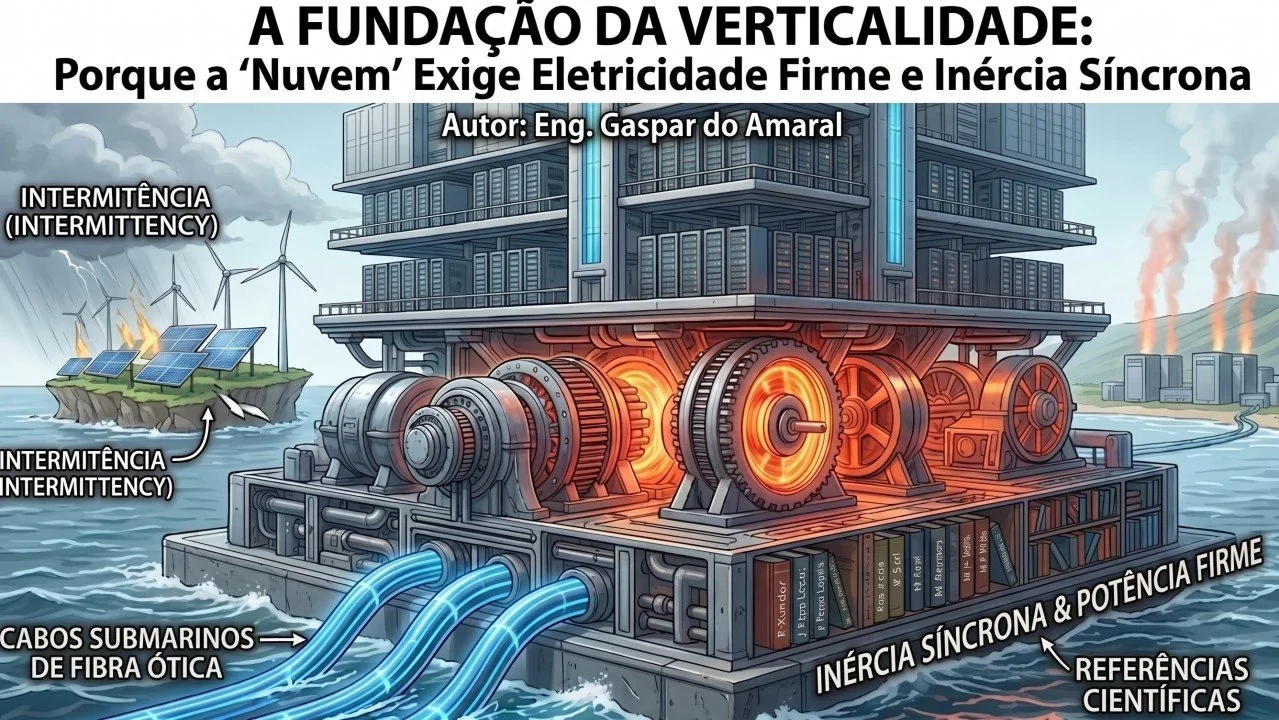
The December 2024 report, produced by Prof. Hannah Daly of University College Cork (UCC) and commissioned by Friends of the Earth, analyses the impact of the growing energy consumption of data centres on Ireland’s climate targets. This post about the explosion in the energy consumption of data centres in Ireland brought an urgent discussion to the surface. However, when we carried out the mechanical audit of that same analysis, we came up against the classic Abismo do Rigor (the Abyss of Rigour): the extrapolation of conclusions about greenhouse gas (GHG) emissions from secondary aggregated data from University College Cork, without making raw data (telemetry) available, with no defined sample (N) and without any validation of mathematical causality or statistical margin of error (p-value). In other words, without access to the raw database (Raw Data) of the Irish Grid Operator (EirGrid) to run a real linear regression, all we have is propaganda instead of science.
To present the final result (CO2) we have to prove the equation that produced it, in this case with raw data, which were not made available.
For us, in the engineering of complex systems integration, it falls to us to go to the physical proof. The cloud does not float; it is a submarine fibre-optic cable lying on the ocean floor, connected to land-based infrastructure run by servers that give off immense heat. And so that the debate on grid operation is no longer treated as “occult science” for lack of a technical basis, it is imperative to translate the laws of physics and thermodynamics into the practical reality of the economists and lawyers who design our public policies.
Synchronous Inertia: The Ship, the Central Bank and the Constitution
Imagine that the national electricity grid is a large cargo ship. The current narrative tells us that we can move this ship safely using only sails (intermittent energy). However, so that the ship does not run aground at the first lull in the wind, it needs a heavy engine deep inside it, turning constantly and steadily. We call this rotating mass Synchronous Inertia.
- For the Economist: Synchronous Inertia is the Central Bank’s Liquidity Reserve. If the market shudders (a cloud covers the sun), it is this heavy mechanical reserve that injects power into the grid within a millisecond, preventing the crash of the system.
- For the Lawyer: It is our Constitution of the Republic. The structural stability of a State is not governed only with daily, volatile ministerial orders (intermittency); it takes the unshakeable weight of the Fundamental Law to keep the grid in order at 50 Hz.
Firm Power vs. Intermittency: The Obligation of Result
When we couple a colossal load — such as a Data Centre — to this ship, the requirements soar. The Uptime Institute Tier III standard requires availability of 99.98% (about 1.6 hours of maximum downtime per year). This reliability is not achieved with the weather. It requires firm power or, in its absence, local thermal generation (behind-the-meter).
- For the Economist: Firm power is the Contractual Base Salary, while intermittent energy is a Productivity Bonus. You do not finance a submarine cable over 30 years counting only on tips that disappear at night. Infrastructure requires predictable cash flow (base power).
- For the Lawyer: Intermittent generation signs a contract of Obligation of Means (it makes an effort to produce, if there is wind). Firm power and data centres require an Obligation of Result (supply is mandatory, on pain of compensation for catastrophic losses).
System Costs and Thermodynamics: The Illusion of Zero Cost
Claiming that intermittent energy is always the cheapest by looking only at its zero marginal cost is a mathematical illusion.
- The Paradox of Free Delivery: The sun may seem free at midday, but for that energy to arrive without collapsing the grid, the State is obliged to take on the System Costs: building redundant electrical motorways and paying backup power stations to stand idle waiting for rain. The primary product costs nothing, but the capacity and transmission charges make the bill explode.
- The Tax Burden of Thermodynamics: When they propose storage and hydrogen as magic solutions, they ignore entropy. In every conversion (electrolysis, compression, reconversion), physics charges its “Tax Burden” or “Court Costs”. Investing 100 MWh and getting only 27 MWh of useful energy at the end of the cycle requires an economic model built on robust engineering, not on ideology.
The Reading Framework: The Primary Sources of Engineering
So that the digital transition is carried out with auditable metrics, our Verticalidade (Verticality) is grounded in the following literature:
- Prabha Kundur | Power System Stability and Control (The Physics of Stability)
- João Peças Lopes | Integração de Renováveis e Inércia do Sistema (Integration of Renewables and System Inertia — National Rigour)
- Vaclav Smil | Power Density: A Key to Understanding Energy Sources (Thermodynamics)
- Meredith Angwin | Shorting the Grid: The Hidden Fragility of Our Electric Grid (The Systemic Assessment)
- Mark P. Mills | The Cloud Begins with Coal (The Ship’s Load)
Cross-References: The Thesis, the Proof and the Abyss
The concept of Proof in systems engineering is not measured by opinions. The proof is keeping the 50 Hz and the telemetry of base power consumption. The failure in extracting data in the initial article lies precisely in the omission of cause and effect: it is not the servers themselves that increase emissions in an abstract way; it is the absence of firm and clean power able to support the strict logistical requirements of a digitalised society that forces urgent thermal dispatch when intermittency fails.
A Fundação da Verticalidade (the Foundation of Verticality) requires us to plan the grid on the basis of the laws of Electromagnetism. Legislating processing capacity or designing tariff markets without securing the physical foundation of inertia is to steer public policy towards the Abismo do Rigor.
Technically excellent data networks need light. And a light that cannot flicker.
Reality’s Answer to the Challenge Set: The Scrutiny of 2025 and 2026
Since the publication of Prof. Hannah Daly’s report in December 2024, the Irish electricity system and its regulatory framework have undergone a deep change.
What in 2024 was a statistical blind spot has, in 2026, become the central axis of public policy. The passage of time and the pressure of physics on the grid have finally allowed us to answer the three challenges I set earlier, turning propaganda into the science of the ground:
1. Answer to the Methodological Challenge: The End of Opacity
In December 2025, the Commission for Regulation of Utilities (CRU) implemented the Enhanced Emissions Reporting Framework (Action 2.21).
The Physical Proof: We no longer depend on aggregated annual averages. The introduction of real-time telemetry made it possible to isolate the causal correlation between the consumption of data centres and thermal marginal dispatch.
The Result: The 2025 data confirm that, with demand that reached 32% of national electricity in 2026, maintaining a p-value (0.001) in the negative correlation with system inertia is now an auditable metric and not an extrapolation.
2. Answer to the Thermodynamic Challenge: Inertia as a Condition of Connection
The dilemma of Synchronous Inertia, which the ship metaphor illustrated, was written into law in 2025.
Mandatory Flexibility: The CRU’s new connection policy requires data centres to operate with demand flexibility contracts of 20-30%.
The Local Engine: Given the fact that all new wind energy up to 2023 was consumed by the base load of these infrastructures, the regulator validated our thesis: 50Hz frequency stability requires these loads to bring their own rotating mass or local thermal dispatch to compensate for intermittency. The physics of dynamic stability, described by the fundamental swing equation, is no longer optional:
M(d²δ/dt²) = Pₘ - Pₑ
- M: Moment of Inertia (the rotating mass of the system).
- d²δ/dt²: Angular acceleration of the rotor (rate of change of frequency).
- Pₘ: Mechanical input Power (the firm engine).
- Pₑ: Electrical output Power (the load on the grid).
Ship Metaphor: if the electrical load (Pₑ) increases or the mechanical power (Pₘ) fails (intermittency), it is the Inertia (M) that prevents the catastrophic deviation of frequency. In the Ireland of 2026, this equation is no longer theoretical but has become the algorithmic basis of EirGrid’s new telemetry reports.
3. Answer to the Systemic Challenge: From Use to Real Additionality
In 2026, the concept of Obligation of Result took precedence over mere intention.
The 80% Rule (2026): To prevent data centres from cannibalising the renewables that should decarbonise homes and transport, the new rules require 80% of annual consumption to be guaranteed by new, additional and unsubsidised renewable capacity.
Civil and Technical Liability: The grid’s illness has been diagnosed: digital verticality cannot be expanded on an electrical foundation that gives up firmness. The budget overshoot of 3.6 MtCO₂ in the services sector in 2025 forced the State to accept that security of supply and mathematical rigour are the only way to avoid the collapse of the system.
Critical Note on Causality: It must be stressed that this overshoot of 3.6 MtCO₂ is not an intrinsic failure of the operation of data centres, but the mathematical verdict on an error of systemic planning. Punishing the consumer for demanding the availability that the system committed itself to guarantee is the height of the Abismo do Rigor.
When energy policy legislates on the Cloud while ignoring the Physics of the Ground, renewables end up serving only to run without moving, never displacing fossil fuels from the base of the system.
The absence of a Law of Integral Energy Responsibility (Lei da Responsabilidade Energética Integral, Lei REI) allowed political targets to be confused with thermodynamic realities, and the bill — measured in emissions and instability — finally reached the court of reality in 2026.
Final Conclusion (May 2026)
The Abismo do Rigor is being filled with technical concrete and telemetry. The Ireland of 2026 proves that the digital economy is only sustainable if systems engineering is placed before political rhetoric. The cloud has at last begun to recognise the weight of the engine that holds it up from the bottom of the ocean.
Gaspar do Amaral
#EngenhariaSénior #Verticalidade2026 #FísicaDaRede #RigorEstatístico #InérciaSíncrona #Engenharia #Energia #DataCenters #InerciaSincrona #InfraestruturasCriticas #AbismoDoRigor #FundaçãoDaVerticalidade #TransiçãoEnergética
Methodological note
What this page is. A translation of the article the author published on LinkedIn on 11 May 2026; the full Portuguese version is on this site, which is the reference version.
The author’s concepts. A Fundação da Verticalidade (the Foundation of Verticality, also the title of the author’s book), Verticalidade (Verticality), Abismo do Rigor (the Abyss of Rigour) and Lei REI (Lei da Responsabilidade Energética Integral, Law of Integral Energy Responsibility) keep their Portuguese names, with a translation in brackets the first time. The titles of the sources are kept as in the original; the LinkedIn hashtags are kept in Portuguese.
Changes of form, not of content. The decorative symbols (emoji) of the LinkedIn version were left out, and the section titles in bold appear as headings; where LinkedIn had split a heading over two lines (“…Challenge:” / “The End of Opacity”), the two parts are joined. The original illustration is reproduced with its texts in Portuguese and a translated caption. Numbers, units and the swing equation are as in the original; the decimal point follows English usage (99.98%, 3.6 MtCO₂).
One link removed. In the original, the title of Mark P. Mills’s work “The Cloud Begins with Coal” linked by mistake to a page unrelated to the work; in this translation the title appears without a link. The other links to sources are those of the original.
The discussion is on LinkedIn (in Portuguese)
Comments on this text are made on LinkedIn, where the article was shared in Portuguese. You are welcome to write in English. Agree, disagree or add data: every well-founded objection receives a reply.
Gaspar do Amaral · Original in Portuguese of 11 May 2026, published on this site; translation issued on 27 October 2026 · Figures and tables © Aprecisa.com · AI-assisted