 ← Grupo Aprecisa · Connecting those who know with those who need
Energy and the power system · Article published on LinkedIn on 18 June 2026
The Electron Does Not Queue: The Staging Error of DL 15/2022 and the Illusion of Cheap Energy
The planning errors of Decree-Law 15/2022 and the illusion of cheap energy
Gaspar do Amaral · 18 June 2026
Translated from the Portuguese original. This version was issued on 30 October 2026.
On this site, this article has been
Policy-makers are regularly heard announcing, with enthusiasm, records of installed renewable megawatts or decarbonisation targets written into law. The narrative enshrined in Decree-Law no. 15/2022 of 14 January — which establishes the organisation and operation of the National Electricity System (SEN), transposing Directive (EU) 2019/944 and, in part, Directive (EU) 2018/2001 — promised a decentralised model: the consumer as an active agent, cheaper electricity and a grid managed flexibly by digital means.
As an engineer with practice in the joint integration of complex systems, it falls to me to put this narrative through the technical sieve it demands. Applied physics does not bow to decree-laws, and electricity is not managed with slogans. It is therefore important to separate the political objective — legitimate and unavoidable — from the engineering premises on which its execution rests.
1. The error of the motorway without a surface: installed power vs. available power
The text of DL 15/2022 was organised around simplifying prior control and maximising the hosting capacity of the Public Service Electricity Grid (RESP), favouring the connection of decentralised renewable generation. The implicit assumption was that the accumulation of installed nameplate capacity would, in itself, be the indicator of the transition’s success.
The error lies in the quantity chosen. Building a motorway for 1,000 vehicles is irrelevant if those vehicles only travel when there is sun or wind. Portugal today has installed nameplate capacity far above the national peak demand (in the order of two and a half times the maximum demand observed). The problem is no longer the nominal quantity; it is the firm availability at the instant the system faces a critical situation.
The distinction is standardised in system adequacy analysis through the concept of capacity credit — the fraction of nameplate capacity that can be counted as firm for security-of-supply purposes. For solar and wind, that value is a small fraction of installed capacity, and it degrades precisely in the hours of greatest system stress. Intermittent power is not firm power.
2. The inertia error: the invisible support that prevents a blackout
Conventional power plants operate with rotating synchronous machines — high-mass turbo-generators — physically coupled to the grid frequency. The kinetic energy stored in those rotating masses constitutes synchronous inertia, the invisible and instantaneous support of system stability. When generation or load is suddenly lost, it is this inertia that limits the rate of change of frequency before any control action.
This dynamic is described by the swing equation. To a first approximation, the rate of change of frequency (ROCOF) following a power imbalance ΔP is:
ROCOF = df/dt ≈ (f0 · ΔP) / (2 · Hsys · Ssys)
where f0 is the nominal frequency (50 Hz), Hsys the aggregate inertia constant of the system and Ssys the apparent power of the coupled synchronous machines. The reading is direct: as synchronous generation is displaced by electronic inverters without equivalent compensation, Hsys falls and the ROCOF soars for the same disturbance. The time window for protections and regulation services to act shrinks from seconds to milliseconds.
The model underlying DL 15/2022 treated the grid much like a data-flow bus — energy entering and leaving through inverters — undervaluing this stabilising function. Strictly speaking, the integration of inverter-based generation raises two distinct problems that must not be confused: the erosion of synchronous inertia (frequency stability) and the degradation of voltage and reactive power control (voltage stability). Both result from the same underlying phenomenon — the replacement of synchronous machines by power electronics — and both are addressed by the European network codes, namely Requirements for Generators (Regulation (EU) 2016/631 — RfG), which provides for response requirements and the evolution towards grid-forming converters and synthetic inertia.
Technical note. The Iberian blackout of 28 April 2025 — classified by ENTSO-E as a scale 3 event (blackout), the most serious in the European system in more than two decades — was not, according to the final report of the ENTSO-E expert panel, a primary frequency collapse due to an inertia deficit. The documented root cause was the combination of oscillatory instability (local modes at ~0.63 Hz and inter-area modes at ~0.2 Hz), inadequate voltage control and deficient reactive power management, which caused a rapid rise in voltage and successive disconnections of generation in Spain (more than 2.5 GW in seconds), loss of synchronism and collapse. Low inertia was not the trigger, but it is the aggravating factor that reduces the room for manoeuvre: in a grid dominated by power electronics, disturbances propagate faster and the point of no return is reached in a shorter interval. The episode is therefore the first real warning of the architectural fragility of a grid with insufficient synchronous support — provided one describes precisely which fragility is at stake.
3. The illusion of the zero price (why cheap turns out expensive)
It is frequently argued that the occurrence of zero or negative prices on the wholesale (spot) market proves the financial success of the model. The consumer infers, with apparent logic, that the bill will shrink. This is market myopia.
The wholesale price reflects only the marginal cost of energy. To keep the grid from collapsing in the face of intermittency, the global manager of the SEN is obliged to contract, outside the energy market, system services (frequency regulation reserves — FCR, aFRR, mFRR — and voltage management) and dispatchable reserve capacity, called upon whenever the weather fails. Added to these are the costs of redispatch and congestion management.
In addition, the regime introduced flexible connections with restrictions, which translate into the imposition of curtailment or power reductions without compensation, degrading the predictability and the industrial Quality of Service (QoS). This systemic cost does not evaporate: it is transferred to the Network Access component of the bill — via the Global System Use tariff and the Costs of General Economic Interest (CIEG). Hence the indispensable distinction between the technology LCOE and the system LCOE (value-adjusted cost), which internalises these integration charges. The price of energy may tend towards zero; the cost of electricity delivered with a guarantee does not.
4. Batteries are not miracles
The planning of the past decade placed disproportionate faith in short-duration battery storage. A battery with one to two hours of autonomy (BESS) provides relevant services in fast frequency regulation and partial peak shifting. But physics is not suspended by decree.
Faced with prolonged periods of wind deficit and low solar output — the dunkelflaute phenomenon — short-duration batteries are exhausted within a short interval. The system continues to require firm, dispatchable generation able to sustain consecutive days or weeks: pumped-storage hydro (which, being synchronous, also contributes to inertia), natural gas as a transition technology and, on the strategic horizon, nuclear energy. Voltage and frequency stability can also be partly restored by synchronous condensers, but this requires deliberate planning, absent from the decree.
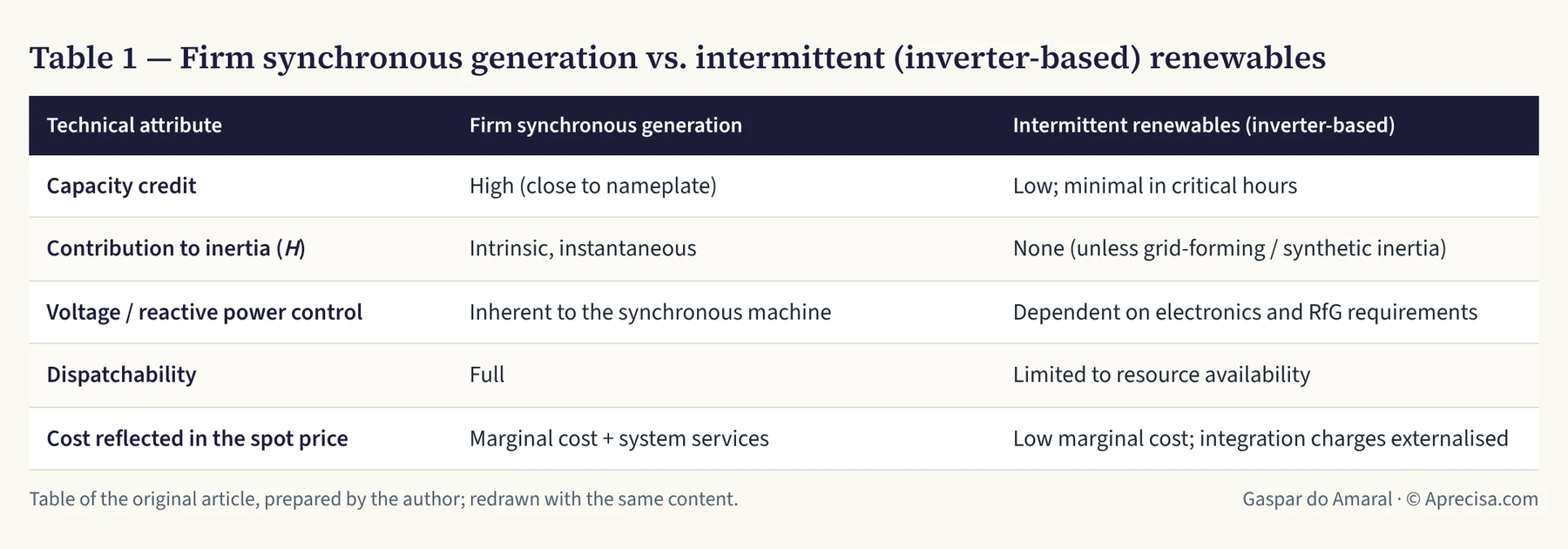
Comparative summary
Conclusion — less propaganda, more system engineering
The real obstacle to the country’s energy development lies not in bureaucracy or environmental opinions, as is sometimes claimed to justify missed targets. It lies in the absence of systemic electrical thinking.
The energy transition is a necessary and unavoidable path — but it demands technical competence, economic realism and absolute respect for the laws of applied physics. Changing the legal regime on paper is a relatively easy political act; ensuring that electricity is delivered with frequency and voltage stability, and with security of supply at all times, is systems engineering.
Portugal does not need less nature in order to install more panels. It needs more engineering to build a safe, competitive and rational electricity system.
Less energy propaganda. More system engineering.
Sources and references
- Decree-Law no. 15/2022 of 14 January — official text (Diário da República): files.dre.pt — consolidated version (PGDL): pgdlisboa.pt
- Directive (EU) 2019/944 (internal market for electricity): eur-lex.europa.eu
- Directive (EU) 2018/2001 (promotion of the use of energy from renewable sources): eur-lex.europa.eu
- Regulation (EU) 2016/631 — Requirements for Generators (RfG) network code: eur-lex.europa.eu
- ENTSO-E — Iberian blackout of 28 April 2025, final report of the expert panel (press release, 20/03/2026): entsoe.eu
- ENTSO-E — repository of reports and data on the incident (factual and final): entsoe.eu
Methodological note
What this page is. An English translation of the article the author published on LinkedIn on 18 June 2026; the full Portuguese version is on this site. The article contains no calculations of its own beyond the first-order swing equation it quotes; the figures on the 28 April 2025 blackout (scale 3, modes at ~0.63 Hz and ~0.2 Hz, more than 2.5 GW) are those of the ENTSO-E report, as in the original.
Changes of form, not substance. In the original, the comparative table appeared as run-together text (an import artefact); here it is redrawn as Table 1 with the same content. The equation is set in plain notation. SEN is the Portuguese National Electricity System, RESP its public service grid and CIEG the costs of general economic interest charged in the access tariffs. The links are those of the original.
The discussion is on LinkedIn (in Portuguese)
Comments on this text are made on LinkedIn, where the article was shared in Portuguese. You are welcome to write in English. Agree, disagree or add data: every well-founded objection receives a reply.
Gaspar do Amaral · Original in Portuguese of 18 June 2026, published on this site; translation issued on 30 October 2026 · Figures and tables © Aprecisa.com · AI-assisted
How to cite: Gaspar do Amaral (2026). O Eletrão Não Espera em Fila: O Erro de Palco do DL 15/2022 e a Ilusão da Energia Barata. Zenodo. https://doi.org/10.5281/zenodo.23814400 · Permanent archive on Zenodo.