 ← Grupo Aprecisa · Connecting those who know with those who need
Energy and the power system
The Abyss of Rigour: The Illusion of Cheap Energy and the Death of Synchronous Inertia
Having energy is not enough; it has to arrive stable: the illusion of cheap energy when the inertia of the machines disappears
Gaspar do Amaral · 28 March 2026
Translated from the Portuguese original. This version was issued on 27 October 2026.
On this site, this article has been
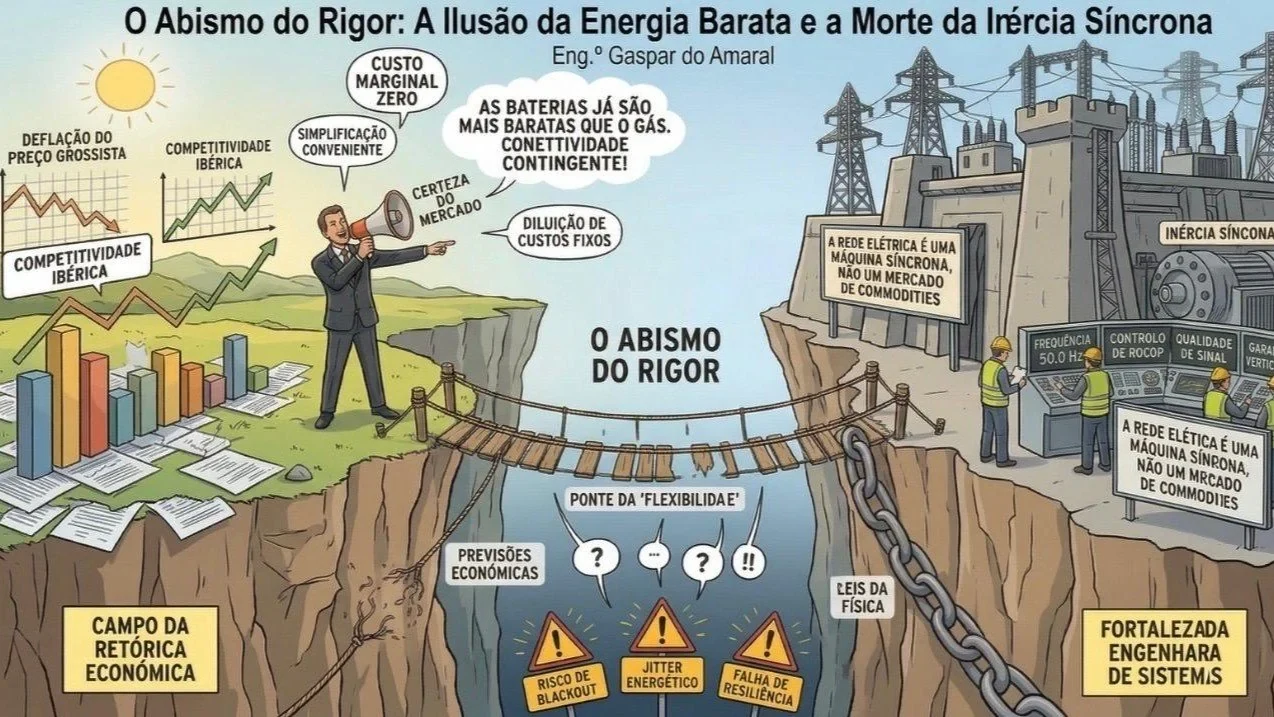
Introduction: “To drive a car, it is not enough to put fuel in it”
A few elementary analogies:
Nobody acquires a transport asset merely to contemplate a “full tank” at rest. The purchase is aimed at operational performance: guaranteed torque, reliable motion and the integrity of the journey between point A and point B. In the power system, the “fuel” is the electron (raw energy), but “performance” is defined by Quality of Service (QoS) — keeping the voltage stable and controlling the frequency rigorously. As Vaclav Smil shows in Energy and Civilization, the real driver of GDP is not the theoretical price of energy, but its energy density and the resilience of its delivery.
The penetration of renewables with electrochemical storage resembles a highly efficient digital banking system: it speeds up flows, but lacks intrinsic backing (except for synthetic emulation through grid-forming inverters, which still lack the scale and critical mass to replace the kinetic energy of the large rotating masses). Synchronous inertia is, in this context, the “physical gold” in the vault of the Central Bank. As under the gold standard, we may not draw on that reserve every day, but it is its physical existence — the rotating masses in synchronism — that ensures that our unit of account, the 50 Hz, does not suffer a catastrophic devaluation in a millisecond of contingency. Without this backing of stability, the grid loses its verticalidade (verticality, the author’s term for standing firm on solid foundations) and the system collapses under its own volatility.
1. The Blank Cheque in the Iberian Peninsula: The Chronicle of Technical Abdication
The origin of today’s instability lies in a “blank cheque” written to economic rhetoric at the expense of the physics of the grid. This process took shape at critical legislative moments in the Iberian Peninsula.
The legislative context (Portugal)
Decreto-Lei n.º 15/2022 (Portugal) and Real Decreto-ley 20/2022 (Spain) consolidated the mechanism of Contingent Access (flexible connections). It is essential to clarify the engineering of this process: conditional access is not an Iberian eccentricity; it appears explicitly in the Grids Package and in the directives of the European Commission as a tool for optimising the use of the grid:
- Decreto-Lei n.º 15/2022, de 14 de janeiro (Decree-Law No. 15/2022 of 14 January): this law established the new organisation of the SEN (Sistema Elétrico Nacional, Portugal’s national power system), giving priority to accelerating renewable generation and introducing mechanisms of Contingent Access (the so-called “flexible connections”). In practice, it allowed capacity-reservation titles to be issued without the grid being physically prepared for injection peaks, creating the paradigm of “conditional connectivity”.
- Decreto-Lei n.º 30-A/2022, de 18 de abril (Decree-Law No. 30-A/2022 of 18 April): at the height of the energy crisis, licensing was simplified (REPowerEU), often riding roughshod over technical opinions on grid stability in favour of statistical decarbonisation targets.
The legislative context (Spain)
Under the aegis of the Ministry for the Ecological Transition and the Demographic Challenge (MITECO), the face of the Spanish Electricity System (SEE) was changed by laws aimed at the “Iberian exception” and at the massive acceleration of renewable GW. That is, this Iberian Exception, not recommended in the European Union, lowered the marginal price but increased the opportunity cost through the degradation of signal quality, something that the system-services (balancing) markets in Spain have also reflected with rising prices:
- Real Decreto-ley 29/2021, de 21 de diciembre (Royal Decree-Law 29/2021 of 21 December): this law anticipated the need to optimise the grids. It introduced measures to promote electric mobility and, crucially, set criteria for releasing grid capacity for self-consumption and energy communities. It was the forerunner of dynamic capacity management, allowing greater penetration of renewables at saturated connection points.
- Real Decreto-ley 6/2022, de 29 de marzo (Royal Decree-Law 6/2022 of 29 March): under the National Plan in Response to the Consequences of the War in Ukraine, this decree drastically simplified the Environmental Licensing (DIA) of renewable energy projects. Like REPowerEU in Portugal, it allowed projects to be approved through an accelerated environmental-impact determination procedure, prompting a technical debate on the balance between administrative speed and systemic stability.
- Real Decreto-ley 20/2022, de 27 de diciembre (Royal Decree-Law 20/2022 of 27 December): this law consolidated the figure of “Access and Connection” with flexibility criteria. It introduced just-transition tenders for the grid nodes freed by the closure of thermal power stations, giving priority not only to installed capacity but also to storage criteria (batteries) to mitigate the volatility of injection.
Analysis of Iberian convergence
Comparing these documents, one sees a regulatory symmetry within MIBEL (the Iberian Electricity Market). In both countries:
- Acceleration vs. inertia: laws were made to inject electrons quickly (volume), but the management of synchronous inertia and of system services (stability) was left dependent on flexibility mechanisms and the secondary market, not on an immediate structural physical requirement.
- Conditional connectivity: the figure of “Access and Connection” in Spain mirrors “Contingent Access” in Portugal, where the developer accepts being disconnected at times of grid saturation so that more capacity-reservation titles can be issued.
This legislative structure reinforces the central thesis: the system is being managed with a “full tank” logic (GW targets), while systems engineering struggles to maintain torque and reliability (operational stability) in the face of a physical infrastructure that does not keep up with the speed of the legislated paper in the Iberian Peninsula.
The paradox of grid-forming and synchronous compensators
The full recognition that synchronous inertia is vital is found in the very plans of the Iberian system operators (REN and REE), which provide for the installation of synchronous compensators. [...] The fact that we need to install synchronous compensators and, in future, deploy grid-forming inverters on a massive scale [...] proves the central thesis: inertia has to be restored at very high CAPEX costs, reflected in the Access Tariffs:
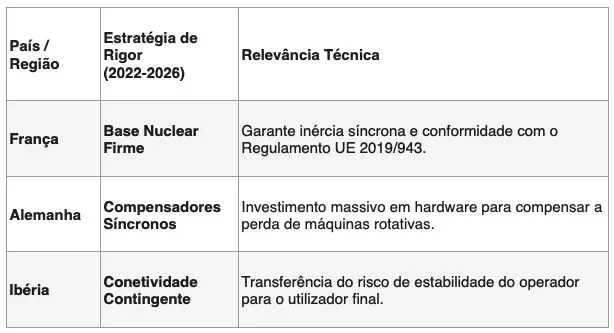
2. Voltage Control, the RfG and the Iberian “Risk Premium”
Portuguese excellence: Portugal complies rigorously with the European network codes (Requirements for Generators, RfG), and has a dynamic voltage-control system far superior to Spain’s.
The bill for instability: the ENTSO-E expert panel report confirmed that the central problem of the Iberian blackout was deficient voltage control in Spain.
However, because we operate in a synchronous block (MIBEL), our neighbour’s structural weakness is reflected in our bill.
- The opportunity cost in the balancing markets: this policy drastically increased the opportunity cost through systemic instability. In Spain, the Balancing Services (secondary and tertiary reserve and voltage control) have shown rising prices. In practice, what was “saved” in the day-ahead market is being charged — with volatility interest — in the technical markets to prevent the collapse of the grid.
The fallacy of substitution and the masters’ rebuttal
The economic concept: “Batteries (BESS) replace gas because the marginal cost is lower.”
The rebuttal of rigour:
- Dieter Helm (Oxford), in his essay Net Zero, explains that the real cost of the system must include the LACE (Levelized Avoided Cost of Energy). Batteries are static converters; they have no synchronous inertia. Without the rotating masses of thermal power stations, the grid loses the ability to resist frequency variations.
- Gretchen Bakke: in The Grid, she recalls that the grid is the most complex machine of humanity. Ignoring the ROCOF (rate of change of frequency) in order to lower the wholesale price is a failure of national security.
- Jean-Marc Jancovici (The Shift Project) stresses that a 100% volatile system requires an oversizing of the grid that political economy tends to hide in infrastructure bills. He shows that productivity depends on energy determinism. A “flexible” system is a system that imposes stoppages on industry, destroying the value that cheap energy promised to create.
3. “Contingent Connectivity” vs. European Standards
The idea that industrial consumption should be “flexible” (that is, interruptible without notice) collides with the rules of ENTSO-E (Regulation (EU) 2019/943). High-value industry does not survive on “energy if and when available”. Conventional batteries (grid-following) are static energy-shifting converters. They inject active power, but provide no mechanical inertia, nor do they have the thermal oversizing to inject the massive fault currents (10 kA to 20 kA).
Analysis of the Recitals and Articles of the Regulation shows that there are several evident areas that could be explored in the context of the article, especially with regard to system stability and the transition to renewable energy:
- Need for flexibility and new technologies (Recitals 9 and 22): the Regulation explicitly recognises that the grid of the future must use all available sources of flexibility, including energy storage and digitalisation, and that prices must encourage investment in these sources. This is directly related to the need to replace the services provided by traditional synchronous inertia.
- Network codes and inertia (Article 59(1)(d)): the Regulation provides for the adoption of implementing acts to establish network codes in areas such as the rules on the provision of non-frequency ancillary services. Specifically, it mentions “inertia for grid stability” as one of the aspects to be regulated. This shows that the importance of inertia is recognised at the level of European legislation, although its detailed implementation depends on secondary regulation.
- Short-term markets and scarcity pricing (Recitals 23 and 24 and Article 10): the text stresses the importance of short-term markets and of scarcity pricing to encourage market participants to react to signals and to ensure cost recovery. The removal of maximum and minimum wholesale price limits is presented as essential for this purpose.
- Capacity mechanisms and emission limits (Recital 44 and Article 22(4)): the Regulation lays down strict rules for the introduction of capacity mechanisms, which must be temporary and based on a European resource adequacy assessment. Crucially, it sets limits on CO2 emissions for generation capacity taking part in these mechanisms, which has a direct impact on the conventional thermal power stations that have traditionally provided inertia.
- Regional cooperation and regional coordination centres (Recitals 52 and 53 and Article 35): stronger regional cooperation is encouraged, including the creation of regional coordination centres, to manage the system in a more integrated and secure way.
- Tasks of the regional coordination centres and inertia (Article 37(1) and Annex I): the Regulation assigns tasks to the regional coordination centres, such as the sizing of regional reserve capacity. Although inertia is not explicitly mentioned as a direct task, Annex I (which is not fully detailed in the extracts provided, but is referred to) may contain more detail on the functions of regional relevance, which could indirectly touch on the management of frequency stability.
Benoît Chevalier and Steve Keen (The Debunking Economics) argue that productivity is linked to available exergy (useful energy). A system that imposes dispatch restrictions on the consumer is transferring the cost of the grid’s inefficiency to the OPEX of factories.
4. The Paradigm of “Conditional Connectivity” (DL 15/2022)
Separating the concepts: grid flexibility vs. synchronous inertia — a common mistake in macroeconomic analysis is to merge congestion management with dynamic stability. Conditional access manages power flows (it prevents the thermal saturation of cables). Synchronous inertia manages the variation of frequency (the ROCOF). They are orthogonal axes. Solving local congestion with flexibility does not give the system back the global kinetic mass it has lost. In practice, new power stations were authorised to connect on the undertaking that they would be “cut” (curtailment) whenever the grid saturates.
That is, Conditional Access serves to manage cables that are heating up (congestion), not to manage the grid’s lack of inertia.
- The critique of Vaclav Smil and Robert Ayres: Smil argues that civilisation depends on density and reliability. By introducing “conditional connectivity”, the legislator turned the power grid — which should be deterministic — into a stochastic (probabilistic) system. For Ayres, this reduces useful exergy: energy that cannot be injected when it is produced (because the grid is saturated) is lost energy, increasing the country’s thermodynamic inefficiency.
- The conflict with the ENTSO-E rules: while the European grid-security rules (Regulation (EU) 2019/943) require operators to guarantee stability, DL 15/2022 allows the opposite: injecting volatile power into a grid that no longer has the mechanical inertia needed to absorb it.
5. Riding Roughshod over Technical Opinions (DL 30-A/2022)
At the height of the energy crisis (after Ukraine), the simplification of environmental and technical licensing aimed at rapid decarbonisation targets. In engineering, however, “fast” is often the opposite of “robust”.
- The perspective of Dieter Helm and Steve Keen: Helm warns that the cost of “reaching Net Zero” is underestimated because the cost of the supporting infrastructure is ignored. By “riding roughshod over” technical opinions on grid stability, the legislator ignored Steve Keen’s warning: the economy is a subsystem of thermodynamics. Ignoring signal and frequency instability in order to reach statistical targets of installed gigawatts is like building a taller building without reinforcing the foundations.
- The Abismo do Rigor (abyss of rigour) of Joseph Tainter: Tainter explains that societies collapse when the complexity of their solutions yields diminishing returns. DL 30-A/2022 increased the complexity of the system (thousands of new, scattered injection points) while reducing technical control over them. The result is a more fragile grid, where the cost of maintaining stability exceeds the benefit of the cheap energy produced.
6. Relevance of the References: The Final Confrontation
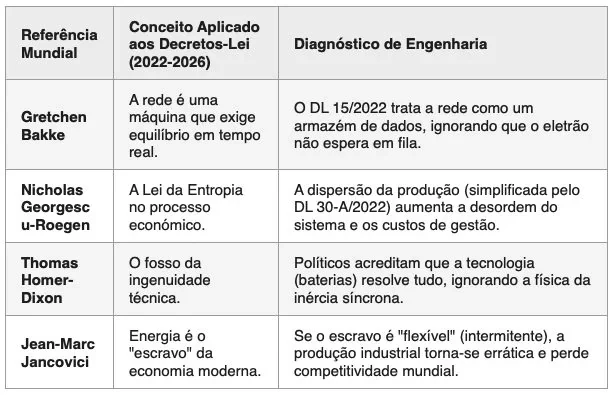
7. Data Audit: Wholesale Price vs. System Cost
The “argumentative decoration” (a term coined by João Vermelho Neves) that focuses only on the wholesale market hides the costs of:
- System services: the cost of maintaining fast reserve to compensate for renewable jitter.
- Grid reinforcement (CAPEX): the investment by REN and REE that will be spread over the tariff, cancelling out the savings in generation.
- Security of supply: dependence on interconnections that ENTSO-E and ACER monitor with growing concern, a regulatory “yellow card”.
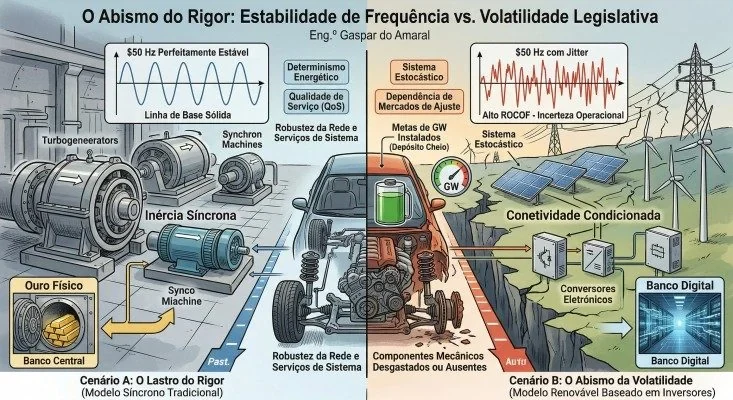
8. Conclusions
Resilience engineering is not free
The ENTSO-E Expert Panel Report shows that engineering solves the problems of intermittency, but physics presents the bill. Energy has not become cheaper overall; its real cost has been transferred from the “Generation Bill” to the mega-bill of CAPEX for supporting infrastructure (grid-forming batteries, pumped-storage hydro, synchronous compensators and very-low-latency digital networks). We wrote a blank cheque to “flexibility”, and now physics is presenting the bill for instability.
Physics does not accept adjectives
We can legislate “flexibility” and call energy “cheap”, but the power grid, like any high-precision communications system, demands Verticalidade (verticality) and Rigour. Without massive investment in inertia, redundancy and signal stability, the “blank cheque” written by politics will be cashed by physics, in the form of lost industrial competitiveness and the erosion of technological sovereignty in the Iberian Peninsula.
Eng. Gaspar do Amaral
Annex A — References and their relevance
For further reading, consult the sources on which this analysis rests:
- Vaclav Smil: Energy Transitions — on the impossibility of leaping over the laws of thermodynamics.
- Dieter Helm: Burn Out — the economics of falling oil prices and the farce of subsidies.
- Jean-Marc Jancovici: Manicore — the inseparable relationship between stable energy and GDP.
- Robert Ayres: Energy, Complexity and Wealth Maximization — why the quality of energy defines the wealth of nations.
- Joseph Tainter: The Collapse of Complex Societies — the rising cost of maintaining hyper-complex networks.
- Nicholas Georgescu-Roegen: The Entropy Law and the Economic Process — the father of bioeconomics on the inevitable degradation of systems.
- Helmuth Trischler: The Anthropocene — a historical perspective on technology and the limits of the planet.
- Steve Keen: The New Economics — a critique of neoclassical theory, which ignores energy.
- Thomas Homer-Dixon: The Carbon Shift — the complexity of the transition and the risks of rupture.
- Gretchen Bakke: The Grid — the biography of humanity’s largest machine and its present fragility.
Methodological note
What this page is. A translation of the article the author published on LinkedIn on 28 March 2026; the full Portuguese version is on this site. The cover illustration, the two tables and the final illustration are the original images, with their texts in Portuguese, and translated captions. The links to sources are those of the original.
Names of laws and the author’s terms. Portuguese and Spanish laws (Decreto-Lei, Real Decreto-ley) have no official English translation and keep their names, with an explanation in brackets; the European regulation is cited by its official English name, Regulation (EU) 2019/943. “O Abismo do Rigor” (The Abyss of Rigour) and Verticalidade (verticality) are the author’s own concepts; the first is translated in the title and both are kept in Portuguese in the text, with a translation.
Changes of form, not of content. The section headings follow the numbering of the original; the separator lines were left out. Obvious slips in the Portuguese page were corrected only in the translation: a doubled comma and a doubled full stop, two misspelt words (“Istoo”, “decoracão”), “União Europa” and “Península Ibéria” (European Union, Iberian Peninsula), and the formula for carbon dioxide, which appears in the Portuguese page as unrendered code (“$CO_{2}$”) and is written here as CO2. The “@” before the name of João Vermelho Neves (a LinkedIn mention) was left out. The two “[...]” in section 1 are in the original.
The discussion is on LinkedIn (in Portuguese)
Comments on this text are made on LinkedIn, where the article was shared in Portuguese. You are welcome to write in English. Agree, disagree or add data: every well-founded objection receives a reply.
Gaspar do Amaral · Original in Portuguese of 28 March 2026, published on this site; translation issued on 27 October 2026 · Figures and tables © Aprecisa.com · AI-assisted