 ← Grupo Aprecisa · Connecting those who know with those who need
Energy and the power system · Article published on LinkedIn on 24 April 2026
The Invisible Bill for CO₂: The Rigour of the System in the Face of the Abyss of the Transition
CO₂ is not only a waste product: removing it from the chain without integrated design threatens food, water and medical security
Gaspar do Amaral · 24 April 2026
Translated from the Portuguese original. This version was issued on 30 October 2026.
On this site, this article has been
By: Gaspar do Amaral
Opening Summary
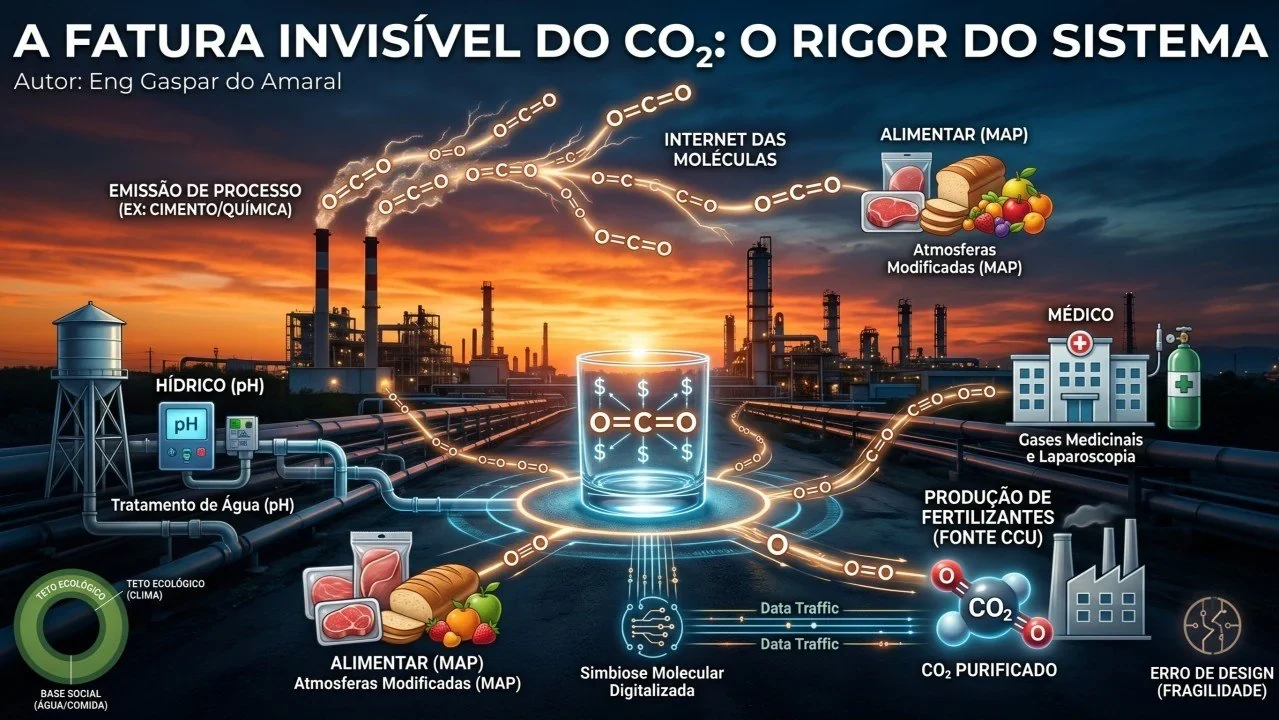
The energy transition is being managed by “emissions calculators”, when it should be designed by Systems Engineers. As someone who has devoted many years to the integration of critical infrastructure, I see a dangerous paradox: while Europe legislates to eliminate CO₂ as a waste product, it ignores that CO₂ is the “blood” of our operational continuity.
Breaking this chain — without integrated design — is shifting hidden costs and vulnerabilities onto Portugal’s food, water and medical security.
1. Foundations: “Physical Literacy”
What is CO₂ and how do we understand it?
Industrial CO₂ is not a luxury; it is a triatomic molecule fundamental to our civilisation. In the atmosphere it is the greenhouse gas that regulates the planet’s heat balance. In industrial terms, however, it is a purified cryogenic and chemical resource. As Vaclav Smil proves in Energy and Civilization, our existence depends on processes of high material density. At secondary school we learn stoichiometry and thermodynamics, yet we seem to have forgotten Nicholas Georgescu-Roegen’s laws of entropy: eliminating a by-product without systemic compensation always generates a cost at another point in the network.
Secondary-school prerequisites for this reading
To understand this thesis, we draw on fundamental “physical literacy”:
- Chemistry (10th/11th year): stoichiometry and industrial by-products.
- Physics (10th/11th year): thermodynamics and the laws of entropy of Nicholas Georgescu-Roegen.
- Geography (11th/12th year): transport networks and global logistics.
The Audience: Technical Rigour Meets Strategic Decision
We address ourselves specifically to those who decide: economists, who should adopt “thermodynamic accounting”; lawyers, who need to protect CO₂ as a security asset; and C-level managers, who cannot ignore systems integration.
2. The Ecosystem and the Design Error
In Portugal we live in legislative “silos” (the Framework Climate Law and the PNEC 2030, the National Energy and Climate Plan). By focusing only on penalising the emitter, we ignore Robert Ayres’s Industrial Metabolism. If we kill fertiliser production (a source of purified CO₂), we stop water purification and food preservation.
This is what Nassim Nicholas Taleb defines as fragility through design error: we have optimised the system for “carbon purity”, but made it vulnerable to logistical collapse. We lack what Mariana Mazzucato advocates: a Strategic Mission that integrates energy, transport and industry into a single, resilient system.
Industrial Metabolism and the Physical Economy
The economy is, above all, physical. Jean-Marc Jancovici and Art Berman remind us that without an adequate energy return (EROI) systems collapse, a thesis reinforced by the financial analysis of Gail Tverberg. Industry does indeed have a metabolism, as proposed by Robert Ayres. If we eliminate the CO₂ “waste” without an alternative, we kill the “nutrient” of the cold chain and of water purification.
While Amory Lovins and Bill Gates focus on technological solutions, political reality faces the “Ingenuity Gap” of Thomas Homer-Dixon: our difficulty in managing the complexity we have created. Managing it requires clear strategic missions (Mariana Mazzucato) and a holistic view of infrastructure (Fritjof Capra, Ervin László and Jeremy Rifkin).
3. The Engineering of Everyday Life: Where Failure Becomes a Bill
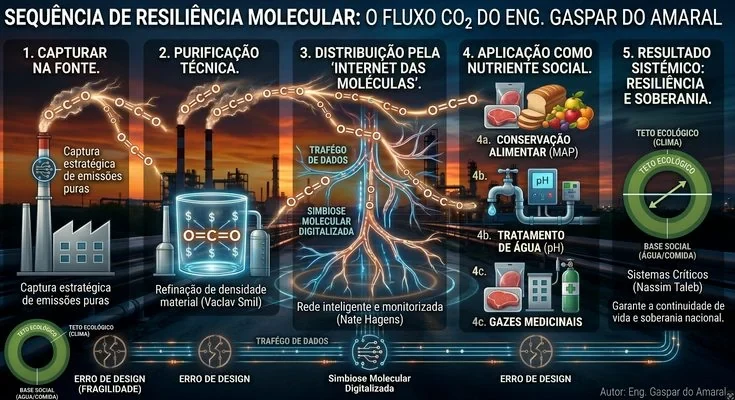
To an eye trained in the integration of complex systems, the supermarket or the utility bill are not merely places of consumption; they are dashboards of infrastructural resilience. What the ordinary consumer reads as “inflation” is, in many cases, the manifestation of a design failure in the industrial metabolism.
🥩 On the Plate: The Cost of Molecular Preservation
Most of the fresh food we eat — from packaged meat to vegetables — uses Modified Atmosphere Packaging (MAP). Industrial CO₂ is injected into the packs to displace oxygen, inhibiting bacterial growth without the need for aggressive chemical preservatives.
- The practical detail: when ammonia production (a primary source of CO₂) slows down because of the cost of natural gas, the supply of purified CO₂ becomes scarce.
- The bill: without this molecule, shelf life falls drastically. The result? An exponential rise in logistical waste and the need for more frequent and faster transport. It is this physical inefficiency that the consumer pays for at the till.
💧 In the Water: The Chemical Balance of Cities
Public water treatment, run by bodies such as Águas de Portugal, uses CO₂ for strict pH control and in remineralisation (recalcification) processes.
- The practical detail: water with an unbalanced pH becomes corrosive to the infrastructure network (pipes) and to citizens’ household appliances.
- The bill: faced with a shortage of domestic CO₂, operators are forced to turn to more expensive alternative reagents or less efficient processes. This invisible operating cost inevitably ends up in the monthly water tariff, under the guise of “treatment cost adjustments”.
🏥 In the Hospital: The Continuity of Critical Care
Carbon dioxide is vital in the clinical setting, from laparoscopy (where it is used to insufflate the abdominal cavity) to cryosurgery and the transport of tissue.
- The practical detail: the logistics of medical gases work as the “nervous system” of modernity (Nate Hagens). It is a high-precision network that tolerates no interruptions.
- The bill: strain on the base supply forces hospitals to manage emergency stocks at inflated costs, diverting resources that should go to the direct provision of care.
Sovereignty at Risk
As Daniel Yergin warns, by allowing the degradation of our domestic industrial capacity to capture and purify by-products, we are trading sovereignty for a critical dependence on uncertain logistical routes.
We are heading for the “Great Simplification” forced by physics: a scenario in which a lack of rigour in managing a “simple” molecule such as CO₂ can bring down the complexity of essential services we take for granted.
The energy transition cannot be merely a substitution of sources; it has to be a guarantee of flows.
4. Conclusion: Rigour as the Only Way Out
The energy transition cannot ignore planetary boundaries or social stability, the balance of the “Doughnut” proposed by Kate Raworth, the economic rigour of Dieter Helm and the network view of Fritjof Capra. The challenge is not political; it is one of Systems Engineering.
Challenges for your everyday life:
- Demand the map: where does the CO₂ that preserves your food come from?
- Check sovereignty: are we importing “fragility” from distant supply chains?
- Technical rigour vs narrative: reject solutions based only on spreadsheets; physics does not accept promises.
📚 The Canon of Industrial Resilience: A Literature Review for the Rigour of the System
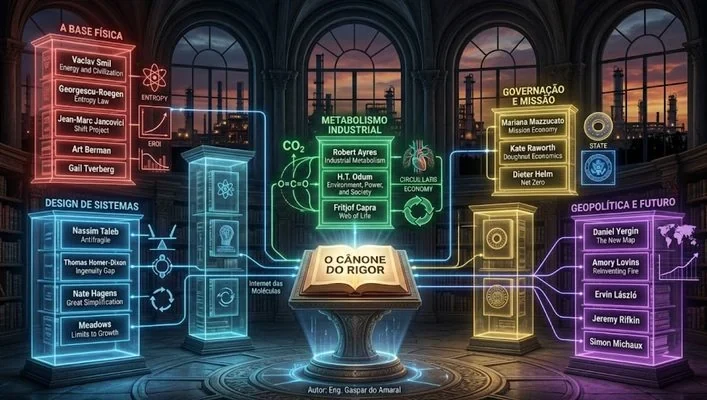
The energy transition is not merely a political target; it is a challenge of Complex Systems Engineering. To support my thesis on the CO₂ paradox and industrial sovereignty, I have selected the 20 minds who define the rigour needed if we are not to fall into the abyss.
📚 The Canon of Industrial Resilience: The Map
To support my view of the industrial CO₂ paradox — which I maintain is the “blood” of operational continuity — I have gathered the reflections that provide the necessary scientific grounding. On LinkedIn I share this synthesis so that economists, lawyers and decision-makers understand that the energy transition requires us to “keep the gas always in step” with physical reality.
Here are the fundamental contributions to the Rigour of the System:
🌐 The Physical Base and Material Inevitability
- Vaclav Smil | Energy and Civilization: proves that modern civilisation is materially dependent on pillars such as ammonia. CO₂ is an intrinsic result of processes that sustain human life.
- Jean-Marc Jancovici | The Shift Project: demonstrates the mathematical correlation between physical energy and GDP. “Cleaning up” CO₂ without a molecular map will lead to a contraction in the country’s operational capacity.
- Gail Tverberg | Our Finite World: crucial to explaining why the “invisible bill” paid by the Portuguese consumer reflects the physical cost of maintaining industrial complexity.
- Art Berman | Energy Restoration: reinforces that the transition has geological limits and that we cannot do without heavy chemical by-products by mere decree.
🏗️ Systems Design and the Prevention of Fragility
- Nassim Nicholas Taleb | Antifragile: identifies the “design error”: by optimising only for carbon efficiency, we make the system fragile in the face of logistical shocks.
- Thomas Homer-Dixon | The Ingenuity Gap: explains the mismatch between the complexity of problems and our technical capacity. Blind decarbonisation is a symptom of this failure.
- Nicholas Georgescu-Roegen | The Entropy Law: the thermodynamic pillar: eliminating a by-product always generates a cost at another point in the system — the “displacement of fragilities”.
🧬 Industrial Metabolism: CO₂ as a Nutrient
- Robert Ayres | Industrial Metabolism: defines industry as an organism. CO₂ is a nutrient for food preservation and water purification. Cutting the flow makes the organism ill.
- Howard T. Odum | Environment, Power, and Society: introduces the concept of emergy (embodied energy), making it possible to measure the real value that purified CO₂ delivers to society.
- Fritjof Capra | The Web of Life: supports the need for a network view. We need an “Internet of Molecules” to manage CO₂ as a critical resource.
⚖️ Governance, Mission and the New Economy
- Mariana Mazzucato | Mission Economy: the State must design joint-integration “missions” that protect industrial sovereignty, not merely punish emissions.
- Kate Raworth | Doughnut Economics: the transition has to fit under the ecological ceiling without breaking through the social foundation (water/food), where industrial CO₂ is a key piece.
- Dieter Helm | Net Zero: criticises the failure of current policies to account for the full life cycle, applying economic rigour to the transition.
🗺️ Geopolitics and the Viability of the Map
- Daniel Yergin | The New Map: shows that by destroying domestic CO₂ chains we hand our resilience over to distant and uncertain logistical routes.
- Simon Michaux | Assessment of Capacity: demonstrates the material infeasibility of certain targets without a map of chemical by-products.
🚀 Vision of the Future and Technical Integration
- Bill Gates | How to Avoid a Climate Disaster: identifies the “Green Premium” and the cost the consumer will end up paying for the lack of viable alternatives in heavy chemistry.
- Nate Hagens | The Great Simplification: maps the risk of a collapse of complexity. The disappearance of industrial gas is the beginning of a forced simplification of our lives.
- Amory Lovins | Reinventing Fire: proposes redesigning the flows of energy and matter in parallel, integrating transport and industry.
- Ervin László | The Systems View of the World: the framework for “Humanist Engineering”: technical rigour at the service of the resilience of life.
- Jeremy Rifkin | The Third Industrial Revolution: the fusion of communications and energy into a single system. The management of molecules must be digitally integrated.
📌 Conclusion of Gaspar do Amaral’s thesis: Portugal’s integrity depends on keeping the “gas always in step” with infrastructure. Thermodynamic rigour proves that decarbonisation without integration is an illusion. The challenge is one of Systems Engineering.
📌 Strategic Annex: From the Abyss of the Silo to the Integration of the System
As an engineer, I know that identifying the problem is only 50% of the work. The other 50% lies in the Rigour of the Action Plan. This annex serves as a compass for decision-makers who want to move from “carbon accounting” to Critical Systems Engineering.
1. Grounding: The Pillars of Resilience
If Portugal is not to fall into the error of systemic design, our strategy must be anchored on four scientific pillars:
- Industrial metabolism: seeing industry as an organism in which CO₂ is a nutrient.
- Antifragility: creating strategic redundancies instead of blind efficiency.
- Molecular sovereignty: guaranteeing domestic production of by-products for health and food.
- Energy return (EROI): validating the physics before the politics.
2. Implementation Roadmap: The Action Plan
I propose a plan structured in three phases to cure “Silo Blindness”:
Phase 1: Diagnosis (0–6 months)
- Create the National Map of Molecular Flows. We need to know exactly where CO₂ is critical — from Águas de Portugal to medical gases.
- Mapping of Critical Interdependencies and Flow Nodes in the main refining and heavy-chemicals plants.
Phase 2: Regulatory Integration (6–18 months)
- Institutionalisation of a mandatory “Systemic Impact Opinion” in all climate legislation. No industrial plant closes without a guarantee that its by-products will be replaced.
- Creation of the Systemic Resilience Council: a forum in which Systems Engineering has the power of veto over political “Silo Blindness”.
Phase 3: The “Internet of Molecules” (+18 months)
- Implementation of the Digitalised Molecular Symbiosis Ecosystem, guaranteeing liquefaction and networked distribution.
- Real-time monitoring of flows to ensure Portugal’s Molecular Sovereignty.
💡 A Challenge to Peers
The energy transition cannot be a leap in the dark. This Action Plan aims to put Systems Engineering in command. As my thesis states, Portugal’s integrity depends on keeping the “gas always in step” with development.
Do you agree with this roadmap, or can you identify any additional systemic “node”? Let us debate the rigour.
#EngenhariaHumanista #PlanoDeAção #SoberaniaIndustrial #GasparDoAmaral #SistemasCríticos #LinkedInPortugal #EngenhariaDeSistemas #RigorCientifico #TransiçãoEnergética #ResiliênciaIndustrial #Complexidade
Methodological note
What this page is. An English translation of the article the author published on LinkedIn on 24 April 2026; the full Portuguese version is on this site. The article contains no calculations of its own. School years are those of the Portuguese system (the 10th to 12th years are upper secondary).
Changes of form, not substance. In the canon, the entry for The Third Industrial Revolution is headed in the original “Jean-Marc Jancovici | The Third Industrial Revolution (Ref. Jeremy Rifkin)”; the book is Jeremy Rifkin’s, as the second figure and the body of the text show, so the heading here names Rifkin. The entry for Howard T. Odum has no link: the original shows only the text “[link suspeito removido]” (suspicious link removed), left over from LinkedIn. The repeated hashtag at the end has been dropped. PNEC is Portugal’s National Energy and Climate Plan; Águas de Portugal is the State water group.
The discussion is on LinkedIn (in Portuguese)
Comments on this text are made on LinkedIn, where the article was shared in Portuguese. You are welcome to write in English. Agree, disagree or add data: every well-founded objection receives a reply.
Gaspar do Amaral · Original in Portuguese of 24 April 2026, published on this site; translation issued on 30 October 2026 · Figures and tables © Aprecisa.com · AI-assisted
How to cite: Gaspar do Amaral (2026). A Fatura Invisível do CO₂: O Rigor do Sistema face ao Abismo da Transição. Zenodo. https://doi.org/10.5281/zenodo.23814376 · Permanent archive on Zenodo.