 ← Grupo Aprecisa · Connecting those who know with those who need
State, public works and governance · Article published on LinkedIn on 26 March 2026
The Physics of Construction: A Factual Audit of Real Estate and the Industrial Leap for Portugal
Labour costs, not licensing, block new housing — and the answer is to industrialise construction
Gaspar do Amaral · 26 March 2026
Translated from the Portuguese original. This version was issued on 30 October 2026.
On this site, this article has been
By Gaspar do Amaral
A technical analysis based on empirical evidence, complementing the reflection of Eng. Fernando Santo, in his post of 26.03.2026, which I call «The Diagnosis of the Cost of Reality: The End of Ideological Narratives and the Mathematics of Housing».
The debate on the housing crisis in Portugal suffers, all too often, from an excess of ideological emotion and a scarcity of mathematical rigour. The recent reflection of Eng. Fernando Santo is therefore of vital relevance: by anchoring his analysis in the market close data, it forces us to abandon political narratives and look squarely at the raw reality that engineering and economics show us.
As he rightly showed, mathematics refutes easy justifications. When the market for second-hand homes dominates 80% of sales and leads inflation (a rise of 18.9%, ahead of the 14.2% of new construction), it proves that the inflationary pressure is organic and structural, and it demolishes the thesis of mere «speculation» by developers of new buildings. The pure statistics, auditable in the Official Highlight of INE (Statistics Portugal) - House Price Index (Indicator 0009485):

However, when the analysis moves from the symptom to the cause — pointing to «production costs» and the «unpredictability of licensing» as the great blockers —, we enter the domain of inference based on experience in the field. Experience is invaluable, but for this diagnosis to become an irrefutable scientific fact, I decided to apply the same «mathematics of physics» to the causes, scrutinising the primary sources. Here is the verticality of the numbers.
Cause I: The Thermodynamics of Labour
The hypothesis of Eng. Fernando Santo: «More new housing is not built because production costs are unaffordable».
Daily experience tells professionals that building today is financially prohibitive. But what does the X-ray of the data reveal? When we audit the official items, we find that severe inflation is no longer in the brick or the steel, but in the human factor.
Consulting the INE Construction Cost Index for New Housing (ICCHN), Year-on-Year Change Table (Indicator 0007725), the numbers show that the cost of Construction Materials has stabilised, with residual year-on-year changes (around 1%). The financial collapse of the building site lies in another item: the cost of Labour has soared at an unsustainable pace, with rates of increase reaching 8.7% to 9% in a single year.
The Verdict: the premise of Eng. Fernando Santo is mathematically validated. The dramatic shortage of workers has pushed the cost of labour to critical levels. With no financial room for manoeuvre, the market adjusted by force: it allocated the scarce (and very expensive) available construction labour to the high-end segment, the only one able to absorb this brutal wage premium.
Cause II: The Licensing Paradox (Fact vs. Perception)
The hypothesis of Eng. Fernando Santo: «Licensing is unpredictable in time and risk».
The belief that the Municipal Councils keep construction paralysed in their drawers is a historical trauma of the sector. However, an audit of current empirical metrics shows a radically different picture.
- The Proof of Volume: the State is approving projects and the paperwork is flowing. The consolidated reports show a growing pace of licensing. In the latest yearbook, the State licensed 34,637 new dwellings in buildings for family housing, a solid growth of +4.7%. (Confirmation in: INE - Construction and Housing Statistics, Highlight, p. 1).
- The Proof of Real Time: waiting time is not a black hole for most. The rigorous national empirical study «Construir Casa: Motivações e experiências» (Building a House: motivations and experiences), carried out by UCI and SPIRITUC, found that the average time to obtain a licence was 105 days (about three and a half months). More revealing: 86.6% of the citizens surveyed stated that the Municipal Council strictly met the expected deadlines. The much-talked-about unpredictability now affects a minority of 13.4% of cases. (Metrics auditable via the summary of the UCI/Spirituc study in Diário Imobiliário).
The Verdict: empirical mathematics contradicts historical perception. Municipal licensing, though still improvable, has ceased to be the central structural blockage. The bottleneck has moved definitively from the Council desk to the mud of the building site.
The Solution: Elon Musk’s Paradigm and the «House Factory»
When we cross the primary sources — the brutal escalation of labour costs with the high volume of licences already approved —, the technical conclusion is cold and crystal clear: the sector has its papers stamped, but companies cannot build the projects because the traditional building site, dependent on massive manual labour, has gone bankrupt as a financially viable operating model.
It is at this exact point that politics must step back and Engineering must take the lead.
Portugal faces a paradox that is our greatest strategic opportunity: we suffer from a chronic lack of «hands» (physical, unskilled labour to lay bricks in the rain), but we have, in return, an excellent brain. Our universities produce world-class talent in engineering, architecture, robotics and automation.
The answer to the crisis requires us to apply to construction the «First Principles» — the exact mental framework that Elon Musk used to revolutionise the car industry at Tesla and the aerospace industry at SpaceX. When Musk realised that traditional assembly was slow and expensive, he did not try to solve the problem by hiring more manual workers with hammers; he transferred the complexity to the robot, automated the production line and hyper-industrialised the process.
Portugal’s path must be this one. We must take the work out of the «building site» and bring it into «industry», adopting on a massive scale Industrialised Construction (Off-Site / Advanced Modular).
By manufacturing buildings on clean, robotised assembly lines (where walls, electrical networks and plumbing are fitted together in a 100% controlled environment), we can:
- Replace Hands with Intelligence: we remove the dependence on thousands of bricklayers (who no longer exist) and employ production engineers, CNC programmers and specialised technicians, retaining our young talent.
- Time Compression: a building is assembled and fitted together on site in weeks, immune to weather interruptions.
- Absolute Predictability: in a factory model, economies of scale eliminate material waste and crush the risk of budget overruns, making it possible to deliver housing at predictable and affordable costs.

The reflection of Eng. Fernando Santo raises the right alarm: production costs have crushed the market. Mathematics has shown us that the fault no longer lies with bureaucracy, but with the end of the life cycle of «brick on brick». The real challenge for Portugal is not to ask municipalities to stamp papers faster; the challenge is to have the ambition to turn civil construction into a technological industry. With no hands for the processes of the past, let us use our brains to design the house factories of the future.
Methodological note
What this page is. A translation of the article the author published on LinkedIn on 26 March 2026; the full Portuguese version is on this site. The article has no calculations of its own: the values (17.6%, 18.9%, 14.2%, 80%, about 1%, 8.7% to 9%, 34,637 dwellings, +4.7%, 105 days, 86.6% and 13.4%) are those of the INE and of the UCI/Spirituc study, exactly as in the original.
The illustrations. The two illustrations are the author’s and keep their Portuguese texts. Some numbers written inside the second illustration differ from those in the text (for example 96.6% for the licences on time and 195 days for the average time); the values that count are those of the text, which are the ones in the sources.
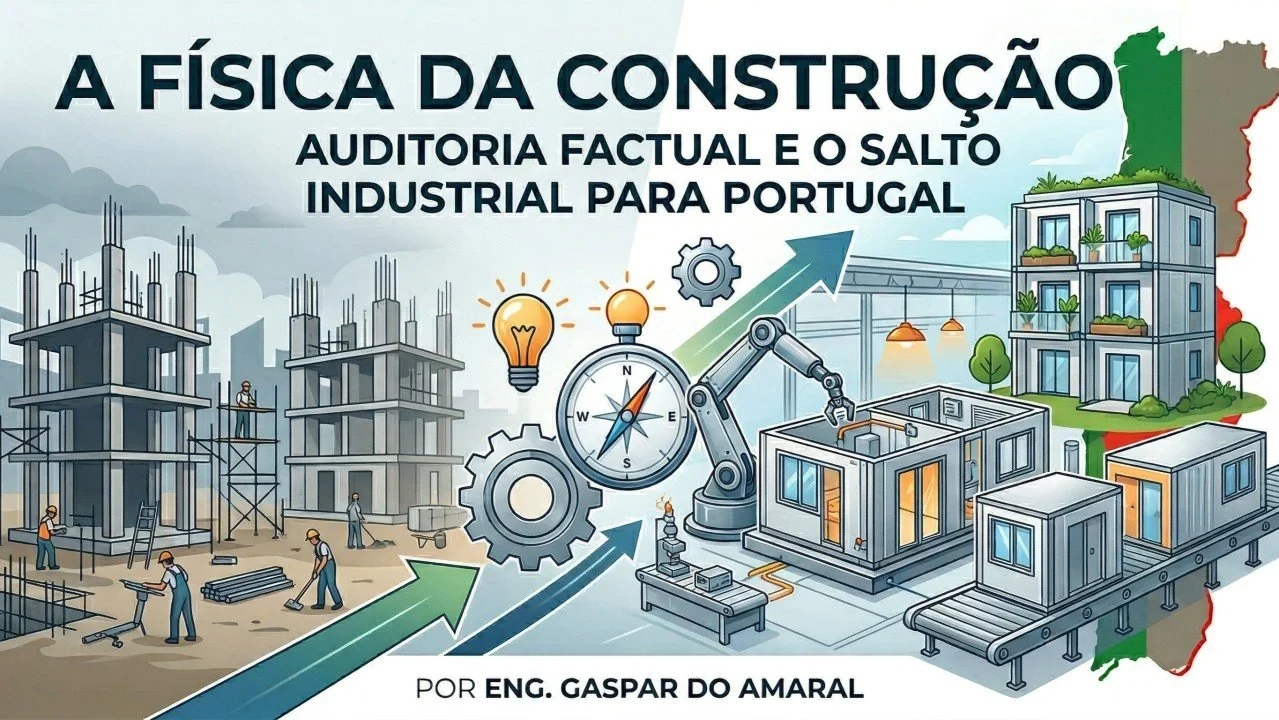
Changes of form, not of content. INE is Statistics Portugal. The titles of the Portuguese sources are translated, with the links of the original. The original cover illustration is reproduced with its Portuguese texts and a translated caption.
The discussion is on LinkedIn (in Portuguese)
Comments on this text are made on LinkedIn, where the article was shared in Portuguese. You are welcome to write in English. Agree, disagree or add data: every well-founded objection receives a reply.
Gaspar do Amaral · Original in Portuguese of 26 March 2026, published on this site; translation issued on 30 October 2026 · Figures and tables © Aprecisa.com · AI-assisted
How to cite: Gaspar do Amaral (2026). A Física da Construção: Auditoria Factual ao Imobiliário e o Salto Industrial para Portugal. Zenodo. https://doi.org/10.5281/zenodo.23814353 · Permanent archive on Zenodo.