 ← Grupo Aprecisa · Connecting those who know with those who need
Energy and the power system · Article published on LinkedIn on 26 May 2026
The War in Iran Proves This Illusion of the Energy Transition
From the consumer’s pocket to the physics of the grid
Gaspar do Amaral · 26 May 2026
Translated from the Portuguese original. This version was issued on 30 October 2026.
On this site, this article has been
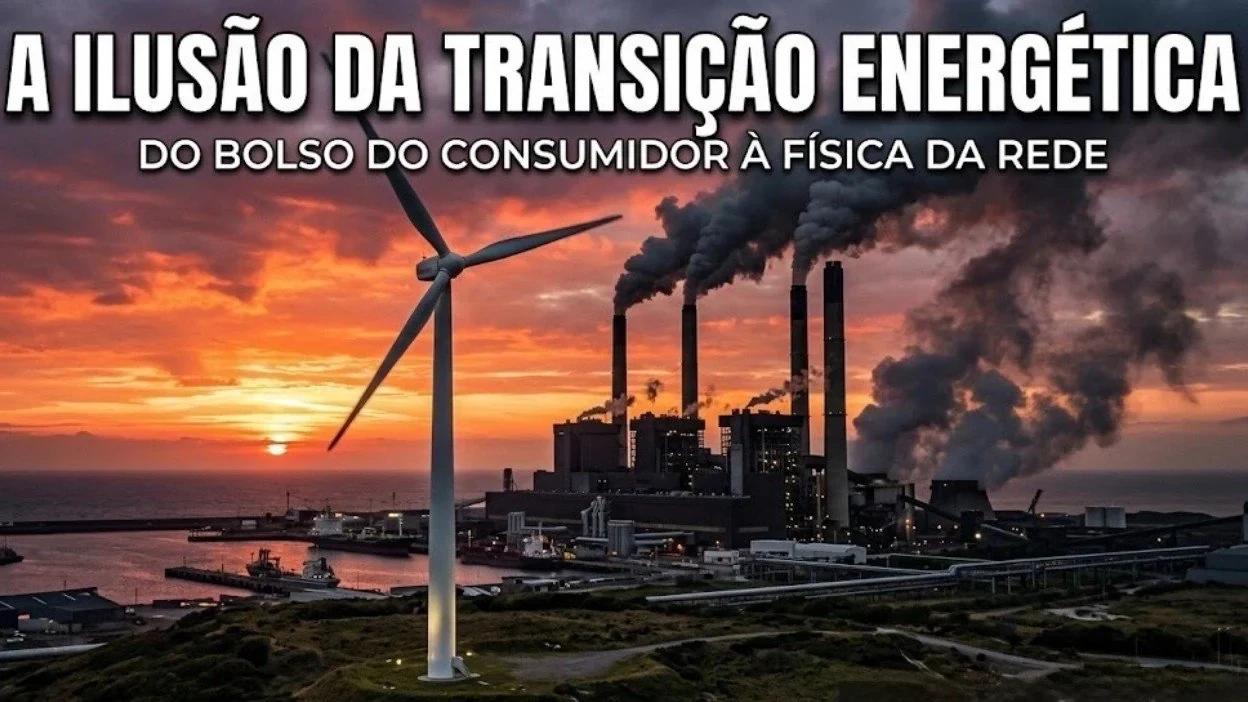
FROM THE CONSUMER’S POCKET TO THE PHYSICS OF THE GRID
Part I: The Fallacy Explained to the Citizen
1. The Common-Sense Test
If we were told that our energy is made from our sun and our wind, and that these sources are free, why does your electricity bill soar at the very moment a war breaks out in the Middle East?
The ordinary citizen’s answer is instinctive: something does not add up. This is the conclusive proof that the narrative of energy independence is a fallacy. If we were independent, the Strait of Hormuz would not dictate the price of electricity in Portugal.
2. The “Taxi at the Door” Metaphor, which explains the gas back-up
Imagine you are sold a very cheap solar car and promised that, from today, your journeys will be almost free. That is the political narrative in Portugal today.
But there is a problem they hid from you: that very cheap solar car only runs when the sun shines or the wind blows. Since we cannot risk being left in the dark or arriving late for work when it rains, the State obliges you to keep a motor Taxi parked at your front door, 24 hours a day, with the engine and the meter always running, ready to set off if your solar car fails. That Taxi is our natural gas power stations.
What happened with the war in Iran? The price of that Taxi’s fuel soared. The political illusion was to show you only the price of the solar car; the Abismo do Rigor (Abyss of Rigour) is the monstrous meter bill you must pay every month just to keep the Taxi waiting.
This image conveys exactly what “Total System Costs” and the socialisation of rents are.
3. The Butcher’s Rule: we pay beef prices for chicken
To make matters worse, our system works against common sense. Imagine you go to the butcher to buy 10 steaks. Nine are chicken (cheap, like renewables) and the last one is beef (very expensive, like natural gas). At the till, the current law obliges you to pay for all 10 steaks at the price of beef.
That is what happens on the electricity bill. It is enough for our system to need a little natural gas to stabilise the grid, and all the energy (including wind) is paid at the price of gold. The developers pocket the profits and all the risk is left to the citizen.
It is obvious to the citizen that the energy transition was an accounting illusion. We are not independent, and all the risk has been transferred to your wallet. The only solution is to oblige by law those who sold you the “solar car” to pay for the “meter” as well.
Part II: The Technical Dossier and the Solution
1. Executive Summary and Framework
The disruption of logistics chains resulting from acute geopolitical instability — such as the prospect of a choke on the Strait of Hormuz — is not merely a diplomatic event; it is the ultimate stress test of the architecture of global critical infrastructure. The economic vulnerability we are witnessing reveals the symptom of a structural problem: energy planning has been dictated by political economy and sectoral interests, neglecting the relentless laws of thermodynamics and electromagnetism.
This document proposes overcoming the Abismo do Rigor — the fatal gap between political propaganda and the mathematics of the system — through a regulatory framework grounded in Systems Engineering: the Integral Energy Accountability Act.
2. The End of the Accounting Illusion: The LCOE Fallacy
The current political-regulatory model has turned the energy transition into a cost-transfer mechanism, in which private developers capitalise on incomplete metrics. The main tool of this illusion is the Levelized Cost of Energy (LCOE), which assesses the cost of the panel or turbine in isolation, ignoring the systemic impact of intermittency.
Our “Matryoshka of Costs” is not merely a demand of local engineering; it is a methodological flaw widely denounced in the most rigorous academic circles worldwide. Feasibility assessment must, of necessity, move to Total System Costs, accounting for the reinforcement of transmission grids, back-up reserve and the loss of inertia.
3. The Abismo do Rigor and the Physics of the Grid (Synchronous Inertia at 50 Hz)
The electricity grid is not a financial balance sheet; it is a physical organism that must operate, in Europe, at a constant frequency of 50 Hz. Intermittent sources connect to the grid through asynchronous electronic inverters, which means they have no physical rotating mass (synchronous inertia) to absorb disturbances on the grid.
Ignoring this mechanical reality results in structural collapses, imposing desperate and costly recourse to thermal power stations (natural gas) at times of crisis, which drags a country’s economy into extreme dependence on fuels whose prices soar in the face of geopolitical shocks.
4. The Baseload Equation and System Requirements
Designing a resilient grid requires firm baseload generation capacity. Bringing nuclear technology into the energy debate obeys not a dogmatic defence, but a strict assessment of the functional requirements of the system.
If the mathematical modelling of the grid requires continuous generation combined with rotating mass for synchronous inertia — replacing natural gas and immunising the system against global logistical blockades — that is a non-negotiable finding of Physics, not a political preference.
5. Implementation: The Integral Energy Accountability Act
For technical rigour to be carried over into the market, economics must submit to science through regulation. We propose the creation of the Integral Energy Accountability Act, a mechanism that internalises all systemic costs.
Mechanism of Application: the injection of new intermittent capacity into the grid becomes conditional on subscribing to an “Adequacy Package”. For each megawatt (MW) installed, the developer will be financially responsible for the costs of the stability it does not provide (direct investment in synchronous condensers, grid batteries or funding of firm reserve capacity). This model is rooted in already validated mechanisms of Capacity Markets (Capacity Remuneration Mechanisms).
Direct Impact: by forcing the internalisation of these Total System Costs into the developer’s business architecture, the capture of rents based on public subsidies and the absence of risk is stopped. Speculative profit margins, which can be in the order of 40%, are technically and legally reduced to fair levels of 20% return. The remaining 20% is returned directly to its rightful owner — the final consumer — guaranteeing truly resilient infrastructure and lowering the final price of energy.
6. Conclusion
Auditing the financial past and tracing capital flows is a vital act of democratic hygiene, but pure accounting does not hold the grid frequency when the wind suddenly drops.
It is in the face of this limit that we apply the principle of Verticalidade (Verticality): the guarantee that a Nation’s critical infrastructure answers, before all else, to the relentless sovereignty of Physics. Financial rigour reveals the past to us; the rigour of Systems Engineering secures the operational future of the grid and the true sovereignty of the country.
Technical Annex: Proofs of Concept and Global Cross-References
For the purposes of technical audit and scientific validation of the Integral Energy Accountability Act and of the accounting of Total System Costs, the original transcriptions and documentary records of the global authorities underpinning the axes of this document are presented below:
1. On the LCOE Fallacy and the Omission of System Costs
The LCOE metric is scientifically considered inadequate for assessing intermittent energy, as validated by the Massachusetts Institute of Technology (MIT).
- Author/Institution: Professor Paul L. Joskow, MIT - Center for Energy and Environmental Policy Research.
- Document: Comparing the Costs of Intermittent and Dispatchable Electricity Generating Technologies (American Economic Review).
- Original transcription: “Using levelized costs to compare intermittent technologies with dispatchable technologies is fundamentally flawed. [...] The economic value of electricity supplied varies widely over time, and these metrics must reflect system integration costs and the differing value of output at different times.”
- Access: American Economic Association
2. On the Abismo do Rigor: The Loss of Synchronous Inertia at 50 Hz
The requirement for electromagnetic inertia (rotating mass) is not a political option but an imposition of Physics to avoid structural collapse, as the European grid operator attests.
- Author/Institution: ENTSO-E (European Network of Transmission System Operators for Electricity).
- Document: High Penetration of Power Electronic Interfaced Power Sources and the Potential Contribution of Grid Forming Converters.
- Original transcription: “The displacement of traditional synchronous generators by power electronic interfaced power sources reduces the total system inertia. This makes the system frequency more vulnerable to fast disturbances, increasing the rate of change of frequency (RoCoF) and the risk of cascading outages and system blackouts.”
- Access: ENTSO-E Publications
3. On the Requirement for Baseload and Technological Integration
Energy stability immune to geopolitical shocks requires continuous firm capacity, in which gas or nuclear meet the structural requirements of the grid, avoiding the hyperinflation of costs with extreme storage.
- Author/Institution: IEA (International Energy Agency).
- Document: Nuclear Power in a Clean Energy System.
- Original transcription: “A failure to invest in existing and new nuclear plants would have implications for emissions, costs and energy security. [...] Without nuclear power, the cost of achieving a sustainable energy system would be significantly higher, requiring extreme and costly levels of battery storage and transmission expansions.”
- Access: IEA Reports
4. Proof of Concept of Systemic Collapse (South Australia Blackout)
The empirical demonstration that omitting stability costs (synchronous inertia) results in the collapse of a sovereign infrastructure.
- Event: the blackout in the State of South Australia (September 2016).
- Technical record (AEMO): the system suffered a weather event, but the total collapse (System Black) occurred because the very high wind penetration, connected through asynchronous inverters, did not offer enough physical inertia to hold the abrupt change in grid frequency (RoCoF), triggering automatic protection mechanisms that disconnected the infrastructure. The event forced a regulatory review requiring synchronous inertia in planning.
- Access: AEMO - Australian Energy Market Operator
Methodological note
What this page is. An English translation of the article the author published on LinkedIn on 26 May 2026; the full Portuguese version is on this site. The article contains no calculations of its own; the margins of 40% and 20% are the author’s figures, as in the original.
Changes of form, not substance. In Part I of the original only the third section is numbered; here the three are numbered 1 to 3, and a stray closing quotation mark at the end of Part I has been removed. The English transcriptions in the annex are reproduced exactly as in the original; they have not been checked word for word against the documents cited. The tracking parameters LinkedIn added to the links have been removed; the addresses are otherwise those of the original. The author’s concepts (Abismo do Rigor, Verticalidade) keep their Portuguese names.
The discussion is on LinkedIn (in Portuguese)
Comments on this text are made on LinkedIn, where the article was shared in Portuguese. You are welcome to write in English. Agree, disagree or add data: every well-founded objection receives a reply.
Gaspar do Amaral · Original in Portuguese of 26 May 2026, published on this site; translation issued on 30 October 2026 · Figures and tables © Aprecisa.com · AI-assisted
How to cite: Gaspar do Amaral (2026). A Guerra no Irão prova esta ILUSÃO DA TRANSIÇÃO ENERGÉTICA. Zenodo. https://doi.org/10.5281/zenodo.23814388 · Permanent archive on Zenodo.