 ← Grupo Aprecisa · Connecting those who know with those who need
Energy and the power system · Article published on LinkedIn on 31 May 2026
The Illusion of Resilience and the Hidden Cost: The Omitted Side of the Iberian Blackout
The ERSE classifies the blackout as an exceptional event: the hidden cost that is left to consumers
Gaspar do Amaral · 31 May 2026
Translated from the Portuguese original. This version was issued on 27 October 2026.
On this site, this article has been
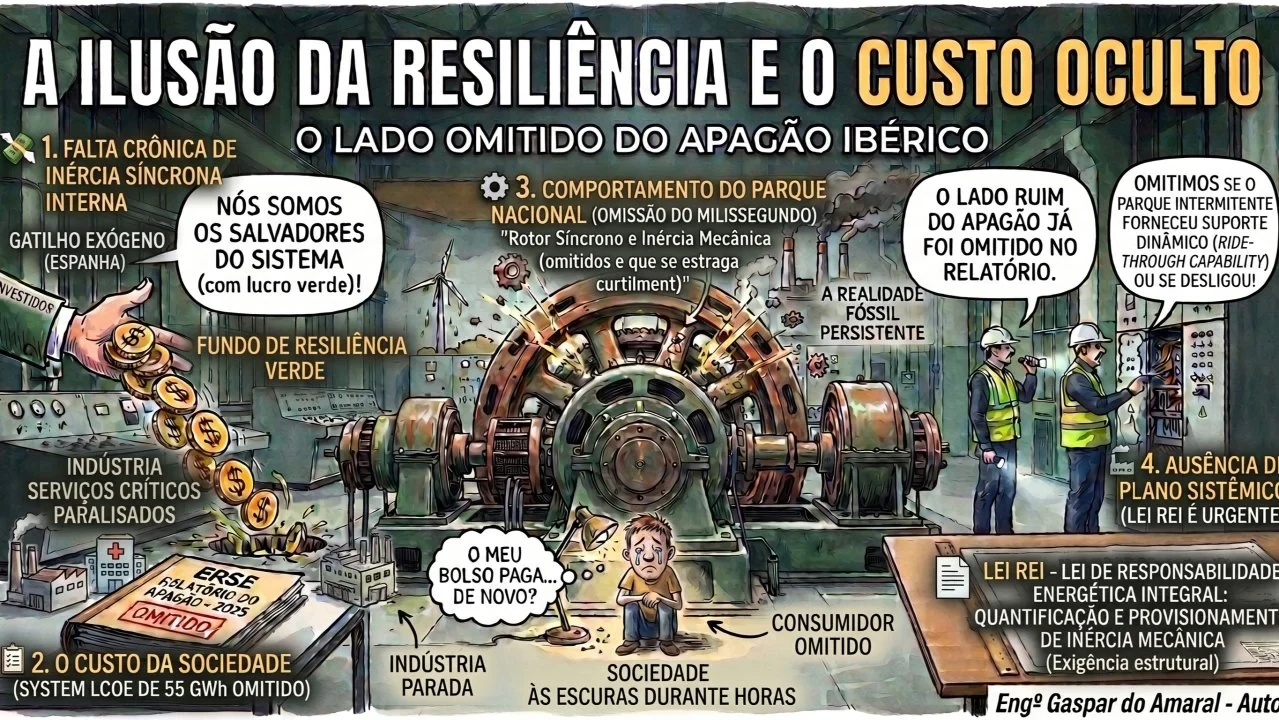
The Illusion of Resilience and the Hidden Cost: The Omitted Side of the Iberian Blackout
The recent decision of the Entidade Reguladora dos Serviços Energéticos (ERSE, Portugal’s energy services regulator), widely documented in the press (https://www.publico.pt/2026/05/27/economia/noticia/erse-classifica-apagao-iberico-evento-excepcional-compensacoes-automaticas-2176156), formally closes the legal chapter of the Iberian blackout of 28 April 2025. By classifying the occurrence as an “exceptional event”, the regulator exempts the operators (REN and E-Redes) from penalties and cancels the right to automatic compensation for the 6.4 million consumers affected, pushing the bill into the attrition of the courts.
To support this decision, the ERSE relied on an extensive documentary arsenal: the reports of ENTSO-E (which classified the event as the most serious of the last 20 years, with 55 GWh of energy not supplied), the technical opinion of the DGEG (Direção-Geral de Energia e Geologia, Portugal’s Directorate-General for Energy and Geology) and the internal operational audits. From an administrative and legal point of view, the file is impeccably closed.
However, systems engineering takes no comfort in regulatory shielding. When we analyse this outcome from the perspective of network physics and the integration of complex systems, it becomes evident that the ERSE decision exposes — but chooses to ignore — four critical structural failures of our energy model. This is the side of the coin that political voluntarism insists on hiding:
1. The Root Cause and Dynamic Fragility
The report confirms that the origin was exogenous (Spain) and resulted from “interconnected operation”. But what was the exact thermodynamic trigger? The decision masks our chronic lack of internal firmness and of synchronous inertia (the vital rotating mass). The frequency stability of the Portuguese grid lives on borrowed time, fully indexed to and dependent on the solidity of its neighbours. When the support fails on the other side of the border, our collapse is immediate.
2. The Behaviour of the National Fleet
How did our generating assets react in the millisecond of the disturbance? The energy transition demands rigorous integration, but the documents omit whether our installed intermittent capacity provided dynamic support (Ride-Through Capability) or whether, on the contrary, the power stations disconnected abruptly for their own protection, worsening the fall in frequency. The abismo do rigor (“abyss of rigour”) demands that we know what internal resilience we can really count on.
3. The Asymmetry of Cost (The Loss to the Real Economy)
The ERSE justifies the exceptional classification by arguing that “it is not economically reasonable to avoid all of the consequences”, since the investments would be borne by the tariffs. This is the central fallacy of current planning. The regulator protected the accounts of the electricity system, but ignored the cost imposed on society. Who bears the true cost (System LCOE) of the 55 GWh not supplied? What was the financial impact on industry brought to a standstill and on the disruption of critical services? The profits of theoretical efficiency are privatised and the loss from material fragility is nationalised.
4. The Absence of a Systemic Plan (Lei REI)
Classifying the collapse as “exceptional” is a legal palliative that does not add a single megawatt-hour of security to the system. Where is the structural plan to mitigate this dependence? It is urgent to implement a true Lei de Responsabilidade Energética Integral (Lei REI) (Law of Integral Energy Responsibility) that requires the quantification and internal provisioning of the mechanical inertia needed for us to survive the next shock.
Anticipating the Institutional Narrative
It is to be expected that the defence of this market design will rest on three justifications that should, right now, be dismantled with the rigour of engineering:
Economic fallacy (“Redundancy is too expensive for the tariff”): the opposition between tariff cost and grid security is false. What is saved on the tariff by importing stability is paid back with interest when disruption comes. The Lei REI is not meant to make energy more expensive, but to internalise the risk and provision the stability that is needed, avoiding throwing the real loss into the courts.
Technological fallacy (“Mechanical inertia belongs to the fossil past; the future is batteries and inverters”): physics has no ideology. Advanced inverters are tools for rapid mitigation, but they do not replace the real physical inertia required to absorb the initial shock. Without rotating mass at the critical moment, the frequency collapses before the software can act.
Regulatory fallacy (“The ERSE merely complied with the Regulation”): the question is not whether the regulation was complied with, but whether this ERSE regulation complies with the laws of physics. Validating the collapse administratively is falling into a true abyss of rigour. A regulation that classifies a failure of structural architecture as an “exceptional event” is an obsolete document that protects the operator and leaves the country unprotected.
Experience dictates to me an unbreakable law: physics imposes boundaries that economics cannot repeal. Resilience is built with redundancy and scientific rigour, not with decrees of exceptionality.
Gaspar do Amaral
Methodological note
What this page is. A translation of the article the author published on LinkedIn on 31 May 2026; the full Portuguese version is on this site.
Names and concepts. Portuguese bodies are named in Portuguese with an explanation in brackets: ERSE (Entidade Reguladora dos Serviços Energéticos, the energy services regulator), DGEG (Direção-Geral de Energia e Geologia), REN (the transmission system operator) and E-Redes (the distribution system operator). ENTSO-E is the European Network of Transmission System Operators for Electricity. The author’s own concepts keep their Portuguese name, with a translation in brackets: abismo do rigor (“abyss of rigour”) and Lei REI (Law of Integral Energy Responsibility). The quotation from the ERSE is translated from the Portuguese.
Changes of form, not of content. The decorative symbols (emoji) of the LinkedIn version were left out. The first paragraph, which LinkedIn had split into three around the link to the press article, appears as a single paragraph. The section titles, which in the original are bold text at the start of the paragraph, appear as headings. The original illustration is reproduced with its texts in Portuguese and a translated caption. The link to the source is that of the original.
The discussion is on LinkedIn (in Portuguese)
Comments on this text are made on LinkedIn, where the article was shared in Portuguese. You are welcome to write in English. Agree, disagree or add data: every well-founded objection receives a reply.
Gaspar do Amaral · Original in Portuguese of 31 May 2026, published on this site; translation issued on 27 October 2026 · Figures and tables © Aprecisa.com · AI-assisted