 ← Grupo Aprecisa · Connecting those who know with those who need
Energy and the power system · Article published on LinkedIn on 1 April 2026
Systemic Integrity: An Architecture of Responsibility and Energy Sovereignty
From managing flows to managing integrity: an architecture for a power system that does not lose its ballast
Gaspar do Amaral · 1 April 2026
Translated from the Portuguese original. This version was issued on 30 October 2026.
On this site, this article has been
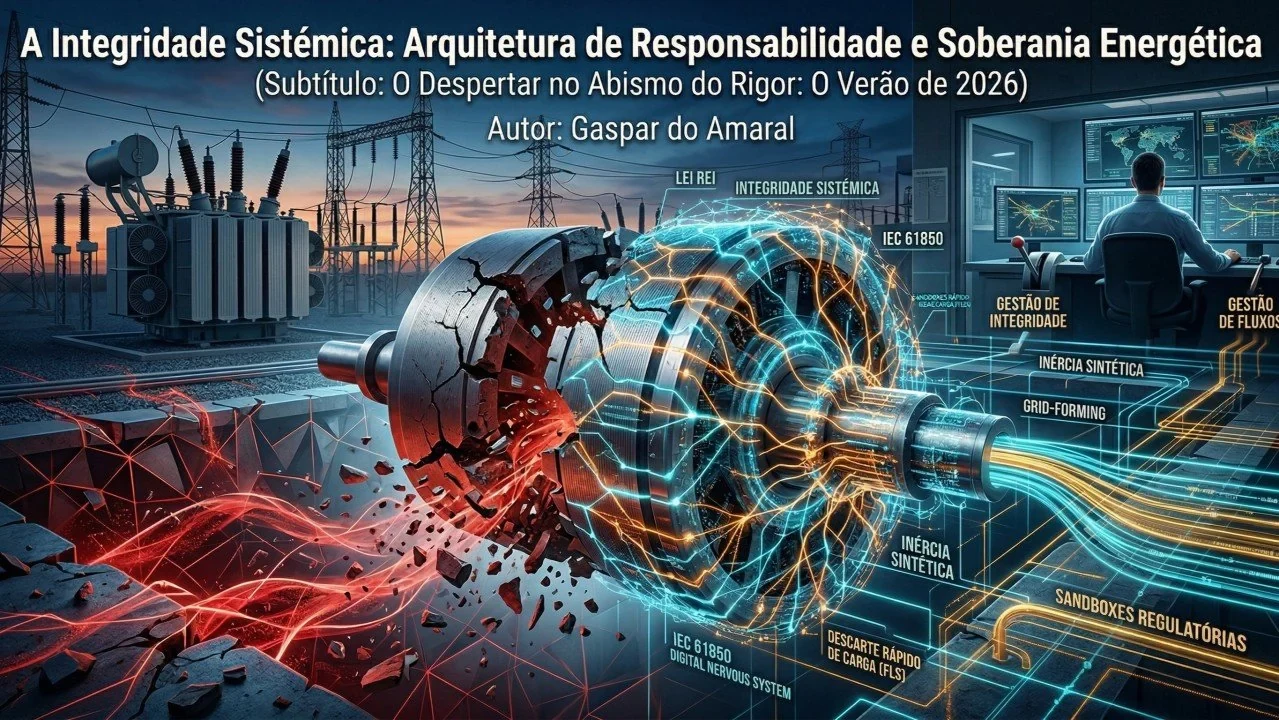
The Awakening at the Abismo do Rigor: The Summer of 2026
The energy transition is heading for an “Abismo do Rigor” (Abyss of Rigour). The power system — humanity’s most complex machine (Gretchen Bakke) — is losing its physical “ballast”. The 2026 Trigger: the risk of a systemic blackout in 2026 is not an abstraction; it is the critical point at which the withdrawal of conventional plants (rotating mass) and the massive entry of renewables reach an instability threshold. Without inertia, any small local fault propagates at the speed of light, collapsing the grid before current systems can react. We propose the transition from “Flow Management” to “Integrity Management”.
1. The Energy Metabolism: Beyond the Cheap Electron
To understand the grid, we must see it as a country’s metabolism. The solar electron may be “cheap” at source, but if the body (the grid) cannot “digest” it stably, it becomes toxic. As Steve Keen and Robert Ayres show, wealth depends on useful exergy (firm energy), not on chaotic flows.
- Action (System LCOE): Portugal should adopt the System LCOE metric (Paul L. Joskow and Ueckerdt). The €1,691.5 million planned in REN’s PDIRT-E 2024 (the national transmission grid development plan) is the vital investment in the system’s “support organs” (Dieter Helm).
- Case Study: the Stability Pathfinder (United Kingdom) shows that paying for the grid’s “firmness” is cheaper than paying for the consequences of a blackout.
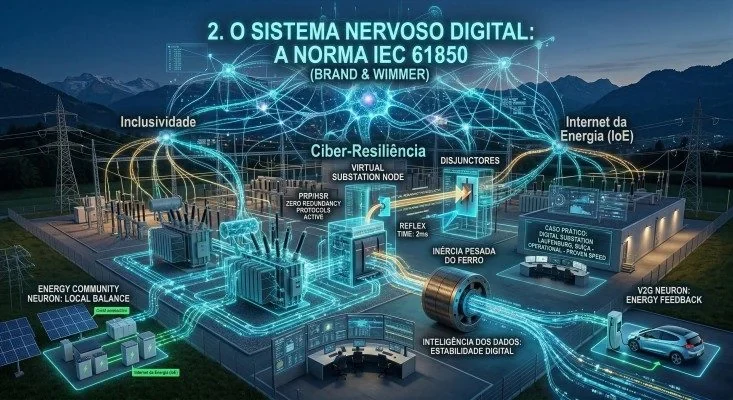
2. The Digital Nervous System: The IEC 61850 Standard
If the grid is the body, the IEC 61850 standard (Brand & Wimmer) is its nervous system. Stability can no longer depend on the heavy inertia of iron; it must depend on the intelligence of data.
- Action (Cyber-Resilience): implement substation virtualisation with zero-recovery-time redundancy protocols (PRP/HSR, by Hubert Kirrmann). This lets the grid have “reflexes” in milliseconds (Dominique Verhulst).
- Inclusiveness: through the Internet of Energy (IoE) (Narottam Das and Taha Selim Ustun), energy communities and Vehicle-to-Grid stop being “consumers” and become “neurons” that help balance the system.
- Case Study: the Laufenburg Digital Substation (Switzerland) proves that the speed of information is the best shield against physical collapse.
3. The Lei REI: The End of the “Anatomy of Parcelling”
To avoid the collapse through complexity described by Joseph Tainter, the Integral Energy Responsibility Act (initial proposal for the Lei REI) introduces the Principle of Topological Aggregation.
- Action (Transparency): use the RCBE (Central Register of Beneficial Owners) to audit the fragmentation of projects aimed at bypassing Environmental Impact Assessments (EIA), a practice denounced by Nunes and Canas (CCDR Algarve).
- Social Justice: the Lei REI ensures that intermittency costs are not pushed onto household consumers (Severin Borenstein) but are instead managed by a Stability Market in which those who invest in support technology (Grid-Forming) are rewarded.
- Case Study: Denmark’s Energy Islands show how integrated planning protects the public interest against regulatory entropy.
Note: for a deeper understanding of the transition from the fragmented model to a holistic view of infrastructure, see the article The Abyss of Rigour III: The Parcelling of the System and the Illusion of “Flexibility”. In it I propose the Principle of Topological Aggregation as the antidote to Joseph Tainter’s collapse through complexity, arguing that transparency through the RCBE and social justice in the Stability Market are the only paths to protect consumers and guarantee the energy system’s resilience against regulatory entropy.
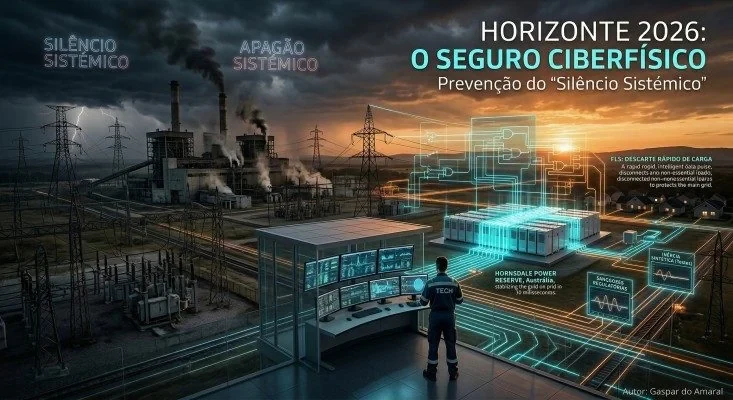
4. Horizon 2026: Cyber-Physical Insurance
Preventing “systemic silence” (Jean-Marc Jancovici and Thomas Homer-Dixon) requires active defence tools.
- Action (Active Defence): implement Fast Load Shedding (FLS) systems (Aurangzeb and Hossenlopp) and create SandBoxes to test synthetic inertia. It is the correction needed to avoid new extra costs running into billions (João de Jesus Ferreira/SEDES and Jorge Vasconcelos/FFMS).
- Case Study: the Hornsdale Power Reserve (Australia) uses batteries to “hold” the grid within milliseconds. It is not just a battery; it is an algorithm of sovereignty.
Conclusion: Leadership through Integrity
The energy transition will only triumph when physics guides economics. The Lei REI, supported by IEC 61850, is the mechanism that ensures Portugal will have not only the greenest energy, but the most resilient in the world. Raising the grid to the status of Critical Sovereignty Infrastructure is the only way to ensure that responsibility becomes the pillar of our future freedom and prosperity (Vaclav Smil).
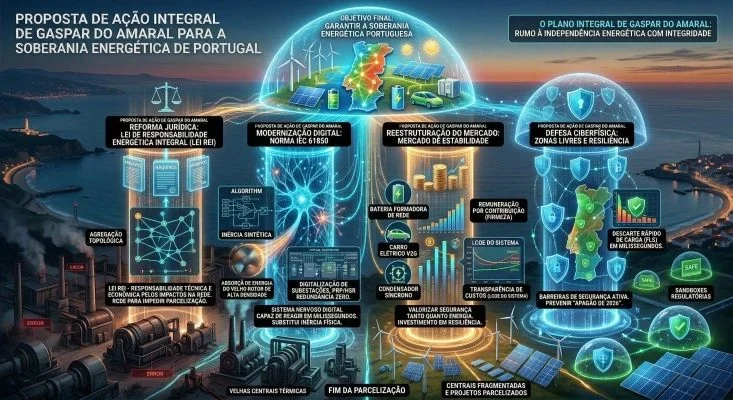
Gaspar do Amaral’s Proposal for Action
1. Legal Reform: Integral Energy Responsibility Act (Lei REI)
Proposes a new legal framework that obliges developers to take technical and economic responsibility for their impacts on the grid.
- End of Parcelling: use the RCBE to prevent large plants from being sliced into small projects to escape grid costs and environmental assessments.
- Topological Aggregation: require planning to be done for the integrity of the grid node rather than project by project.
2. Digital Modernisation: The IEC 61850 Standard
Turn the passive infrastructure into a “Digital Nervous System” able to react in milliseconds to the loss of physical inertia (a situation to which REN has so far provided no answer).
- Substation Digitalisation: implement mission-critical protocols (PRP/HSR) to guarantee zero-recovery-time redundancy and ultra-fast communications.
- Synthetic Inertia: replace the “ballast” of the rotating masses of old plants with digital control algorithms that stabilise grid frequency.
3. Market Restructuring: A Stability Market
Change the remuneration model so that system security is valued as much as the energy produced.
- Remuneration by Contribution: create a market in which assets such as grid-forming batteries, synchronous condensers and V2G (Vehicle-to-Grid) are paid to provide stability.
- Cost Transparency (System LCOE): reveal the real cost of intermittency in tariffs, encouraging investment where the grid is most resilient.
4. Cyber-Physical Defence: Free Zones and Resilience
Implement active security barriers to prevent the “2026 Blackout”.
- Fast Load Shedding (FLS): install automatic systems that isolate faults within milliseconds to protect industry and household consumption.
- Regulatory SandBoxes: create real test zones for new stabilisation technologies before their large-scale deployment.
Final Objective: guarantee Energy Sovereignty, ensuring that the transition to renewables does not sacrifice the reliability and integrity of the national economy.
References
- Gaspar do Amaral (O Abismo do Rigor): technical integrity and the Lei REI.
- Vaclav Smil (Energy and Civilization): energy density and GDP.
- Dieter Helm (Net Zero): infrastructure costs.
- Paul L. Joskow (System LCOE): integration economics.
- Klaus-Peter Brand & Wolfgang Wimmer (IEC 61850): digital automation.
- Ueckerdt et al. (System LCOE Math): proof of the LCOE fallacy.
- Aurangzeb & Hossenlopp (Fast Load Shedding): defence against blackouts.
- Narottam Das (Internet of Energy): DER interoperability.
- Taha Selim Ustun (V2G Validation): stability through electric vehicles.
- Nunes & Canas (CCDR Algarve): denunciation of parcelling.
- Gretchen Bakke (The Grid): grid vulnerability.
- Jean-Marc Jancovici (The Shift Project): energy and physical economics.
- Steve Keen (The New Economics): economic thermodynamics.
- Joseph Tainter (Collapse of Societies): systemic complexity.
- Georgescu-Roegen (The Entropy Law): energy degradation.
- Hubert Kirrmann (PRP/HSR): data resilience.
- Jorge Vasconcelos (Fundação FFMS): regulatory critique.
- João de Jesus Ferreira (SEDES): quantification of extra costs.
- Severin Borenstein (UC Berkeley): tariff fairness.
- Peter Cramton (Capacity Markets): remuneration of firmness.
- Robert Ayres (Exergy and Wealth): energy quality.
- Thomas Homer-Dixon (The Carbon Shift): paradigm rupture.
- Dominique Verhulst (Nokia): mission-critical telecommunications.
Methodological note
What this page is. An English translation of the article the author published on LinkedIn on 1 April 2026; the full Portuguese version is on this site. The article contains no calculations of its own; the only figure (€1,691.5 million in the PDIRT-E 2024) is the one in the original, with the original link.
Changes of form, not substance. The original numbers its figures 2 to 4, with no description; here each one has a translated caption. The redundancy protocols PRP/HSR (IEC 62439-3) are described as “zero-recovery-time”, which is what the original’s “redundância zero” means. REN is the Portuguese transmission system operator; RCBE is the Portuguese register of beneficial owners. The author’s concepts keep their Portuguese names. The links to other articles by the author point to their English versions; the links to sources are those of the original.
The discussion is on LinkedIn (in Portuguese)
Comments on this text are made on LinkedIn, where the article was shared in Portuguese. You are welcome to write in English. Agree, disagree or add data: every well-founded objection receives a reply.
Gaspar do Amaral · Original in Portuguese of 1 April 2026, published on this site; translation issued on 30 October 2026 · Figures and tables © Aprecisa.com · AI-assisted
How to cite: Gaspar do Amaral (2026). A Integridade Sistémica: Arquitetura de Responsabilidade e Soberania Energética. Zenodo. https://doi.org/10.5281/zenodo.23814357 · Permanent archive on Zenodo.