 ← Grupo Aprecisa · Connecting those who know with those who need
State, public works and governance · Article published on LinkedIn on 20 March 2026
The New Santa Engrácia Works: State Engineering and the Illusion of Paper
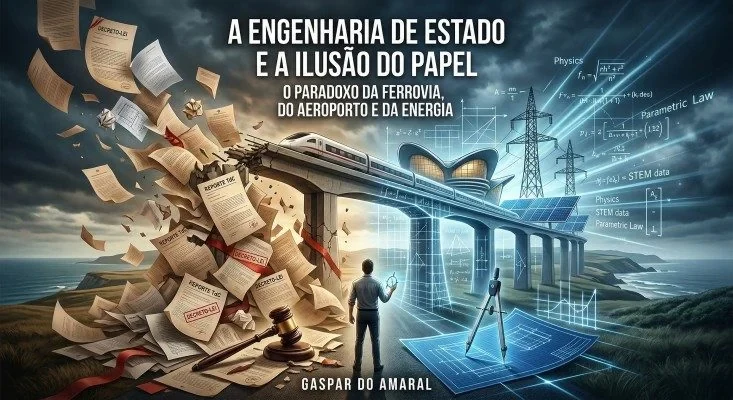
Why great public works drag on: when the politician becomes technical and the technician becomes political, nobody answers for the physics
Gaspar do Amaral · 20 March 2026
Translated from the Portuguese original. This version was issued on 30 October 2026.
On this site, this article has been

The empirical observation that, in Portugal, “the politician becomes technical and the technician becomes political” is the exact description of the bureaucratic dystopia in which the State operates. When public debate focuses on the decades of delay in the New Lisbon Airport, the stagnation of railway modernisation or the chronic deficit of the Electricity System, the target of criticism should not be the alleged lack of competence of Portuguese engineering. What is at stake is the financial and temporal cost of trying to bend the laws of nature and physics to the convenience of the political calendar.
To understand the vacuum of accountability in the country’s great infrastructure, it is imperative to analyse the dilution of spheres and the price the State pays for removing engineering from the leadership of technical decision [1].
The Dilution of Responsibility and the Confusion of Spheres
When the political or administrative decision-maker faces the technical complexity of a great infrastructure, his reaction of institutional survival is not the organic validation of the project, but the politicisation of the physical variable.
This mechanism serves to mask technical insecurity. By politicising physics, the decision-maker drags the problem onto his comfort ground: rhetoric, the study commission and the legal sub-paragraph. The result is the perfect bureaucratic storm: the engineer cannot take final responsibility because the administrative structure blocks the technical side; and the decision-maker does not take political responsibility because he fears signing the authorisation for infrastructure governed by a physics he does not master.
The National Scale of the Paradox
The Railway, the New Airport and the Electricity System are the national monuments to our “Administrative Tower of Babel”, the new Obras de Santa Engrácia (in Portugal, a byword for works that never end, after the Lisbon church that took nearly three centuries to complete). But in these new Santa Engrácia works the deadlock does not result from insoluble engineering doubts, but from the attempt to debate soil mechanics, dynamic friction and thermodynamics in party plenaries, instead of treating them as non-negotiable mathematical limits.
For decades, nature and geography have been forced to fit the convenience of politics. As detailed in the Annexes to this document — and unequivocally proven by successive audits of the Court of Auditors (TdC) —, the separation between technical leadership and political decision has produced schedule overruns of more than 50 years and financial holes in the order of billions of euros [2][3][4].
The Documentary Proof: The Court of Auditors’ Diagnosis
The systemic failure of government planning is not a theoretical assumption; it is a reality that has been invoiced. The Court of Auditors’ reports are the documentary proof that the State fails because it replaces engineering leadership with political rhetoric:
- Public works and airports: the TdC proved it to be “widespread practice for there to be marked financial overruns (between 25% and 295%) and time overruns (between 1.4 and 4.6 years)” [2]. The cause identified is moving to the award of works on the basis of mere “preliminary studies”, forced by the political calendar, before engineering has closed the definitive structural calculations.
- The Railway: the audit of the Ferrovia 2020 Programme attested that “the initial planning and the adjusted forecast (…) proved unrealistic in the face of their actual execution” [3]. The unrealism was born of drawing up targets in offices, ignoring geological time and the material slowness of civil engineering on the ground.
- The Electricity System: the legislator tried to keep the tariff artificially low and to subsidise million-euro rents (CMEC), ignoring the real physical cost of thermodynamics. The discrepancy between the decreed cost and the physics of production produced the historic Tariff Deficit [4].
The Way to the Solution: The Decision Triad and Parametric Law
Correcting this course requires restoring the inalienable boundary between what belongs to Physics (material reality) and what belongs to the State (administrative decision). For governance to recover its effectiveness, the adoption of Parametric Law is imperative: the laws of engineering are not suggestions or management options; they are binding, non-negotiable parameters that precede and limit any political debate.
The solution requires the creation of “Security to Decide”, put into practice through a chain of distinct and complementary authorities:
1. The Engineer: Technical Authority (the Axiom)
Holds custody of the Material Truth. His role is to deliver the unassailable reality — the Mathematics, the Physics and the Geometry of the project. The Engineer embodies Technical Authority, defining the physical limits of the “possible”. Without his parametric validation, the process should not even begin legally.
2. The Decision-Maker (Civil Servant): Functional Authority (the Bridge)
As guarantor of the continuity of the State, the career civil servant holds Functional Authority. It is he who translates the technical parameters into administrative feasibility. He acts as the balance between the Engineer’s technical requirements and the strategic vision of Political Power, ensuring that execution does not stray from physical reality for the sake of management convenience.
3. The Political Decision-Maker: Hierarchical Authority (Sovereignty)
Holds Hierarchical Authority and the legitimacy of choice. His role is not to discuss soil mechanics or thermodynamics, but to decide on timeliness and strategic priority, receiving the technical solutions in shielded form. By respecting Technical Authority, the politician gains the security needed to decide without fear of physical failure, taking active responsibility for the strategic “Yes” or “No”.
4. The Jurist: The Normative Architect (the Paper Shield)
The Jurist acts as the “Official Scribe of the Real”. His authority is strictly Normative and Formal: he translates technical reality and political decision into legal norm, creating the “paper shield” that protects the public interest and the agents involved.
Note: the Jurist has no authority to replace the Engineer in technical definition, nor the Politician in strategic choice. Holding “the pen” does not give him the right to change physical parameters; his role is to ensure that the law serves reality, not that reality be forced to fit a blind bureaucratic interpretation.
Summary of the structure of the decision team
- Engineer: says what IS (Physics).
- Political Decision-Maker: says what IS DONE (Strategy).
- Civil Servant: says how it is CARRIED OUT (Operation).
- Jurist: says how it is SHIELDED (Form).
This division prevents the “logical blackout” from setting in, because it prevents any of these spheres from trying to revoke the competences of the others, ensuring that the State operates as an integrated high-reliability system.
References and Grounding
The need to reintroduce technical expertise into governance is defended by the greatest minds in engineering and management worldwide. The diagnosis of the “logical blackout” rests on the following academic and institutional evidence:
- [1] Bent Flyvbjerg (2023). How Big Things Get Done. Oxford’s world expert on megaprojects shows, with global data, that great infrastructure fails chronically because of “political optimism bias”. Politics rushes planning and throws the works onto the ground before engineering has closed the physical reality (“think slow, act fast”). Lack of initial rigour is the main cause of overruns.
- [2] Tribunal de Contas (2009). Relatório n.º 17/2009 - Auditoria Temática à Gestão de Empreendimentos de Obras Públicas (thematic audit of the management of public works projects). Open the document (PDF)
- [3] Tribunal de Contas (2025). Relatório n.º 11/2025 - Auditoria à execução do Programa Ferrovia 2020 (audit of the execution of the Ferrovia 2020 Programme). Open the document (PDF)
- [4] Tribunal de Contas (2015). Relatório n.º 14/2015 - Auditoria aos Custos de Interesse Económico Geral e Sistema Elétrico Nacional (audit of the Costs of General Economic Interest and the National Electricity System). (See also the annual Opinions on the General State Account.)
- [5] Mariana Mazzucato (2013). The Entrepreneurial State. The UCL economist argues that the modern State has lost its capacity to execute by stripping itself of technical knowledge. A strong State needs to retain scientific and engineering literacy “in house” to govern technological risk.
- [6] Takahiro Fujimoto (1999). The Evolution of a Manufacturing System at Toyota. An exploration of the concept of Monozukuri. Management has to be “technically informed”. The decision-maker cannot manage processes on paper alone; he must deeply understand the physical nature (“Gemba”) of what he is regulating.
- [7] Lee Kuan Yew (2000). From Third World to First: The Singapore Story. Recounts the Asian infrastructural success based on technocratic governance, in which planning was led by engineering (STEM) criteria, subordinating political convenience to material reality.
- [8] Tribunal de Contas (2023). Relatório n.º 6/2023 - Auditoria de Seguimento aos Empreendimentos de Obras Públicas (follow-up audit of public works projects). Open the document (PDF)
Annexes: The Bureaucratic Autopsy

Annex A: The Airport (57 Years of the Illusion of Paper)
- Chronology: the New Lisbon Airport process formally began in 1969. For more than five decades the airport floated politically between Rio Frio, Ota, Alcochete and Montijo. In 2026, with the Alcochete location confirmed, the first runway is still planned for the next decade. The country spent almost 60 years debating soil mechanics in Parliament instead of applying it on the ground.
- The TdC proof: the Court of Auditors, in its Report no. 17/2009 [2] (followed up in Report no. 6/2023 [8]), dissected the way the State approves budgets based on paper without validated ground geometry. It concluded that there were widespread overruns in costs (up to 295%) and schedules, caused by awards based on deficient “preliminary studies”.
Annex B: The Railway (Unrealistic Planning)
- Chronology: high speed dominated the debate in the 1990s and 2000s. The contracts signed were cancelled in 2011, proving that paper always yields to financial mathematics. The ambitious Ferrovia 2020 programme, launched in 2016 for the conventional network, sank into chronic delays in which bureaucracy outweighed the laying of rails.
- The TdC proof: in the audit set out in Report no. 11/2025 [3], the TdC attested that “the initial planning and the adjusted forecast of the Ferrovia 2020 Programme proved unrealistic in the face of their actual execution”. The targets were drawn up in an office, ignoring geological time and the technical complexity on the ground.
Annex C: The National Electricity System (Legislating against Thermodynamics)
- Chronology: the politicisation of the cost of energy crystallised in the 2000s. Politics “decreed” ceilings on consumer tariffs while guaranteeing rents to generation, ignoring the real thermodynamic and infrastructural cost, culminating in a historic “Tariff Deficit”.
- The TdC proof: through Report no. 14/2015 [4] (and successive Opinions on the General State Account), the TdC scrutinised how the costs passed on were aggravated by political decisions (such as the CMEC and the CIEG) that disconnected the cost paid from the true physical cost. When the State tried to master energy reality by administrative means, mathematics presented the bill to the nation.
About the Author
Gaspar do Amaral is an Electrical and Computer Engineer from Instituto Superior Técnico, with roots in Guimarães — the cradle of Portuguese nationhood — and currently living in Dili, Timor-Leste, where about 40% of the population is under 20. With a path forged in military service, from recruit to the rank of Lieutenant-Colonel of Signals, and in the technical leadership he continues to exercise, he is a member of the Portuguese Association of Electrical Engineers (EEP), focusing on its international representation through technological vanguard. He is the mentor of “Security to decide, in the Lusophone world”, with the vision of an architecture of Authentic Generative Intelligence, native in the Portuguese language, to restore and preserve knowledge in Portuguese. He is dedicated to the mission of “connecting those in need with those who know”, defending the primacy of technical evidence over bureaucratic opacity.
Methodological note
What this page is. An English translation of the article the author published on LinkedIn on 20 March 2026; the full Portuguese version is on this site. The article contains no calculations of its own; the figures (overruns of 25% to 295% and of 1.4 to 4.6 years, 1969, 2011, 2016, about 40% of the population under 20) are those of the original, and the quotations from the Court of Auditors are translated from Portuguese.
Changes of form, not substance. The original has no link for Ref. [4]; none has been added. The tracking parameters LinkedIn added to the link to the author’s post on the “logical blackout” have been removed. TdC is the Portuguese Court of Auditors; CMEC (costs for the maintenance of contractual balance) and CIEG (costs of general economic interest) are charges of the Portuguese electricity system.
The discussion is on LinkedIn (in Portuguese)
Comments on this text are made on LinkedIn, where the article was shared in Portuguese. You are welcome to write in English. Agree, disagree or add data: every well-founded objection receives a reply.
Gaspar do Amaral · Original in Portuguese of 20 March 2026, published on this site; translation issued on 30 October 2026 · Figures and tables © Aprecisa.com · AI-assisted
How to cite: Gaspar do Amaral (2026). As Novas Obras de Santa Engrácia: A Engenharia de Estado e a Ilusão do Papel. Zenodo. https://doi.org/10.5281/zenodo.23814343 · Permanent archive on Zenodo.