 ← Grupo Aprecisa · Connecting those who know with those who need
Resilience · Newsletter “A Porta Estreita” (The Narrow Door)
The waves around the world and your plan
Supplement to episode 3 — the maps of the waves, the four continents, the other stones and the wave clock, with the sheet to fill in
Gaspar do Amaral · 19 October 2026
Translated from the Portuguese original. This version was issued on 27 October 2026.
On this site, this article has been
Gaspar do Amaral · 19 October 2026 · Day 233 · Series “A Porta Estreita” (The Narrow Door), supplement to episode 3
Supplement to episode 3 of “A Porta Estreita”, “Dia 228: O efeito dominó” (Day 228: The domino effect). It brings together, in a single document, what did not fit in the article: in part A, the waves moving across the map; in part B, where they come in on each continent and what they lead to at the limit; in part C, what to do, with a sheet to print.
Part A — The pool at four moments
A1. How to read these maps
Each domino piece that falls sets off a wave. The domino gives the order: first energy, then transport and fertiliser, then the harvest, and finally food. The waves tell when and where each piece reaches each country.
In the top corner, the domino shows the pieces that have already fallen. At the bottom, the ruler shows the day of each wave and where we are. In each region, the little icons are those of the waves that have already arrived there: the oil drop is the 1st wave, energy stuck; the ship is the 2nd, dearer transport and fertilisers; the fertiliser sack is the 3rd, farmers cutting back on fertiliser; the ears of wheat are the 4th, smaller harvests; the shopping trolley is the 5th, dearer food.
The blue circles start from Hormuz and show only the idea of spreading: they carry no number and do not measure distances. The purple and brown circles, from the summer onwards, are other stones in the same pool: the Black Sea and the Saudi pipeline.
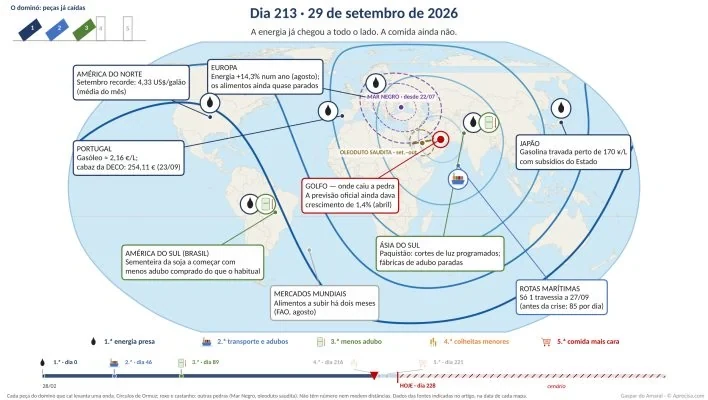
Look at the icons: almost all of them are oil drops, the 1st wave. Only Brazil and South Asia show the fertiliser sack of the 3rd wave, the one of farmers cutting back on fertiliser, and the world markets are still grey. In the Gulf, the official forecast still showed growth.
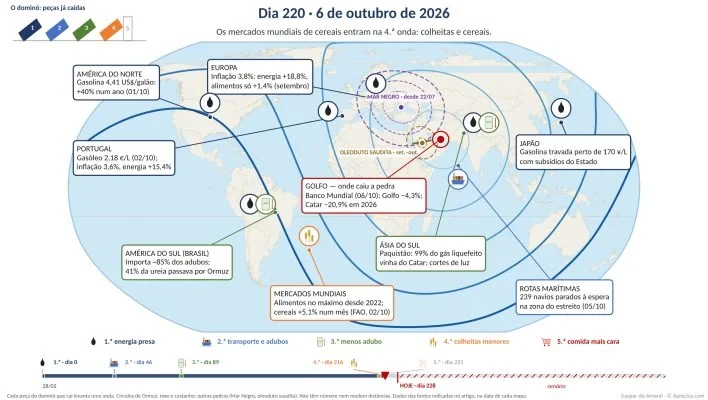
Within a week, the ears of wheat of the 4th wave appear on the world markets: the FAO announced food prices at their highest since 2022. And the Gulf goes from forecast growth to recession: minus 4.3%.
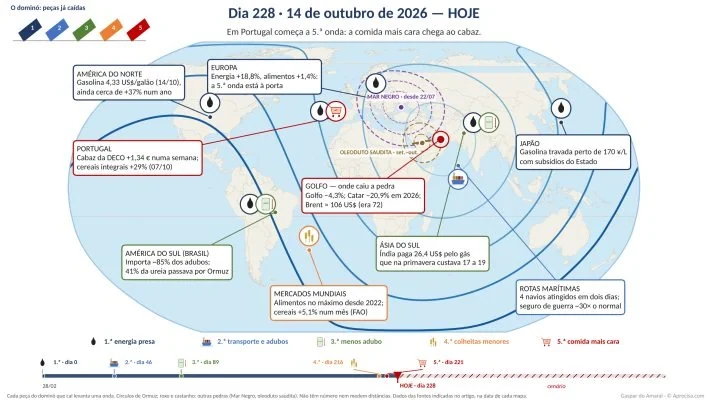
What is new is the shopping trolley in Portugal: it is the 5th wave reaching the shopping basket. In Europe, energy is already 18.8% dearer, but food is still rising by only 1.4%: the European trolley has not appeared yet.
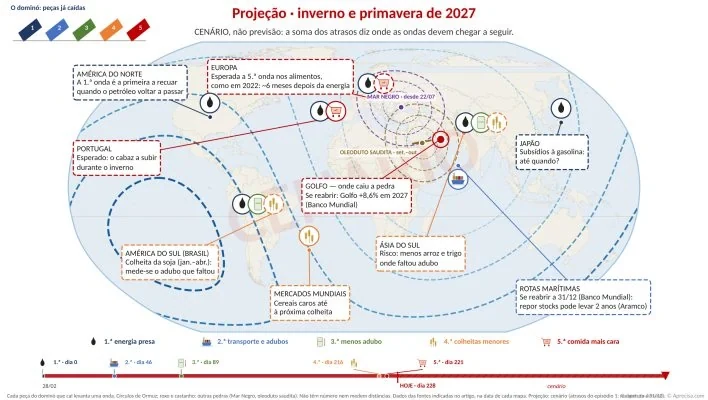
The dashed outlines mark what has not happened yet. If the delays repeat as in 2022, the 5th wave, the one of dearer food, reaches Europe during the winter; the soya harvest in Brazil, between January and April, shows the fertiliser that was missing; and in South Asia the risk is less rice and wheat. Even with the door reopening, the queue takes time to clear.
A2. What changed in two weeks
- Day 213: almost nothing but oil drops. Energy had already reached everywhere; food had not yet.
- Day 220: the ears of wheat of the 4th wave appear on the world cereal markets, and the Gulf goes from forecast growth to recession.
- Day 228: the shopping trolley appears in Portugal: the 5th wave, the one of dearer food, reaches the shopping basket.
- Winter, as a scenario: the trolley should appear across Europe, and the ears of wheat in Brazil, when the soya sown with less fertiliser is harvested.
See the waves moving: the videos “A pedra caiu em Ormuz” (The stone fell in Hormuz), with the music “O Relógio da Água” (The Water Clock), musical direction by Gaspar do Amaral, and “As cores das ondas” (The colours of the waves), published on LinkedIn, show the same evolution, day by day, with the date and the news item that confirms each step.
Part B — Four continents and other stones
B1. The same stone, four continents
The stone fell in just one place, but the queue spreads all over the world. On each continent it comes in through a different door and reaches a different wave.
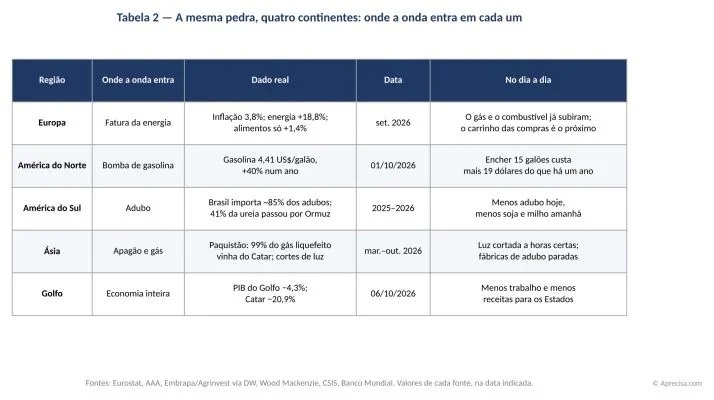
Read the table row by row. The second column says through which door the crisis comes into each region; the third, the number that shows it; the last, what it changes in the lives of the people who live there. The same stone produces different effects depending on what each region depends on.
Europe — it comes in through the energy bill. In September, inflation in the euro area rose to 3.8%, with energy 18.8% dearer than a year earlier and food only 1.4%. These are the 1st wave, the one of energy, already inside the home, and the 5th, the one of dearer food, still at the door. Example: the gas bottle and the car’s tank already cost more; the shopping trolley is next.
North America — it comes in through the petrol pump. The United States produces more oil than it uses. Even so, on 1 October a gallon of petrol cost on average 4.41 dollars, against 3.16 a year earlier: 40% more; September was the most expensive September ever. Example: anyone who fills a 15-gallon tank, about 57 litres, pays 19 dollars more today than a year ago. The lesson: having oil at home does not protect you from the price, because oil is sold at the world price.
South America — it comes in through fertiliser. Brazil, one of the world’s biggest farms, imports about 85% of the fertilisers it uses, and in 2025 about 41% of the urea it bought passed through Hormuz. This is the 3rd wave, the one of farmers cutting back on fertiliser, which prepares the 4th, the one of smaller harvests. Example: the farmer who puts less fertiliser on the soya he is sowing now harvests less early next year. And that soya feeds pigs and chickens all over the world, including in Europe: the shortage reaches our plates through meat.
Asia — it comes in through the blackout. Here the wave does not arrive only as a price. It arrives as a shortage. Pakistan bought from Qatar 99% of the liquefied natural gas it imported, and Bangladesh more than 70%. With the strait closed, Pakistan scheduled power cuts across the whole country and stopped two fertiliser plants to send the gas to the power stations. In September India paid 26.4 dollars for the same amount of gas that in the spring cost it 16.8 to 18.8. And Japan, one of the richest countries in the world, is drawing on a reserve fund of 2.5 trillion yen to keep petrol close to 170 yen per litre. Example: in Lahore or in Dhaka, the power is cut at set times: the fan stops, the fridge switches off, the factory works fewer hours. And the fertiliser plant stopped today means less rice and less wheat tomorrow: the 1st wave jumps straight to the 3rd and the 4th.
Four continents, the same stone, four doors in: the bill in Europe, the petrol pump in North America, fertiliser in South America, the blackout in Asia. And they all end up in the same place: the price of food.
The Gulf — on the other side of the door. Those who sell the oil and the gas also lose. On 6 October, the World Bank revised its forecasts: the Middle East and North Africa are expected to shrink by 2.1% in 2026. The Gulf countries, on average, by 4.3%. Qatar, by 20.9%, the worst result in five decades, after its gas production fell by about 67% between March and July. Example: fewer ships leaving means less revenue for the States and less work for the millions of foreign workers who live there and send money to their families.
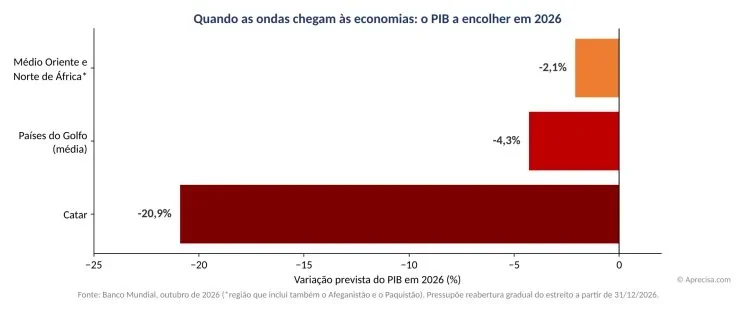
Each bar shows how much the economy is expected to shrink in 2026: the longer the bar, the bigger the fall. Qatar, which exports liquefied natural gas almost only through the strait, loses about a fifth of its economy in a single year. It is the same domino, seen from the other side of the door.
The most important detail is in the small print: the forecast assumes that the strait begins to reopen gradually on 31 December. And the chief executive of Aramco, the Saudi oil company, warned that rebuilding world stocks could take up to two years.
The door can open in a day. The queue takes years to clear.
B2. Other stones in the same pool
Other stones in the same pool. Hormuz did not fall alone. In a crisis of more than 200 days, other stones fell into the same water, and when the waves from two stones meet they do not cancel out: they add up. It is the equation of episode 2 at work: in a long crisis, the second piece of bad luck stops being bad luck.
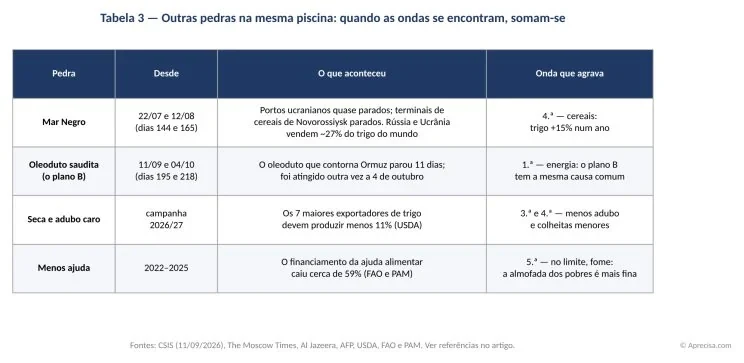
Each row is a different stone, with the date on which it fell and the wave it makes worse. Look at the second row: the Saudi pipeline was the plan B for getting round Hormuz, and it was hit by the same conflict. And look at wheat: today it sits at the crossing of three stones at once, Hormuz through fertiliser, the Black Sea through exports and the drought through the harvest.
Black Sea. Russia and Ukraine sell about 27% of the world’s wheat. Since 22 July, Russian attacks have stopped almost all traffic in Ukrainian ports; on 12 August, a Ukrainian attack stopped the grain terminals at Novorossiysk. Russian wheat exports fell to about half. Example: bread in Egypt, in Turkey or in Indonesia depends on this wheat; when it does not leave the port, the buyer goes elsewhere and pays more, and that price reaches everyone.
The Saudi plan B. The East-West pipeline, which carries Saudi oil to the Red Sea without passing through Hormuz, stopped from 11 to 22 September after an attack, and was hit again on 4 October. Example: it is like having a back-up generator connected to the same switchboard that has failed. It is the common cause of episode 2.
Drought and expensive fertiliser. In the seven largest wheat exporters, the US Department of Agriculture forecasts 11% less production in 2026/27, because of the drought and expensive fertiliser. It is the 3rd wave, less fertiliser, joining a stone from the climate.
Less aid, and the limit of the 5th wave. Funding for food aid fell by about 59% between 2022 and 2025. In March, the World Food Programme warned that 45 million more people could fall into acute hunger if the conflict lasted until June; it did. In Oleshky, an occupied town in the Kherson region, the Ukrainian official says that people survive on one meal a day, and in Gaza there are families who queue for hours for one meal. Note: in these two cases the hunger comes from the war on the spot, not from Hormuz, and the situation in Oleshky could not be independently verified. They serve to show what the 5th wave is at its limit: in Portugal, a dearer shopping basket; where there is no margin, one meal fewer.
B3. What each wave takes from us, what it gives us and what it leads to at the limit
Each wave takes money from us and gives us time. The time it gives is the warning of the next wave. And at the limit, each wave stops being a price and becomes a shortage: while there is a price, there is a product, only dearer; at the limit, there is none.
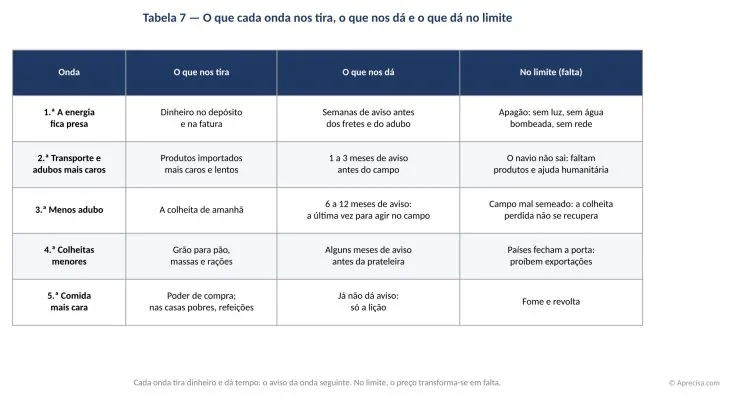
Read each row from left to right: what the wave costs, the warning it leaves for the next one, and what happens when there is no margin. In rich countries, the waves stop at the price; in poor countries they reach the limit, and often all at the same time, as in Pakistan, where the same missing gas causes blackouts and stops the fertiliser plant.
Real examples of each limit: scheduled power cuts in Pakistan for lack of gas (1st wave); hundreds of ships stopped and war-risk insurance withdrawn (2nd); urea plants stopped in Pakistan (3rd); India banned wheat exports in 2022, after a heatwave (4th); and, in 2008, more than 60 food riots in about 30 countries, according to a 2011 study (5th).
Part C — The wave clock: your plan in 10 minutes
C1. Act on the previous wave
If each wave arrives with a delay, that delay is time. And time, in resilience, is the only thing that cannot be bought on the day of the crisis.
The rule is simple: the best moment to prepare for a wave is when the previous one arrives. The interval between the two is your deadline to decide.
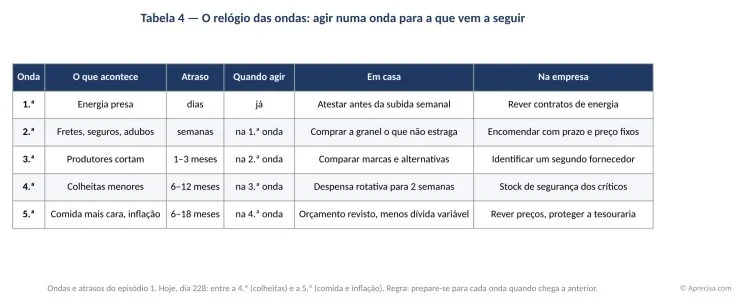
Read the table row by row. Each row is a wave of the domino of episode 1. The “Delay” column says how long it takes to arrive after the shock. The “When to act” column always points to the previous wave: that is where time is gained. The last two columns are examples of a concrete action, one for the home and one for the company.
Today, day 233, we are between the 4th wave, the one of smaller harvests, and the 5th, the one of dearer food and inflation. This means that the time to prepare for dearer food is now. Not when it appears in the news.
- At home: review the shopping budget six months ahead and not month by month; try alternative brands and pack sizes before the rise, not after; keep a rotating pantry for two weeks, which is used up and restocked, so as not to waste.
- In the company: ask each supplier when the stocks and contracts bought at the old price run out, because that date is the date of their next price rise; review selling prices and payment terms; protect cash flow before inflation reaches interest rates.
- In the State: follow the indicators of the earlier waves, such as freight, fertilisers and sowing, and not just the final price. When the rise shows up in the inflation statistics, the window to act has already closed.
And to know when each wave should recede, use Table 5 of the article, the plan of the foreseeable up to 31 December 2028: it says what should happen, when, and which news item confirms it.
C2. Sheet: your wave clock (10 minutes)
Step 1. Write the five waves in rows. You can copy the first column of Table 4.
Step 2. For each wave, write what affects you: the fuel for the car, the electricity bill, the price of a raw material, the home loan repayment.
Step 3. Write the delay: when does that rise reach your bill? Ask whoever sells to you. The supplier knows when the cheap stock runs out.
Step 4. In the “When to act” column, point to the previous wave. In “What I do”, write one single concrete action. In “Who decides”, write a name. An action without an owner does not happen.
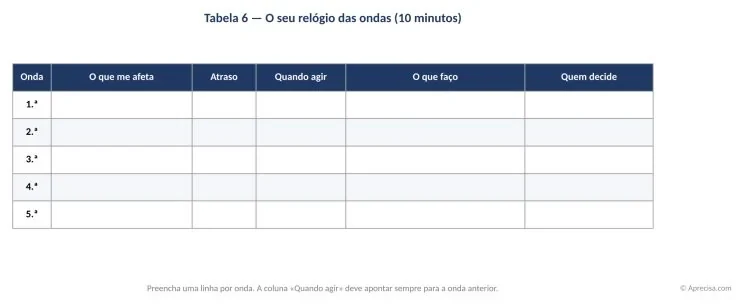
It is the same structure as Table 4, blank, to fill in at home or in a team meeting. The most important column is the last one: a plan in which nobody decides is just a wish list.
Illustrative example, the Martins family from episode 2: in the 1st wave, the one of energy, in March, they started filling up the car before the weekly rises. Now, before the 5th wave, the one of dearer food, reaches their shopping, they have reviewed the shopping budget six months ahead and set up a rotating pantry for two weeks. The most valuable action cost no money: asking the local butcher and grocer when they expected new price lists.
Note: the figures and examples in the annex are illustrative and serve to teach the method. They do not constitute financial advice.
Your turn
- Look at today’s map: which wave is your country, or your company, in? Say the number and what made you choose it.
- Fill in Table 6 and say in the comments: what action did you write for the 5th wave, the one of dearer food?
- Send this sheet to whoever does the buying for a canteen, an aged care home or a small company. It is 10 minutes that can be worth months.
On Tuesday, 20 October, episode 4 comes out, “A ilusão de ter dois” (The illusion of having two): why two suppliers, two routes or two networks are not always worth two.
Methodological note. “Day” means the full days since 28/02/2026. Maps: the circles are illustrative and grow with the days, without measuring distances; the icons in each region correspond to dated facts cited in the references; the April forecast for the Gulf (+1.4%) results from −4.3% + 5.7 points of revision indicated by the World Bank; the projection is a scenario with the delays of episode 1 and the assumption of reopening on 31/12/2026. North America: 15 gallons ≈ 57 litres; 15 × (4.41 − 3.16) ≈ 19 dollars. The 45 million of the World Food Programme are a projection, not a count; the hunger in Oleshky and in Gaza comes from the war on the spot, not from Hormuz. The delays in Table 4 are those of episode 1; the examples in the sheet are illustrative and do not constitute financial advice. Text, maps and tables by the author, AI-assisted. Music of the video “A pedra caiu em Ormuz”: “O Relógio da Água”, musical direction by Gaspar do Amaral, AI-assisted.
The tables are numbered jointly across the article and this supplement: Tables 1 and 5 are in the article; Tables 2, 3, 4, 6 and 7 are here.
References
- Gaspar do Amaral (27/09/2026). Dia 211: A Porta Estreita por onde passa a nossa resiliência (Day 211: The narrow door our resilience passes through; episode 1). https://www.linkedin.com/pulse/dia-211-porta-estreita-por-onde-passa-nossa-gaspar-do-amaral-vd9gc/
- Gaspar do Amaral (06/10/2026). Dia 220: O azar nunca vem só (Day 220: Bad luck never comes alone; episode 2). Newsletter “A Porta Estreita”, LinkedIn.
- Gaspar do Amaral (14/10/2026). Dia 228: O efeito dominó (Day 228: The domino effect; episode 3). Newsletter “A Porta Estreita”, LinkedIn.
- Gaspar do Amaral (17/10/2026). Video “A pedra caiu em Ormuz”: the five waves, day by day (supplement to episode 3). Music “O Relógio da Água”, musical direction by Gaspar do Amaral. LinkedIn.
- Gaspar do Amaral (18/10/2026). Video “As cores das ondas”: the Hormuz shock going round the world (supplement to episode 3). LinkedIn.
- Straits.live (14/10/2026). Situation in the Strait of Hormuz: latest IMF PortWatch count (4 transits on 04/10), Brent, war-risk insurance. https://straits.live/
- FAO (02/10/2026). Food Price Index for September 2026. https://www.fao.org/newsroom/detail/fao-food-price-index-rises-in-september-amid-weather-concerns-and-transport-disruptions/en
- DECO PROteste, via DNoticias / Lusa (07/10/2026). Basket of 63 goods: €255.56; +€1.34 in one week; +5.68% since January. https://www.dnoticias.pt/2026/10/7/508079-cabaz-alimentar-volta-a-subir-para-25556-euros-na-ultima-semana/
- Eurostat, via NewKerala (02/10/2026). Flash estimate of euro-area inflation in September: 3.8%; energy +18.8%; food +1.4%. https://www.newkerala.com/news/a/inflation-europe-jumps-38-september-energy-inflation-188-652.htm
- AAA (01/10/2026). US national average price of petrol: US$4.41/gallon; 3.16 a year earlier; record September. https://gasprices.aaa.com/national-average-dips-following-record-setting-september/
- ISTOÉ / Deutsche Welle (12/03/2026). Brazil imports about 85% of its fertilisers (Embrapa); 41% of the urea imported in 2025 passed through Hormuz (Agrinvest). https://istoe.com.br/como-guerra-no-ira-afeta-o-agronegocio-do-brasil/
- Wood Mackenzie (12/10/2026). South Asia: dependence on liquefied natural gas from Qatar; power cuts; prices paid by India. https://www.woodmac.com/press-releases/south-asia-lng-demand-growth-derailed-as-middle-east-conflict-exposes-critical-supply-vulnerabilities/
- CSIS (26/08/2026). Pakistan: scheduled power cuts and fertiliser plants stopped. https://www.csis.org/analysis/pakistans-lng-imports-under-pressure-impacts-strait-hormuzs-closure-and-pakistans
- Nippon.com / Jiji (25/08/2026). Japan keeps its target price for petrol close to 170 yen per litre. https://www.nippon.com/en/news/yjj2026082500825/
- World Bank, via The National (06/10/2026). Forecasts for the Middle East and North Africa and for the Gulf in 2026. https://thenationalnews.com/business/economy/2026/10/06/world-bank-says-middle-east-economy-to-contract-21-in-2026-on-iran-war
- CSIS (11/09/2026). How Do the Latest Black Sea Attacks Affect Global Food Security? (27% of world wheat; ports stopped; USDA −11%). https://www.csis.org/analysis/how-do-latest-black-sea-attacks-affect-global-food-security
- The Moscow Times (17/08/2026). Ukrainian Strikes Halt Most Russian Grain Exports in the Black Sea. https://www.themoscowtimes.com/2026/08/17/ukrainian-strikes-halt-most-russian-grain-exports-in-the-black-sea-a93517
- Al Jazeera (12/09/2026). Saudi Arabia shuts critical oil pipeline after drone attack. https://www.aljazeera.com/news/2026/9/12/saudi-arabia-shuts-critical-oil-pipeline-after-drone-attack-what-happened
- Türkiye Today / AFP (05/10/2026). Saudi East-West pipeline halted again after fresh attack. https://www.turkiyetoday.com/region/saudi-east-west-pipeline-halted-again-after-fresh-attack-3229662
- FAO and WFP (17/06/2026). Hunger Hotspots: 13 hunger hotspots; funding for food aid −59% between 2022 and 2025. https://www.wfp.org/news/new-fao-wfp-report-warns-worsening-hunger-puts-13-hotspots-significant-risk
- UN News (17/03/2026). Middle East war risks pushing 45 million more people into acute hunger. https://news.un.org/en/story/2026/03/1167147
- Euronews (13/10/2026). “People survive on one meal a day”: Oleshky (cannot be independently verified). https://www.euronews.com/2026/10/13/people-survive-on-one-meal-a-day-oleshky-official-warns-against-giving-russia-more-territo
- Malay Mail / AFP (10/10/2026). A year after Gaza ceasefire, families still queue hours for one meal a day. https://malaymail.com/news/world/2026/10/10/a-year-after-gaza-ceasefire-families-still-queue-hours-for-one-meal-a-day/238547
Gaspar do Amaral · © Aprecisa.com
Methodological note
What this page is. A translation of the supplement to episode 3 of the newsletter “A Porta Estreita” (The Narrow Door), which the author published on LinkedIn on 19 October 2026; the full Portuguese version is on this site.
Images. The ten images of the original (four maps, a bar chart and five tables) are reproduced as they are, with their texts in Portuguese; their captions are translated. The paragraph that follows each image in the text explains what it shows.
Names and titles. The titles of the author’s own works (the newsletter, the episodes, the videos and the music) are kept in Portuguese, with a translation in brackets. The titles of sources are kept as in the original. “2.5 biliões de ienes” in the Portuguese original uses the long scale: 2.5 × 10¹² yen, that is, 2.5 trillion yen.
Changes of form, not of content. The decorative symbols (emoji) and the hashtags of the LinkedIn version were left out; the bulleted paragraphs appear as lists; the numbered list of references appears as a bulleted list. The links to sources are those of the original.
The discussion is on LinkedIn (in Portuguese)
Comments on this text are made on LinkedIn, where the article was shared in Portuguese. You are welcome to write in English. Agree, disagree or add data: every well-founded objection receives a reply.
Gaspar do Amaral · Original in Portuguese of 19 October 2026, published on this site; translation issued on 27 October 2026 · Figures and tables © Aprecisa.com · AI-assisted