 ← Grupo Aprecisa · Connecting those who know with those who need
Energy and the power system · Article published on LinkedIn on 1 July 2026
Decrees against the Physics of the System: An X-Ray of Decree-Law 130/2026 and the Raid on the Citizen’s Bill
Decree-Law 130/2026 and the administrative shortcuts that manage a saturated grid without an electrical adequacy check
Gaspar do Amaral · 1 July 2026
Translated from the Portuguese original. This version was issued on 30 October 2026.
On this site, this article has been
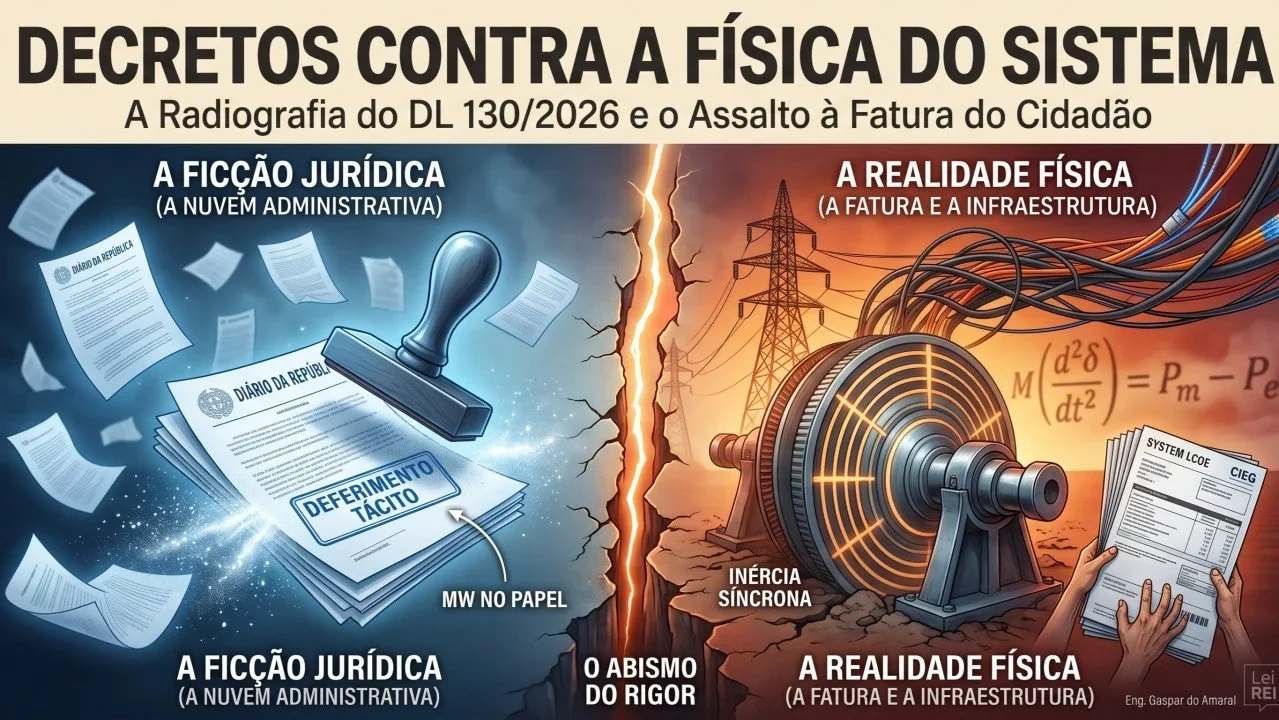
The publication of Decree-Law No. 130/2026 [1], amending Decree-Law No. 15/2022 [2], confirms a recurring temptation of energy governance: legislating against the physical inflexibility of the power system. Under cover of transposing Directives (EU) 2024/1711 [3] and 2023/2413 (RED III) [4] and of cutting red tape, the decree manages the saturation of a critical infrastructure through administrative shortcuts.
The National Electricity System (SEN) is not an abstraction of the State: it is a sovereign infrastructure whose sole owner and financier is the citizen. Joint-integration engineering — which fuses energy, communications and transport networks with minimal tolerance for failure — does not allow regulatory make-believe. When political rhetoric collides with the inflexibility of the System LCOE (the total cost of the system) and of synchronous inertia, the bill for blackouts and for the Costs of General Economic Interest (CIEG) is invariably paid by the final consumer.
It is important, however, to be rigorous in criticism. The decree is not a mere piece of propaganda: it contains environmental screens, capacity-conversion mechanisms and real financial brakes. That is precisely why its true gap — the absence of a mandatory electrical adequacy check on the fast track — deserves to be exposed without exaggerations that would weaken the point.
What follows is the technical, legal and economic dissection of the decree’s four pillars.
1. The Confession of Collapse: Access “With Restrictions” (Article 52-A)
The decree formally introduces the concept of “capacity with restrictions” (defined in Article 3(l) and put into operation in the new Article 52-A) for injection into the Public Service Electricity Grid (RESP).
What it sets out to solve. it legalises the management of grid saturation, allowing generating plants to connect to a grid without free evacuation capacity, subject to mechanical curtailment.
The honest caveat. contrary to what a hasty reading suggests, Article 52-A does not establish curtailment as an end in itself. Paragraph 2(b) requires capacity with restrictions to be converted into firm capacity once the RESP reinforcements are completed; paragraph 2(d) requires a certified power-control device to be installed; and paragraph 3 obliges the title to specify the probability, duration and tariffs of curtailment. There is, therefore, a mitigation architecture.
The harm to the Common Good. the problem is not the existence of curtailment — it is its sufficiency and the door opened by paragraph 2(c), which allows curtailment to become a permanent solution wherever ERSE considers that reinforcement is not “the most efficient solution”. The system continues to depend on control devices at the boundary, sacrificing the capacity factor of the generating asset, without solving downstream the need for synchronous inertia and long-duration storage (pumped hydro).
For the Systems Engineer. security comes to rest on action at the boundary, not on deterministic planning. Curtailment is acceptable as a transitional measure; it is dangerous as a permanent regime, because it shifts security validation from design (load-flow calculation, N-1 contingencies) to control at operating time.
For the Economist. CapEx risk soars and the System LCOE worsens: a park with “access with restrictions” has uncertain projected output and therefore an effective levelised cost higher than announced. The promoter injects when it suits it, but the citizen pays, through the Network Use Tariffs, for the idle infrastructure and the balancing costs.
For the Lawyer. the right of access becomes precarious, conditional on the — always delayed — development of the RESP. The polluter-pays principle is not violated here for lack of liability (there is liability, see pillar 3), but because the systemic externality of firmness — the cost of dispatchable back-up and inertia — is not internalised by those who introduce intermittency.
For an 8-Year-Old. it is like buying a ticket for the slide at the water park. You can go in, but the lifeguard has a remote control that turns the water off whenever the pool gets full — and in the end it is your parents who pay the bill for the wasted water.
2. The Bureaucratic Illusion: Tacit Approval and the RAAs (Articles 14-B and 40-A)
The decree creates Renewable Energy Acceleration Areas (RAAs, ZAER in Portuguese) (Articles 40-A to 40-D, defined by a sectoral programme under the Legal Regime of Territorial Management Instruments, RJIGT — Decree-Law 80/2015 [7]) and tacit approval of the production licence (Article 14-B).
What it sets out to solve. the procedural bottleneck at DGEG (the Directorate-General for Energy and Geology), cutting licensing times to six months for projects in RAAs (Article 14(2)).
The honest caveat. tacit approval is not blind: Article 14-B(2) expressly excludes it for projects subject to Environmental Impact Assessment (the regime of Decree-Law 151-B/2013 [8]) or to environmental incidence assessment. The RAAs are themselves defined by a sectoral programme subject to strategic environmental assessment (Article 40-C(3), under Decree-Law 232/2007 [6]), with criteria excluding Natura 2000 sites and migratory routes (Article 40-B). The screen exists — but it is environmental and territorial.
The harm to the Common Good. this is where the real failure lies: none of these screens is an electrical adequacy check. On the fast track there is no mandatory gate for validating system security — load-flow calculation, N-1 contingencies, limits on RoCoF (Rate of Change of Frequency) and minimum inertia. Tacit approval covers administrative licensing; it does not replace — and the decree keeps them separate — technical access to the grid (Articles 19(9) and 52-A, with the operator’s opinion). The risk is not “blind injection” — it is pressure of deadlines and the logic of silence eroding the depth of the technical validation that should precede firmness.
For the Systems Engineer. approving the licence because a deadline has lapsed is acceptable for administrative acts; never for certifying that the grid survives a contingency. The point to watch is that the adequacy check (N-1, load flow, inertia/RoCoF studies) remains autonomous and binding, and is not dragged along by the compression of licensing deadlines.
For the Economist. combining RAAs with tacit approval can create stranded assets: assets that are licensed but physically useless for lack of evacuation capacity. Avoiding integration CapEx benefits the promoter and shifts reactive investment in the grid onto the State.
For the Lawyer. applying Article 130 of the Code of Administrative Procedure (CPA) to sovereign infrastructure turns the inaction of the Administration into a presumption of viability — but only administrative viability, not technical. The certificate under Article 14-B(3) attests that the deadline has lapsed, not that the system is secure; that is the distinction that must be preserved in litigation.
For an 8-Year-Old. it is like asking your mother: “Can I eat the box of chocolates?” If she does not answer within five seconds, the law says you can. But the tummy ache — the grid congestion — happens anyway.
3. The Transfer of Chaos: Collective Self-Consumption (Articles 86-A to 88-C)
The decree fleshes out the duties of the grid operator (Article 88-A) and of the Collective Self-Consumption Management Entity (EGAC) (Article 88-B), lays down the principles of collective self-consumption (ACC, Article 86-A) and requires meters to be interoperable.
What it sets out to solve. it tidies up the legal chaos of energy communities, establishing market hierarchies and responsibilities.
The correct attribution of liability. it is essential not to confuse the roles: those financially responsible for deviations from schedule are the self-consumers (Article 86(6)), who may delegate that balance responsibility under Article 5 of Regulation (EU) 2019/943 [5]. Article 88-B merely sets out the EGAC’s powers and duties (submitting the sharing agreement, negotiating with suppliers when authorised, ensuring confidentiality). The civil-liability time bomb therefore lies in the delegation of balance responsibility and its attribution among dozens of participants — not in an autonomous liability of the EGAC.
The harm to the Common Good. the total exemption from CIEG on energy self-consumed through a self-consumption production unit (UPAC) (Article 195(2)(b)) creates a risk of asymmetric socialisation: those with the capital to install generation stop contributing to the upkeep of the public grid, whose back-up cost falls on those who cannot generate. It is a question of tariff design and intertemporal equity, not of mere ideology.
For the Systems Engineer. decentralised management ceases to be a strictly electrical problem and becomes one of telecommunications, data and latency. The decree itself defines “interoperability” (Article 3(ffff)) and “near real time” (Article 3(mmmm)) — but a legal definition is not a specification. Without meters that communicate according to IEC 61850 [9] (substation and DER communication), IEC 62056 / DLMS-COSEM [10] (smart metering) and IEEE 1547 [11] (interconnection of distributed resources), near-real-time balancing is a regulatory aspiration. If telemetry fails, settlement of deviations fails, and frequency stability degrades.
For the Economist. hidden transaction costs (telemetry, data management, sharing software) can cancel out local efficiency. The cost of the heavy grid is socialised while the saving is privatised.
For the Lawyer. the sharing of liability for deviations among participants (Article 86(6)) and representation by the EGAC (Article 88-B) create, in the inevitable failure of aggregation software, a dispute over the attribution of punitive costs that is complex to resolve. Clarity in the mandate of representation is the only armour.
For an 8-Year-Old. imagine sharing a giant pizza among 50 friends in different rooms, with a stopwatch making sure everyone chews at the same time. If your phone loses signal, the order collapses — and the fine comes out of your pocket money.
4. The Emergency Brake: the End of the Premium at Negative Prices (Article 17)
The decree opens the door to “two-way contracts for difference” (defined in Article 3(aaaa)) and sets settlement and premium at zero whenever the day-ahead market price is negative (Article 17(2) and (3)).
What it sets out to solve. it stems the financial haemorrhage: it prevents producers from continuing to be subsidised with public funds in the hours when the grid is flooded with energy for which there is no demand.
The harm to the Common Good. prohibiting the subsidy at negative prices mitigates the bill but masks the disease: it remains unresolved who provides — and who pays for — the firm technology that sustains the country on windless nights.
For the Systems Engineer. this is a belated alignment with the reality of dispatch. A non-dispatchable source without storage does not guarantee security of supply. Firmness is measured with the metrics proper to adequacy — LOLE (Loss of Load Expectation) and EENS (Expected Energy Not Served), within the European Resource Adequacy Assessment methodology (ERAA) [14], which the decree itself invokes in the “reliability standard” of Article 100(5). Talking of “five nines” (99.999%) is importing a telecommunications SLA into a domain where the correct metric is a different one. Firmness is guaranteed by rotating mass (pumped hydro, thermal baseload in certain profiles) — and, increasingly, by grid-forming inverters, synthetic inertia and fast frequency response (FFR), regulated by the RfG (Regulation (EU) 2016/631 [12], already invoked in Article 81(6)) and by the SO GL (Regulation (EU) 2017/1485) [13]. Recognising these alternatives does not weaken the argument: it strengthens it, because none of them removes the need, in scenarios of very low renewable output, for sufficient firm reserve.
For the Economist. by adopting the two-way model, the State protects citizens from negative prices and recovers revenue at peaks, starting to rationalise the System LCOE. It is a victory, albeit a partial one.
For the Lawyer. it establishes synallagmatic equity in energy purchase contracts: technological risk ceases to be a lifelong, unconditional burden on the public purse.
For an 8-Year-Old. if all the children sell lemonade at noon and there are no customers, the lemonade is worth nothing. The new law says the State will no longer give you a prize just for making lemonade nobody drinks.
Synthesis: the Same Bill, in Three Stages (2019 → 2022 → 2026)
The thread is a single one and runs through the whole analysis: the capacity that is announced is not the firm energy the grid can bear — and the difference ends up on the bill. So that it can be understood by everyone, from the engineer to the citizen, the development is summarised in three stages, with practical cases.
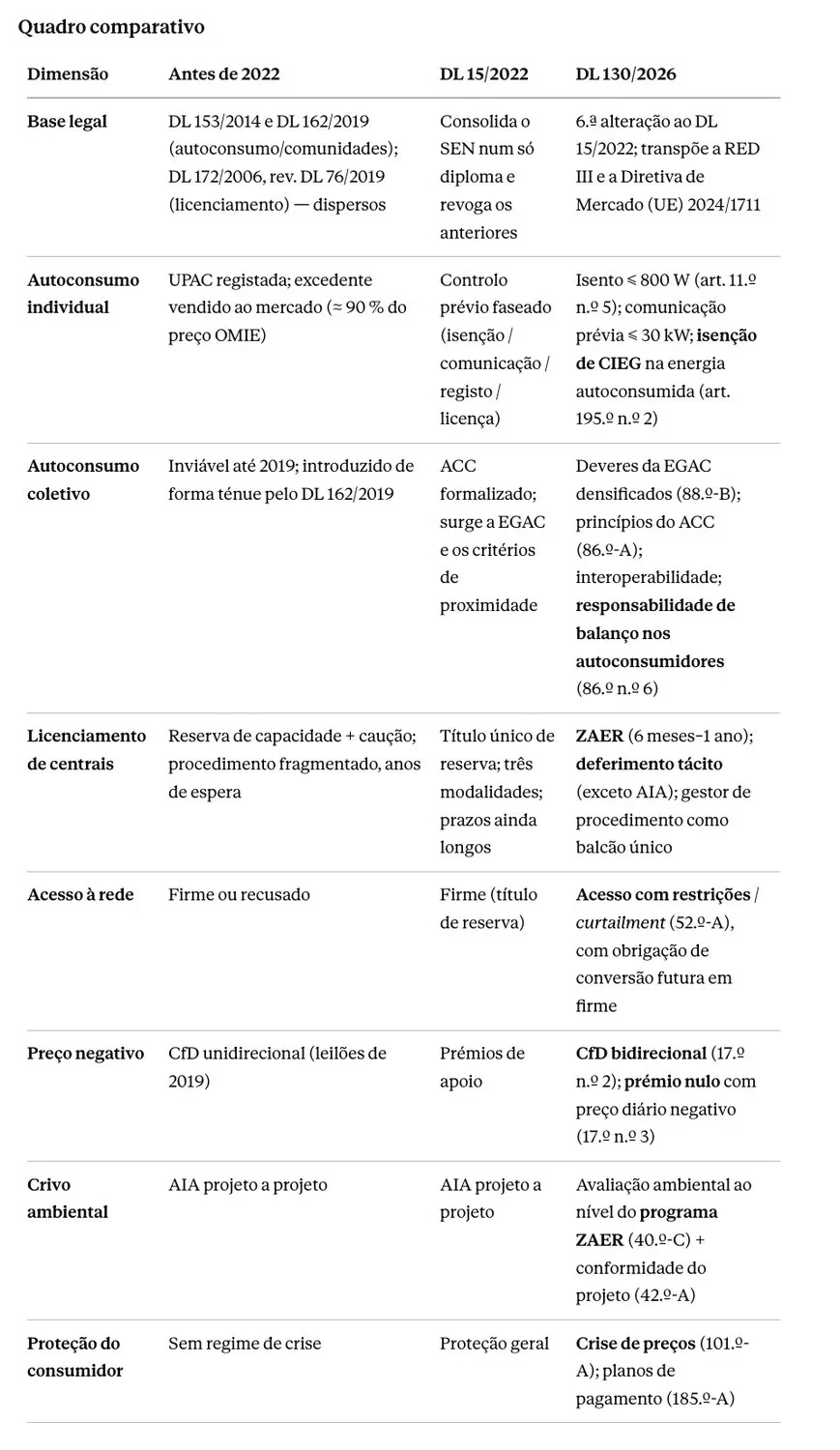
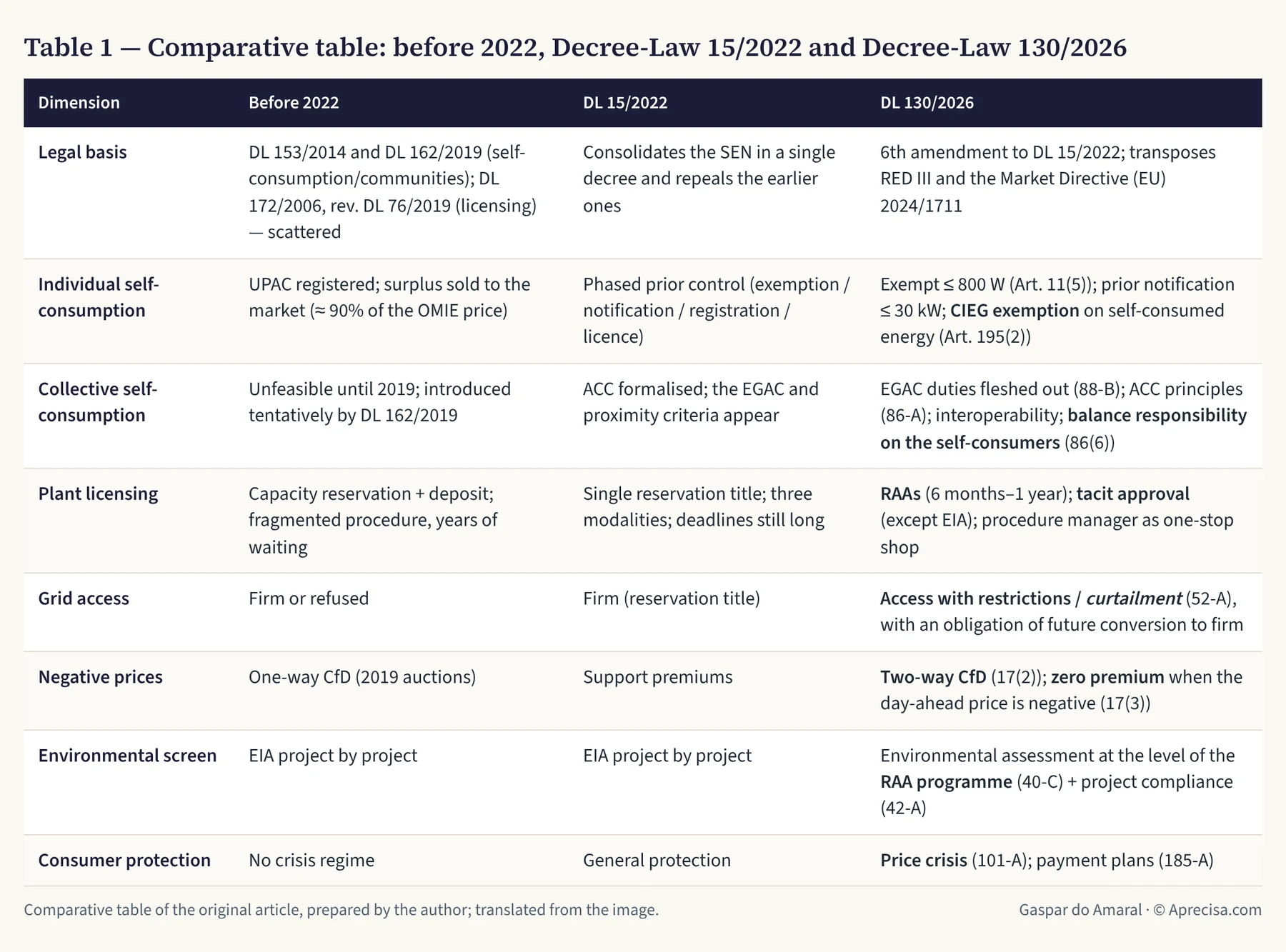
Note to the table. The Market Directive (EU) 2024/1711 [3] amends the Electricity Directive (EU) 2019/944 [15]; Decree-Law 130/2026 also partially transposes the Energy Efficiency Directive (EU) 2023/1791 [16]. The scattered pre-2022 regime (Decree-Laws 153/2014, 162/2019, 172/2006 and 76/2019) can be consulted on the Diário da República portal.
The critical engineering point runs through the whole table and is never resolved: in none of the three stages is there a mandatory, autonomous electrical adequacy check — N-1 contingencies, load flow, limits on inertia and RoCoF — that makes firmness conditional on the physics of the system. Before, it was slow; now it is fast — but it still validates the paper, not the grid.
Three Practical Cases
Case 1 — Dona Maria puts panels on her roof. Before 2022: she registers the UPAC and sells the surplus to the market for about 90% of the exchange price. In 2022: clear tiers appear — tiny installations exempt, small ones requiring only prior notification. Now (130): up to 800 W she does not even notify; up to 30 kW notification is enough; and she stops paying CIEG on the energy she self-consumes. Dona Maria wins — but the CIEG she no longer pays has to be charged to another consumer.
Case 2 — The neighbours in the building want one installation for everyone. Before 2022: practically impossible; only in 2019 did the law allow it, and poorly. In 2022: collective self-consumption is born, with the EGAC representing the group. Now (130): the EGAC acquires detailed duties and meters are required to communicate in near real time. The new risk is technical: a single point of failure (SPOF) in telemetry, or excessive latency, makes the sharing and the settlement of deviations fail — and financial responsibility for those lies with the self-consumers (86(6)), not with the grid.
Case 3 — A promoter wants to build and connect a solar park. Before 2022: a reservation with a deposit, licensing spread across several bodies, years before connection. In 2022: a single reservation title, but long deadlines and firm access (or nothing). Now (130): in an RAA, licensing falls to 6 months to 1 year, there may be approval by silence (except with environmental assessment) and connection may be with restrictions — subject to curtailment when the grid saturates. Connection is faster; firmness is less guaranteed.
For the 8-Year-Old
Imagine that electricity is water in a giant hose that supplies the whole town.
- Before 2022: to put in a new tap, you had to ask lots of people for permission and wait for ages. It was safe, but very slow.
- In 2022: they put all the requests at one counter. Tidier, but the hose was still filling up fast.
- Now, with 130: they let you put in taps much faster — sometimes even when nobody answers in time. But the hose is always the same thickness: if everyone turns on their tap at the same time on a day with no sun and no wind, the water may run out. And the bill for the wasted water, or for the extra pump that has to be switched on so it does not run out, always ends up at your parents’ house.
The moral is simple: opening taps faster does not make the hose any thicker.
Conclusion
As long as the promoter is not physically and financially obliged to guarantee (or to contract) the firmness of what it connects to the grid, the gap between the installed capacity announced and the energy that is actually firm will continue to be paid, every month, on the citizen’s bill. That is the subject of a future Integral Energy Responsibility Law — the proposal defended here: internalise firmness, do not decree it.
References
Numbered in order of first appearance in the text. Formatted according to the APA standard (7th ed.), with the European legislation identifier (ELI/CELEX) for EU acts and the Diário da República reference for national legislation.
National legislation
- [1] Presidência do Conselho de Ministros. (2026). Decreto-Lei n.º 130/2026, de 29 de junho [Amends Decree-Law 15/2022, transposing Directive (EU) 2024/1711 and, in part, Directives (EU) 2023/2413 and 2023/1791]. Diário da República, 1st series, No. 123, 29-06-2026. https://diariodarepublica.pt/dr/detalhe/decreto-lei/130-2026-1139897687
- [2] Presidência do Conselho de Ministros. (2022). Decreto-Lei n.º 15/2022, de 14 de janeiro [Establishes the organisation and functioning of the National Electricity System] (consolidated version). Diário da República, 1st series, No. 10. https://diariodarepublica.pt/dr/legislacao-consolidada/decreto-lei/2022-177634029
- [6] Ministério do Ambiente e do Ordenamento do Território. (2007). Decreto-Lei n.º 232/2007, de 15 de junho [Regime for the environmental assessment of plans and programmes — SEA; transposes Directive 2001/42/EC]. Diário da República, 1st series, No. 114. https://diariodarepublica.pt/dr/detalhe/decreto-lei/232-2007-639155
- [7] Ministério do Ambiente, Ordenamento do Território e Energia. (2015). Decreto-Lei n.º 80/2015, de 14 de maio [Legal Regime of Territorial Management Instruments — RJIGT]. Diário da República, 1st series, No. 93. https://diariodarepublica.pt/dr/detalhe/decreto-lei/80-2015-67212743
- [8] Ministério do Ambiente, Ordenamento do Território e Energia. (2013). Decreto-Lei n.º 151-B/2013, de 31 de outubro [Legal Regime of Environmental Impact Assessment — RJAIA]. Diário da República, 1st series, No. 211 (supplement). https://diariodarepublica.pt/dr/detalhe/decreto-lei/151-b-2013-513863
European Union law
- [3] European Parliament and Council. (2024). Directive (EU) 2024/1711 of 13 June 2024 [Amends Directives (EU) 2018/2001 and (EU) 2019/944 as regards improving the Union’s electricity market design]. OJ L, 2024/1711. https://eur-lex.europa.eu/legal-content/PT/TXT/?uri=CELEX:32024L1711
- [4] European Parliament and Council. (2023). Directive (EU) 2023/2413 of 18 October 2023 [RED III — promotion of energy from renewable sources]. OJ L, 2023/2413. https://eur-lex.europa.eu/legal-content/PT/TXT/?uri=CELEX:32023L2413
- [5] European Parliament and Council. (2019). Regulation (EU) 2019/943 of 5 June 2019 [Internal market for electricity]. OJ L 158, p. 54. https://eur-lex.europa.eu/legal-content/PT/TXT/?uri=CELEX:32019R0943
- [12] European Commission. (2016). Regulation (EU) 2016/631 of 14 April 2016 [Network code on requirements for grid connection of generators — RfG]. OJ L 112, p. 1. https://eur-lex.europa.eu/legal-content/PT/TXT/?uri=CELEX:32016R0631
- [13] European Commission. (2017). Regulation (EU) 2017/1485 of 2 August 2017 [Guideline on electricity transmission system operation — SO GL]. OJ L 220, p. 1. https://eur-lex.europa.eu/legal-content/PT/TXT/?uri=CELEX:32017R1485
- [15] European Parliament and Council. (2019). Directive (EU) 2019/944 of 5 June 2019 [Common rules for the internal market for electricity]. OJ L 158, p. 125. https://eur-lex.europa.eu/legal-content/PT/TXT/?uri=CELEX:32019L0944
- [16] European Parliament and Council. (2023). Directive (EU) 2023/1791 of 13 September 2023 [Energy efficiency — recast EED]. OJ L 231, p. 1. https://eur-lex.europa.eu/legal-content/PT/TXT/?uri=CELEX:32023L1791
Standards and technical references
- [9] International Electrotechnical Commission. (2026). IEC 61850:2026 SER — Communication networks and systems for power utility automation [complete series]. IEC Webstore. https://webstore.iec.ch/en/publication/6028
- [10] DLMS User Association. (n.d.). DLMS/COSEM (IEC 62056 series) — Device Language Message Specification / Companion Specification for Energy Metering. https://www.dlms.com/
- [11] Institute of Electrical and Electronics Engineers. (2018). IEEE Std 1547-2018 — Standard for Interconnection and Interoperability of Distributed Energy Resources with Associated Electric Power Systems Interfaces. IEEE Xplore. https://ieeexplore.ieee.org/document/8332112/
- [14] European Union Agency for the Cooperation of Energy Regulators (ACER) & ENTSO-E. (n.d.). European Resource Adequacy Assessment (ERAA) [adequacy methodology; LOLE, EENS, reliability standard, under Article 23 of Regulation (EU) 2019/943]. https://www.acer.europa.eu/electricity/security-of-supply/european-resource-adequacy-assessment
Methodological note
What this page is. An English translation of the article the author published on LinkedIn on 1 July 2026; the full Portuguese version is on this site. The article contains no calculations of its own. The articles of Decree-Law 15/2022 and Decree-Law 130/2026 are cited as the author cites them; Portuguese article numbering (e.g. “art. 52.º-A, n.º 2, al. b)”) is rendered here in the English form “Article 52-A(2)(b)”. This translation is for information only; the legally binding texts are those published in the Diário da República.
Changes of form, not substance. The comparative table, which in the original is an image, is also given as Table 1, translated. The link to the ERAA methodology, which the original split into three, is now a single link. The reference list keeps the original numbering, which, despite the note, is not strictly in order of first appearance ([7] and [8] appear before [6], and [5] before [3] in the list). RAA (Renewable Energy Acceleration Area) translates the Portuguese ZAER; CIEG are the Costs of General Economic Interest included in Portuguese access tariffs; UPAC is a self-consumption production unit; EGAC, the collective self-consumption management entity; ERSE, the energy regulator; DGEG, the Directorate-General for Energy and Geology; RESP, the public service electricity grid.
The discussion is on LinkedIn (in Portuguese)
Comments on this text are made on LinkedIn, where the article was shared in Portuguese. You are welcome to write in English. Agree, disagree or add data: every well-founded objection receives a reply.
Gaspar do Amaral · Original in Portuguese of 1 July 2026, published on this site; translation issued on 30 October 2026 · Figures and tables © Aprecisa.com · AI-assisted
How to cite: Gaspar do Amaral (2026). Decretos contra a Física do Sistema: Radiografia do DL 130/2026 e o Assalto à Fatura do Cidadão. Zenodo. https://doi.org/10.5281/zenodo.23814404 · Permanent archive on Zenodo.