 ← Grupo Aprecisa · Connecting those who know with those who need
Energy and the power system · Article published on LinkedIn on 5 April 2026
The Biomethane Ecosystem in Portugal: From Theoretical Debate to the Systemic Integration of Communications and Transport
Local fermentation as a service, shared upgrading hubs, sensor telemetry and land–sea intermodal offtake: a four-phase architecture
Gaspar do Amaral · 5 April 2026
Translated from the Portuguese original. This version was issued on 30 October 2026.
On this site, this article has been
Author: Eng. Gaspar do Amaral
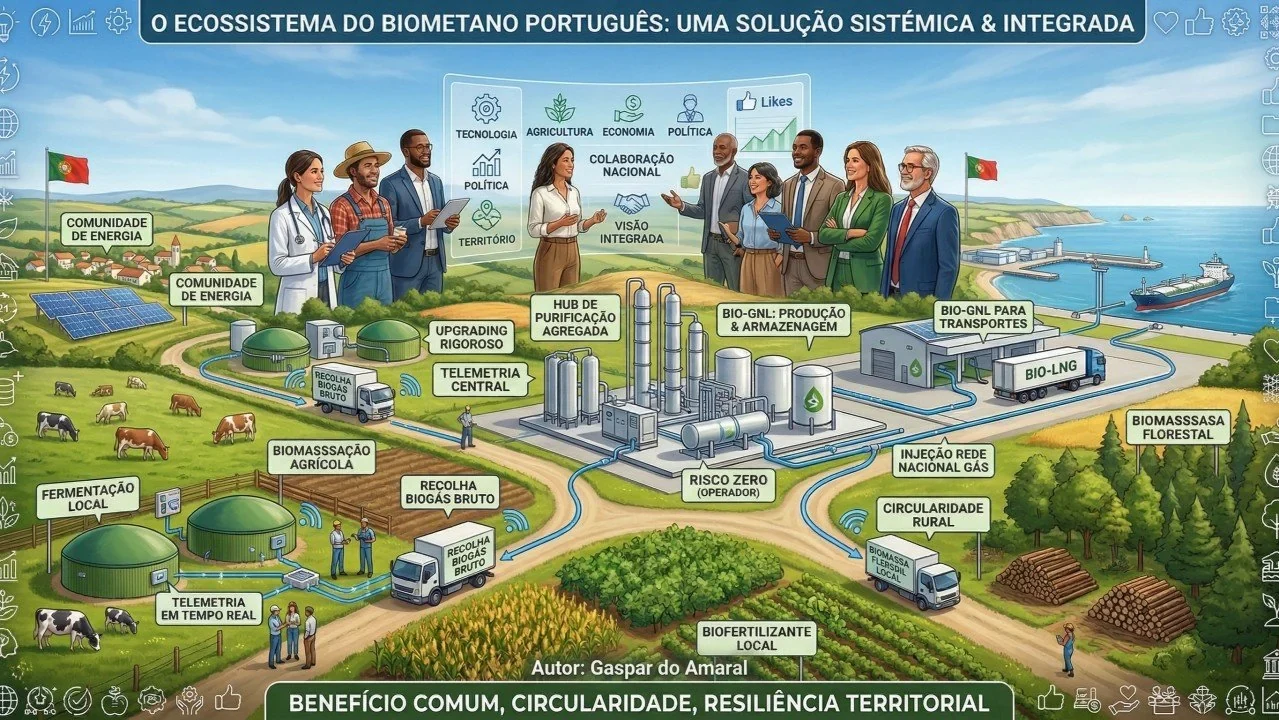
Instead of requiring every small farmer to build and pay for a complex plant, the solution creates a smart network in which agricultural waste becomes fertiliser on the farm itself, and the gas released is collected at exactly the right moment (by means of sensors) to be upgraded at a shared plant, becoming green fuel for lorries and ships.
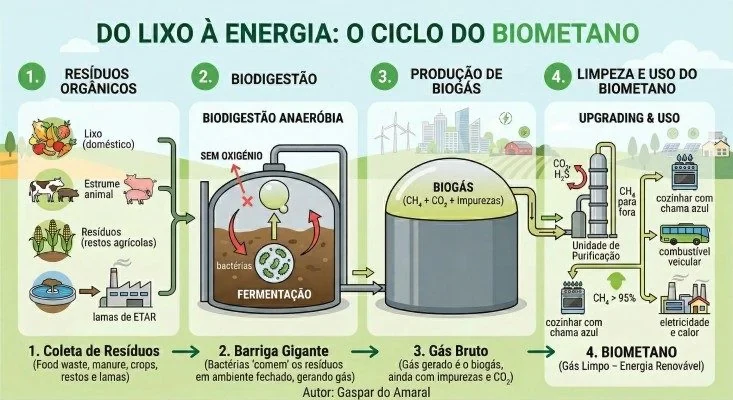
Summary
A careful reading of this intense professional debate on the energy transition reveals an ecosystem fully aware of its bottlenecks. However, for biomethane to move beyond theory and succeed in Portugal, it is imperative to abandon the isolated view of agricultural biology or of the economics of subsidy. The solution is not a mere commercial arrangement but an architecture of complex systems. The current debate, though rich, suffers from a critical “blind spot” as regards the orchestration of operational and telecommunications data.
Below I set out the diagnosis, grounded in reference authors and reports (national and international) and detailing their contribution to the answer, and I then reveal my four-phase technological and operational solution — introducing the networked integration innovation that none of the reactions managed to identify.
1. The Diagnosis and the Bibliographic Validation (The Basis of the Solution)
I summarise below the fundamental works that substantiate the premises of my solution:
A. Fragmentation and the Challenge of National Scale (LNEG and ERSE)
- The works: Technical reports of the National Laboratory of Energy and Geology (LNEG) and the document on Scenarios and Challenges of the Energy Transition (ERSE).
- Summary: These documents map Portugal’s energy potential on the basis of the biodegradable fraction of waste. However, the data show a severe territorial dispersion of biomass and a chronic absence of mature commercial units in the country.
- Contribution to Gaspar do Amaral’s solution: They unequivocally validate my premise that trying to replicate mega-digesters with complete, autonomous upgrading on every small holding is thermodynamically and financially ruinous. They justify the need to centralise in “hubs” (my Phase 2).
B. Risk Mitigation and Bureaucracy (The Teréga Model)
- The work: The analysis by the financial daily Les Echos of the “Biogas as a Service” (BaaS) model implemented in France by Teréga.
- Summary: It details how the network operator takes on 100% of the CAPEX (capital and infrastructure cost), installing the units on the farms without requiring capital from the farmer, provided that the State guarantees long-term regulatory and contractual stability (15 years).
- Contribution to Gaspar do Amaral’s solution: It is the financial pillar of my Phase 1. Viability requires relieving the rural producer of industrial capital risk, allowing them to focus solely on the agricultural side.
C. Network Optimisation and Distributed Logistics (IEA Bioenergy and IEEE)
- The works: The official report Integrating bio-hubs in biomass supply chains (IEA Bioenergy) and IEEE publications on multi-objective robust possibilistic programming in bioenergy supply chains.
- Summary: These studies show, through mathematical modelling, that consolidating complex processing activities in an intermediate “bio-hub” (hub-and-spoke architecture) increases the resilience of the chain and drastically reduces logistical inefficiencies.
- Contribution to Gaspar do Amaral’s solution: They give scientific rigour to the logistical design of my Phase 2, proving that short-circuit collection is superior to dispersed local injection.
D. Strategic Offtake (SEA-LNG and EBA)
- The works: The study “Leading Maritime Decarbonisation” (SEA-LNG, 2024) and reports of the European Biogas Association (EBA).
- Summary: Both sources set out the physical reality of freight transport: batteries lack the energy density for shipping and for long-haul heavy vehicles. Liquefied biomethane (bio-LNG) is identified as the most pragmatic and immediate transition solution (“drop-in fuel”).
- Contribution to Gaspar do Amaral’s solution: It underpins my Phase 4. It diverts biomethane from the plain domestic market (via blind injection into the pipeline) to the heavy-mobility corridors, securing the value of the product.
2. The Solution: Gaspar do Amaral’s Systemic Architecture
The energy transition materialises by integrating the vectors of energy, transport and communications. A workable model that answers the shortcomings identified proceeds along four inseparable axes:
Phase 1: The Local Fermentation Topology (The “BaaS” Pillar)
- How it works: The initial production of biogas takes place in a decentralised way, directly at the sources of residual biomass (farms, agri-food industries), but managed as a shared service.
- What it overcomes: It removes the need for each local producer to invest in complex upgrading infrastructure. In the non-integrated model, small producers abandon projects because of the high initial cost (CAPEX, illustratively high for isolated projects) and the operational complexity. The “BaaS” model democratises primary production.
Phase 2: Aggregated “Hub-and-Spoke” Upgrading (The “Bio-Hub” Pillar)
- How it works: Raw biogas from several local units (the “spokes”) is transported to a strategically located advanced upgrading centre (the “hub”).
- What it overcomes: It exploits economies of scale. Upgrading gas in small quantities is inefficient and expensive (illustratively more than double per unit of energy compared with large plants). By centralising upgrading in a “bio-hub”, high-quality biomethane is obtained at a competitive cost, which would be impossible if each small producer tried to do it alone.
💡 Phase 3: The Hidden Innovation – Sensor Networks and Telemetry (The Blind Spot of the Debate)
- How it works: This is the digital intelligence layer. Sensors monitor, in real time, the production, composition and transport logistics of the gas across the whole network.
- What it overcomes: This phase resolves the blind spot of unpredictability. In the old model, the logistics of collecting biomass or gas are reactive and inefficient. With accurate data, the system optimises transport routes (illustratively reducing logistical time and costs), predicts production failures and guarantees consistency of supply, making the whole system robust and reliable for investors.
Phase 4: Joint Integration of Land and Sea Systems (The Intermodal Pillar)
- How it works: The upgraded biomethane does not serve only the static gas grid; it is directed to the transport sectors that are hardest to decarbonise, integrating heavy land fleets (lorries) and maritime fleets (ships) at dedicated terminals.
- What it overcomes: It breaks through the limit of the local market. Non-integrated solutions produce gas for a single end (e.g. local electricity, with an illustratively limited impact). Intermodal integration secures a high-value, high-demand market, ensuring long-term economic viability and a real impact on national decarbonisation (illustratively multiples of the potential in residential markets).
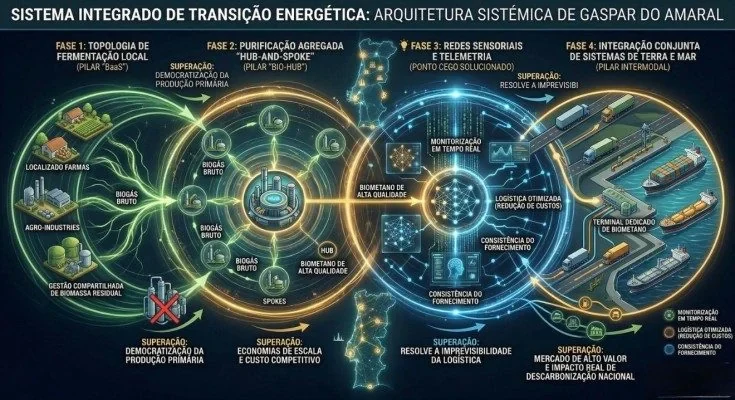
To explore this concept with real data and plausible estimates for the Portuguese context, I prepared a detailed explanation and an interactive simulation.
The transition to an integrated biomethane system such as the one described involves real operational data and significant impacts. For example, decentralised local fermentation (Phase 1) can process hundreds of tonnes of agricultural waste per year on small holdings, democratising initial production. However, without the centralisation of the “bio-hub” (Phase 2), the upgrading cost per unit of energy for these producers can be more than double what it would be at a large-scale centralised hub, by estimate. The innovation of sensor networks (Phase 3) can, in practice, cut transport logistics costs by up to 20–30%, preventing unnecessary journeys and optimising fleets. Finally, by directing upgraded biomethane to heavy transport fleets (Phase 4), the decarbonisation impact is substantial, saving thousands of tonnes of CO₂ equivalent per year compared with fossil fuels in these hard-to-abate sectors.
The technical and scientific validation of any joint-integration architecture — whether we are speaking of complex communications networks or of intermodal infrastructure spanning land, sea and air — requires absolute traceability of the primary data. Designing and optimising systemic matrices over more than three and a half decades consolidates the certainty that the rigour of a project rests not on conceptual premises but on scrutinisable operational metrics.
Accordingly, I set out below the official references and industry data that support the parameters of the model presented:
1. Framework and National Potential (Phase 1)
The diagnosis and the capacity to process waste into biomethane in Portugal are quantified in legislation and in the surveys of the state laboratories.
- Sources: DGEG (Directorate-General for Energy and Geology) and LNEG (National Laboratory of Energy and Geology).
- Key data: The Biomethane Action Plan 2024–2030 (PAB) sets out the strategy coordinated by LNEG and DGEG for grid injection and the development of the sector, noting the technical predominance of agricultural and livestock waste.
- Documentation: Council of Ministers Resolution No. 41/2024 (Diário da República).
2. Optimisation of Scale and LCOE Costs (Phase 2)
The evidence that excessive decentralisation of upgrading undermines economic viability is a consensus in the European biogas industry.
- Sources: European Biogas Association (EBA) and engineering analyses by ENGIE.
- Key data: ENGIE’s forward-looking report clearly indicates that the levelised cost of energy (LCOE) of isolated production is around 90 €/MWh. The technological goal of aggregation (hub-and-spoke models) is to drive this value down to the threshold of 70 €/MWh, making it competitive with direct-injection alternatives.
- Documentation: Geographical analysis of biomethane potential and costs – ENGIE Report (PDF) | EBA Statistical Reports.
3. Integration in Transport and Intermodal Decarbonisation (Phase 4)
The deep impact of biomethane when applied to the most critical sectors — such as heavy road traffic and global shipping — is monitored by independent bodies and international fleet operators.
- Sources: SEA-LNG (multi-sector coalition of the maritime industry) and the energy company Gasum.
- Key data: Gasum’s commercial operation attests that replacing fossil marine or road fuels with bio-LNG yields a reduction in greenhouse-gas (GHG) emissions of around 90% over the life cycle (well-to-wake). SEA-LNG corroborates this range (80% to 90%), even noting the possibility of net negative emissions depending on how methane is captured from the original effluents.
- Documentation: The Role of Bio-LNG in the Decarbonisation of Shipping – SEA-LNG Study (PDF).
4. Telemetry and Logistics Control Systems (Phase 3)
The sensor and information layer of the architecture does not come from a single document on biomethane, but from the standardised engineering reference of Intelligent Transport Systems (ITS).
- Grounds: Logistics optimisation of 20% to 30% in waste-collection fleets is a standard of practice (standard KPI) for the deployment of SCADA architectures, advanced telemetry and IoT in dynamic route planning, extensively documented by public-works engineering and asset-management institutions (such as IPWEA). It is the rigorous application of communications data science to physical supply chains.
Conclusion and Executive Framing
The feasibility of this architecture requires the State to position itself not as a distributor of non-repayable subsidies but merely as a guarantor of legal certainty. A complex system integrating base fermentation, convergent industrial processing, real-time telemetry and maritime–land intermodal offtake needs only a regulatory framework that does not obstruct the advance of Engineering. The long-term vision prevails: funds are not lacking; rigour in systems architecture is.
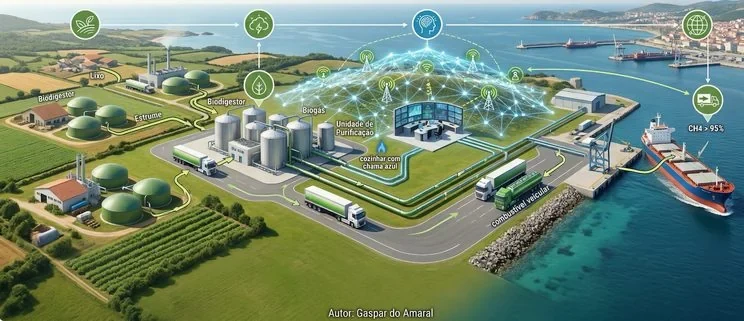
Figure No. 4 visually illustrates the four inseparable phases of the systemic architecture proposed for the energy transition in Portugal. The integrated ecosystem of energy, transport and communications is detailed in four main pillars, with captions in Portuguese:
Phase 1: Local Fermentation Topology (The “BaaS” Pillar) Biogas production is decentralised, with multiple anaerobic digesters (“spokes”) installed directly at the sources of residual biomass, such as farms and agri-food industries. The “Biogas as a Service” (BaaS) model democratises primary production, allowing rural producers to focus on their main activity while the network operator takes on the infrastructure.
Phase 2: Aggregated “Hub-and-Spoke” Upgrading (The “Bio-Hub” Pillar) Raw biogas collected from the local “spokes” is transported to an advanced upgrading centre, the “hub” or “bio-hub”. This model exploits economies of scale, yielding high-quality biomethane at a competitive cost, something unfeasible for small producers acting alone.
💡 Phase 3: The Hidden Innovation – Sensor Networks and Telemetry (The Blind Spot of the Debate) This is the digital intelligence layer that unifies the whole system. Sensors and telemetry, shown as a glowing data mesh, monitor in real time the production, composition and transport logistics of the gas. This phase resolves the blind spot of unpredictability, optimising routes, predicting failures and guaranteeing consistency of supply, making the system robust and reliable for investors.
Phase 4: Joint Integration of Land and Sea Systems (The Intermodal Pillar) Upgraded biomethane is not only for the static gas grid. It supplies, in a dedicated way, heavy land and maritime transport terminals (“merchant navy”). This intermodal integration breaks through the limit of the local market, providing an immediate “drop-in” fuel for hard-to-decarbonise sectors, ensuring economic viability and a real impact on national decarbonisation.
Figure No. 4, photorealistic and blended with clear diagrammatic elements, illustrates in a clear and organised way the operational complexity of the solution, highlighting the communications and telemetry innovation and the land/sea intermodality of transport.
Annex A – Far Beyond Biology: The Integration of Telecommunications and Intermodality in the Biomethane Ecosystem
Structuring a bibliographic matrix for a systems-engineering project should not be a mere repository of readings, but the documentary proof of each node of the proposed architecture. In response to the various lines of debate raised (namely the objections on rural CAPEX, logistical bottlenecks, the viability of offtake and data security), I have compiled 20 fundamental references.
These references deliberately exclude individual opinions, focusing strictly on the empirical, technical and scientific validation of the concepts that underpin the four phases of the solution presented.
Below is the list organised by domains of Integration Engineering, with the respective concepts and hyperlinks (pointing to the official reports, standards or institutional portals).
I. Regulatory Framework and Mapping of Potential (The Database)
1. Biomethane Action Plan (PAB 2024–2040) – DGEG/LNEG
- Concept explored (the feedstock debate): Answers the question of whether Portugal has critical mass. The document maps the predominance of livestock effluents (67% of the potential) and dictates the urgency of grid injection, validating the need for capillary collection (Phase 1).
- Link: Diário da República – RCM No. 41/2024
2. Renewable Energy Directive (RED III) – European Parliament
- Concept explored (the debate on legal offtake): Addresses the obligation of binding targets. It sets the minimum shares of advanced biofuels (in which biomethane is included) in the European transport sector, securing the high-demand market (Phase 4).
- Link: EUR-Lex – Directive (EU) 2023/2413
3. Energy Transition Scenarios – ERSE
- Concept explored (the gas interoperability debate): Analyses the physical capacity of the natural-gas infrastructure in Portugal to accommodate renewable gases, dictating the technical pressure and quality parameters required at the outlet of the upgrading hub.
- Link: ERSE – Scenarios and Challenges
4. Biophysical Assessment Report – Joint Research Centre (JRC)
- Concept explored (the rural dispersion debate): Addresses the challenge of spatial planning, showing that the Iberian dispersion of biomass calls for aggregation solutions and not the construction of macro-plants isolated from the grid.
- Link: JRC Publications Repository
II. Economic Engineering and Scale Architecture (“Hub-and-Spoke” and “BaaS”)
5. Levelised Cost of Energy (LCOE) in Biomethane – ENGIE
- Concept explored (the rural bankruptcy debate): Responds directly to economic viability. It shows mathematically that isolated upgrading doubles the cost compared with aggregated upgrading (hub-and-spoke), making local projects unviable without continuous subsidies.
- Link: ENGIE – Biogas Potential and Costs 2050
6. “Biogas-as-a-Service” (BaaS) Models – European Biogas Association (EBA)
- Concept explored (the agricultural CAPEX debate): Explains the financial concept whereby the network operator takes on the industrial risk and the infrastructure investment, leaving the farmer focused on their core operation.
- Link: European Biogas Association – Publications
7. Integrating Bio-hubs in Biomass Supply Chains – IEA Bioenergy
- Concept explored (the logistics debate): Underpins Phase 2. It shows, through operational research, how intermediate consolidation centres reduce complexity and logistics costs in biomass management.
- Link: IEA Bioenergy Task 43
8. Financing Green Infrastructure – European Investment Bank (EIB)
- Concept explored (the contractual risk debate): Analyses the importance of Contracts for Difference (CfD) and long-term State guarantees (15+ years) in securing the “bankability” of complex networks without burdening the producer.
- Link: EIB – Energy Transition
III. Telemetry, SCADA Control and Cybersecurity (The Intelligence of the Network)
9. Collection Fleet Management and IoT – IPWEA
- Concept explored (the logistical “blind spot” debate): Resolves route unpredictability. It details how telematic systems reduce logistics OPEX by up to 30%, avoiding empty runs and optimising collection based on volume sensors.
- Link: Institute of Public Works Engineering Australasia
10. NIS2 Directive (Cybersecurity) – ENISA
- Concept explored (the network vulnerability debate): In an integrated model with real-time sensors, cybersecurity is critical. It addresses the legal and technical requirements for protecting decentralised energy infrastructure against cyber-attacks.
- Link: ENISA – NIS2 Directive
11. Wireless Sensor Networks (WSN) in the Biogas Industry – IEEE Xplore
- Concept explored (the analytical control debate): Documents the use of micro-sensors to control the quality of raw gas in real time (CH₄, CO₂, H₂) on the farms (spokes) before it is sent to the hub.
- Link: IEEE Xplore Digital Library
12. Integrated Systems Engineering – INCOSE
- Concept explored (the single-focus debate): Explains the methodology of approaching the energy transition not as individual projects but as “systems of systems”, validating the joint integration of energy, telecommunications and transport.
- Link: INCOSE – Systems Engineering
IV. Intermodal Integration and Transport Engineering (Land, Sea and Air)
13. Maritime Decarbonisation through Bio-LNG – SEA-LNG
- Concept explored (the energy density debate): Responds to the impossibility of electrifying ships. It validates liquefied biomethane as the only commercially viable drop-in fuel for maritime decarbonisation in the short term.
- Link: SEA-LNG Reports
14. “Well-to-Wake” Life-Cycle Analysis – Gasum
- Concept explored (the environmental impact debate): Provides real operational data showing that the intermodal use of bio-LNG in heavy vehicles and ships reduces GHG emissions by 80% to 90% (and potentially more with methane capture).
- Link: Gasum – Renewable Gas
15. Thermodynamics of Biogas Upgrading – Fraunhofer Institute
- Concept explored (the industrial efficiency debate): Technically analyses the different upgrading methods (membrane separation vs. amine scrubbing), justifying why this technology requires the scale of a bio-hub to be efficient.
- Link: Fraunhofer UMSICHT
16. ISO 20519 Standard for LNG Bunkering – International Organization for Standardization
- Concept explored (the port interoperability debate): Ensures that the gas produced at the Portuguese hub can be physically transferred to international fleets in port (Sines/Leixões), defining safe bunkering protocols.
- Link: ISO/TC 8 Ships and marine technology
17. Report on Decarbonised Heavy Transport – NGVA Europe
- Concept explored (the mixed-lorry debate): Complements the maritime vector, demonstrating the technological readiness (high TRL) of internal-combustion engines adapted to bio-LNG for long-haul European road traffic.
- Link: NGVA Europe – Natural & bio Gas Vehicle Association
V. Circular Transition and Technological Frontiers (Power-to-Gas)
18. European Fertilising Products Regulation (FPR) – European Commission
- Concept explored (the agricultural by-product debate): The architecture does not produce gas alone. It validates the certification of digestate (the residue of local fermentation in Phase 1) as a high-value commercial biofertiliser, returning nitrogen and phosphorus to national soils.
- Link: EC – Fertilising Products Regulation
19. “Power-to-Gas” (PtG) Sector Integration – IRENA
- Concept explored (the electricity curtailment debate): Points to the future of the bio-hub. It explains how to link surpluses from wind farms to the biomethane network through the production of green hydrogen, creating synthetic biomethane (sector coupling).
- Link: International Renewable Energy Agency (IRENA)
20. Interoperability of the European Pipeline Network (TEN-E) – ENTSOG
- Concept explored (the export debate): Defines the harmonised rules so that Portuguese biomethane is not confined to the Iberian Peninsula, ensuring the chemical requirements for injection into the trans-European gas network.
- Link: European Network of Transmission System Operators for Gas
Methodological note
What this page is. An English translation of the article the author published on LinkedIn on 5 April 2026; the full Portuguese version is on this site. The figures for costs, logistics savings and emissions are those of the original, many of them described there as illustrative or estimated; this page makes no calculations of its own. The interactive simulation mentioned in the text is not part of the copy of the article.
Discrepancies kept as in the original. The plan of Council of Ministers Resolution No. 41/2024 is called “2024–2030” in the second part and “2024–2040” in Annex A. The figures are numbered from 2 (the cover illustration is not numbered). The description given in the text for Figure No. 4 (four pillars with captions) corresponds more closely to Figure No. 3; Figure No. 4 shows the same chain in a single landscape.
Changes of form, not substance. Most links in the original point to the home pages of the institutions cited, and are kept as they are. CH₄, CO₂ and H₂ are written with subscripts; numbers use the decimal point. DGEG and LNEG are, respectively, the Portuguese Directorate-General for Energy and Geology and the National Laboratory of Energy and Geology; ERSE is the energy regulator.
The discussion is on LinkedIn (in Portuguese)
Comments on this text are made on LinkedIn, where the article was shared in Portuguese. You are welcome to write in English. Agree, disagree or add data: every well-founded objection receives a reply.
Gaspar do Amaral · Original in Portuguese of 5 April 2026, published on this site; translation issued on 30 October 2026 · Figures and tables © Aprecisa.com · AI-assisted
How to cite: Gaspar do Amaral (2026). O Ecossistema do Biometano em Portugal: Do Debate Teórico à Integração Sistémica de Comunicações e Transportes. Zenodo. https://doi.org/10.5281/zenodo.23814363 · Permanent archive on Zenodo.