 ← Grupo Aprecisa · Connecting those who know with those who need
Energy and the power system · Article published on LinkedIn on 25 March 2026
The New Electrical Maintenance Ecosystem 2026: An Open, Well-Founded Framework
From reactive to predictive: data, IoT, external inspection and regulation in the maintenance of Portugal’s distribution grid
Gaspar do Amaral · 25 March 2026
Translated from the Portuguese original. This version was issued on 30 October 2026.
On this site, this article has been
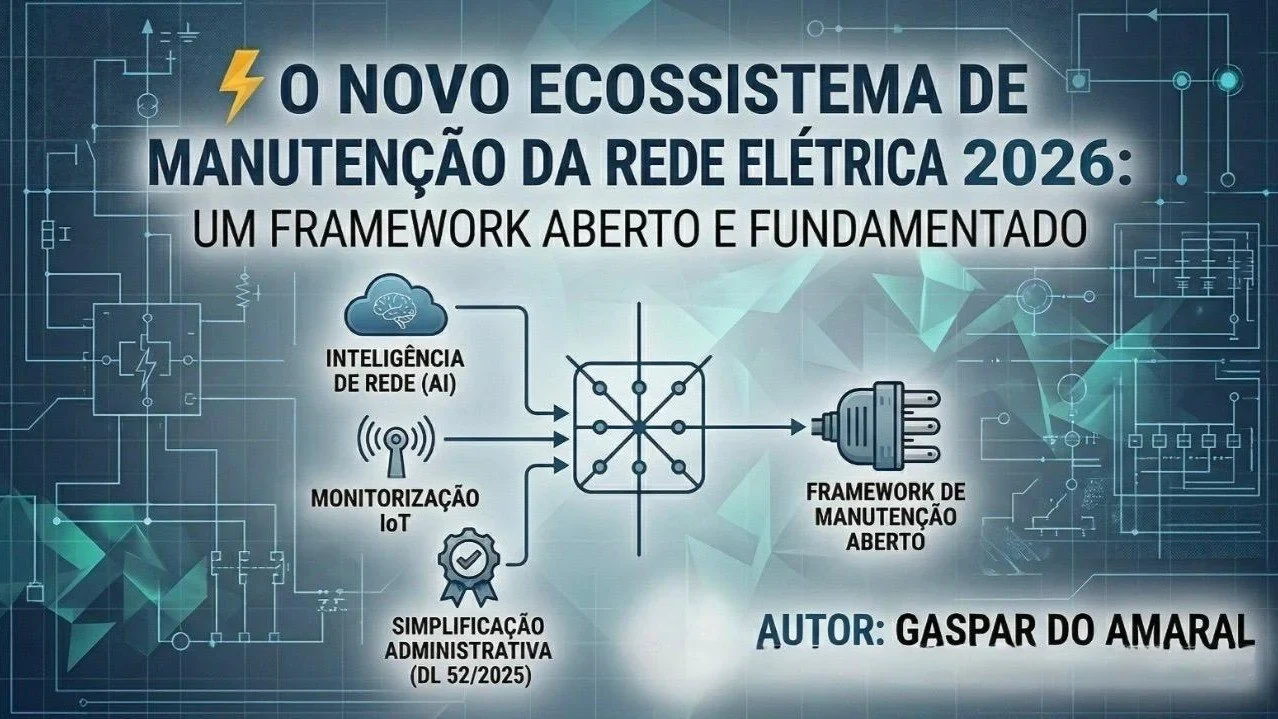
Maintenance of the distribution grid in Portugal has definitively entered the data age.
📋 Demonstrating the Technical Transition: from 2024 to 2026
The ERSE 2024 Quality of Service Report is the diagnosis that grounds the urgency of our framework. That document reported that most long service interruptions originated in “fortuitous causes” or “force majeure” (extreme weather events).
This statistic shows that the maintenance model based on calendar-based prevention and on reaction has reached the limit of its effectiveness. The new 2026 Framework introduces an operational paradigm shift to meet this challenge:
- From reactive to predictive: we replace the reaction to the fortuitous event with real-time IoT monitoring and Health Index (HI) algorithms. The aim is to mitigate the impact of storms and thermal anomalies before they cause the asset to fail.
- From calendar-based to condition-based preventive maintenance: external inspections, carried out with scientific rigour through the GIA app (Aplicação de Gestão de Inspeções de Ativos, asset inspection management application) and SAT protocols (Site Acceptance Test), are no longer done “because it is due”, but on the basis of the real condition of the asset, optimising resources and reducing the risk of human error.
(Source: analysis based on the ERSE 2024 Report and on Decree-Law 52/2025)
As professionals in the sector, we are witnessing a radical transition: from the reactive model to a hybrid architecture in which artificial intelligence, IoT monitoring and external specialisation converge to ensure the resilience of the PCND (switching stations and branch nodes) and of the whole national infrastructure.
In 2026, E-REDES did not merely update its technology; it reshaped its Asset Management strategy through a transparent process based on published results, which should be the foundation of any rigorous technical analysis.
⚖️ The Legal Basis: From the SEN to Administrative Simplification
This technological update does not happen in a vacuum. It is the direct result of a complementary legislative evolution that ensures legal certainty and economic efficiency:
- Decree-Law no. 15/2022 (Basic Law of the SEN): the structuring act that establishes the organisation and operation of the National Electricity System. It defines the mission of the Distribution System Operator (DSO) and the obligation to digitalise and open the grid to ensure continuity of supply.
- Decree-Law no. 52/2025 (Organic Law of the Directorate-General for the Economy): the engine of administrative agility. This decree-law creates the DGE through the merger of earlier bodies, giving it administrative autonomy. Its explicit mission is to support the development of an environment favourable to competitiveness and business innovation.
- Simplification: the DGE must promote policies aimed at reducing or eliminating context costs for economic agents.
- Agility: the act commits to giving the Public Administration greater efficiency, reliability and functional agility.
These acts made the following legally possible:
- Mandatory telemetry: real-time monitoring became the norm for critical assets.
- External inspection: E-REDES evolved into a “platform manager”, delegating continuous diagnosis to qualified partners.
- ERSE 2026 regulation: new quality-of-service metrics make predictive maintenance a regulatory requirement.
🔄 The Metamorphosis of the Maintenance Function and the Role of ERSE
E-REDES’s internal function does not cease to be needed; it undergoes a metamorphosis from labour to grid intelligence. The focus shifts to Second-Line Supervision, centred on strategic asset management and compliance auditing. This evolution allows the grid operator to focus on auditing the auditors and managing the national Health Index (HI), ensuring that the growing complexity of the infrastructure is managed on the basis of data and strategy.
This metamorphosis, however, brings a socio-technical paradox that E-REDES must manage with prudence: the risk of eroding internal practical know-how. By delegating diagnosis and intervention to external partners, the grid operator cannot give away its intellectual capital. Second-Line Supervision should not be merely administrative, but a “Hybrid Intelligence”, in which senior engineers validate the AI and experienced mentors ensure that the tacit knowledge of the grid is preserved and passed on. Asset management is based on data, but the resilience of the system in disaster scenarios will continue to depend on human competence.
In this scenario of decentralisation and specialisation, ERSE (the Energy Services Regulatory Authority) takes on the critical role of guarantor of the transparency and reliability promised in the administrative reform:
- Inspection and standards: ERSE sets the quality-of-service metrics (SARI/SAIDI) and the strictness of the criterion that turn predictive maintenance into a regulatory requirement and not merely a technical option.
- Concordance and audit: the effectiveness of the ecosystem is measured by the convergence between the reports of the external entities and the continuity indicators published by the regulator, ensuring that administrative simplification does not compromise the performance of the National Electricity System (SEN).
🛠️ The Three Technical Pillars of the Operation
I highlight the architecture that sustains this model:
- Predictive maintenance (data-based): IoT sensors validate the telemetry (batteries, motors, SF6). The system uses AI algorithms to calculate the Health Index (HI 1–5).
- Preventive maintenance (scheduled/condition-based): geo-referenced inspections carried out by accredited external entities (IEP, EQS, ISQ, etc.). The use of the GIA app with Bluetooth validation guarantees the non-repudiation of field data.
- Corrective maintenance (reactive/curative): when a failure event occurs (HI 4–5), the CCR (Grid Control Centre) carries out immediate dispatch and self-healing switching. Yet the reliability of this pillar lies not only in the accuracy of the algorithm, but in its explainability (XAI — eXplainable AI). For the CCR to take dispatch decisions with confidence, the AI model cannot be a “black box”. The 2026 framework requires the Health Index (HI) calculation to be accompanied by the explainability of the contributing factors (e.g. the weight of dissolved gas analysis vs. the number of switching operations). Only then do we guarantee technical accountability and transparency in the management of critical assets, turning statistical correlation into engineering causality.
📂 Business Development: Access to Resources
For engineering companies that wish to professionalise their activity, the roadmap is based on consulting the following channels:
- Technical reference: DMA/DPE standards and SAT protocols
- Consolidated legal basis: DL 15/2022 (SEN) and DL 52/2025 (DGE)
- Supplier qualification: E-REDES supplier area / Buyin platform
- Regulatory transparency: Quality of Service indicators (ERSE)
Cost–Benefit Balance: The New Maintenance Ecosystem 2026
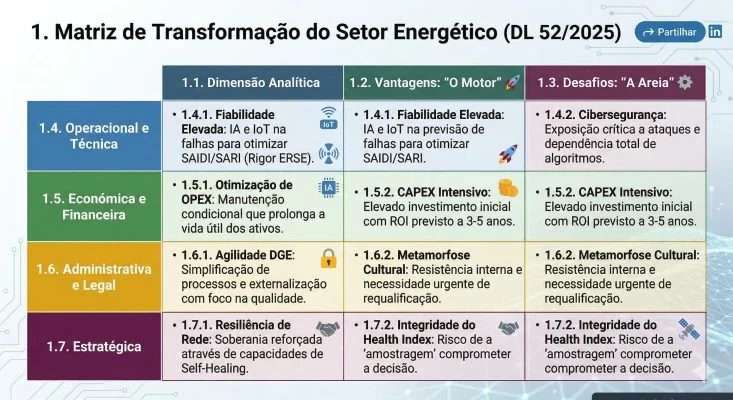
🔍 Efficiency or “Sand in the Gears”?
This model will succeed if digital transparency overcomes the temptation of approximate sampling. The autonomy granted by DL 52/2025 may allow external companies to prepare feasibility requests more quickly, but it demands relentless scientific rigour; although the act does not use the words “approximate sampling”, its Article 2 establishes the legal obligation of administrative simplification and elimination of context costs.
This scientific rigour must extend to cybersecurity and the total integrity of the chain of custody of the data. Procedural “sand” is a risk, but digital “sand” (corrupted or manipulated data) is an existential threat to the physical system. Although Bluetooth validation in the GIA app is a step forward, the framework must provide mechanisms to protect against GPS spoofing attacks and firmware tampering in the IoT sensors. The immutability of field data, perhaps guaranteed by distributed ledger technologies, is the non-negotiable foundation on which the whole predictive model rests.
It is on this legal basis that the conclusion rests: the autonomy of external companies to prepare feasibility processes is the practical instrument that DL 52/2025 created so that the “agility and reliability” promised in Article 1 leave the paper and reach the electricity grid. If the external entities embrace this framework, we will have an unbeatable grid. Otherwise, we will put “sand” into the country’s energy sovereignty.
Where necessary, the DGE Supervision Mechanism is triggered:
If administrative simplification fails, the legal path goes through the Directorate-General for the Economy (DGE).
- Technical support and assessment: the DGE is tasked with providing technical support in the monitoring and evaluation of public policies.
- Correcting context costs: if the autonomy of external companies is blocked by undue bureaucracy, the DGE’s mission of eliminating context costs for economic agents should be invoked.
- Monitoring execution: the DGE must monitor the execution of measures aimed at economic activities. If the sand is procedural, the DGE is the competent body to propose changes to the regulatory framework.
Recourse to Second-Line Audit (ERSE)
If the sand is technical (lack of rigour in inspections or approximate sampling), the path is regulatory inspection.
- Reporting non-compliance: use ERSE’s reporting channels to flag discrepancies between field reports and continuity-of-service indicators.
- Strictness of the criterion: recall that the model’s viability depends on rewarding performance. Random physical verification audits should be requested to validate the data submitted via the GIA app.
Transparency and Scientific Information
To overcome the temptation of sampling, the DGE’s editorial function should be used.
- Dissemination of information: the DGE must coordinate and disseminate scientific and technical information.
- Publication of best practices: create a repository of success stories and technical failures so that the ecosystem learns from error and isolates, through appropriate statistical data, the agents who introduce sand into the system.
Capacity-building and SIADAP 1
If the problem is internal resistance in the Ministry or at E-REDES:
- Capacity-building: invoke Article 3(2)(cc), which provides for capacity-building actions in policy design and evaluation.
- Service evaluation (SIADAP 1): the DGE coordinates the evaluation of the Ministry of the Economy’s services. A gear full of sand should be reflected negatively in the performance evaluation of the structures responsible for administrative simplification.
Technical conclusion: the way to remove the sand is not to go back to the old model, but to apply Article 2 of DL 52/2025 rigorously. Digital transparency is our best filtering tool.
📂 Technical Resources and Reference Links (Real Examples)
To ensure transparency, the technical community should consult the official channels:
- Standards and protocols (DMA/DPE series): E-REDES technical standards portal
- Quality-of-service indicators (SARI/SAIDI): Performance reports and publications
- Company qualification: Supplier area and Buyin platform
- Regulatory inspection: Portal of the Regulatory Authority (ERSE)
📎 Technical Annex: Transparency Checklist (Audit Check)
- Compliance: valid IPAC accreditation and technicians with an active DGEG licence?
- Data integrity: equipment paired via Bluetooth with the GIA app (no manual entry)?
- Geo-referencing: do the GPS coordinates match the real location of the PCND (switching station and branch node)?
- SAT rigour: insulation tests > 2000 MΩ and contact resistance in micro-ohms?
- Digital validation: reports signed with a Qualified Certificate (non-repudiation)?
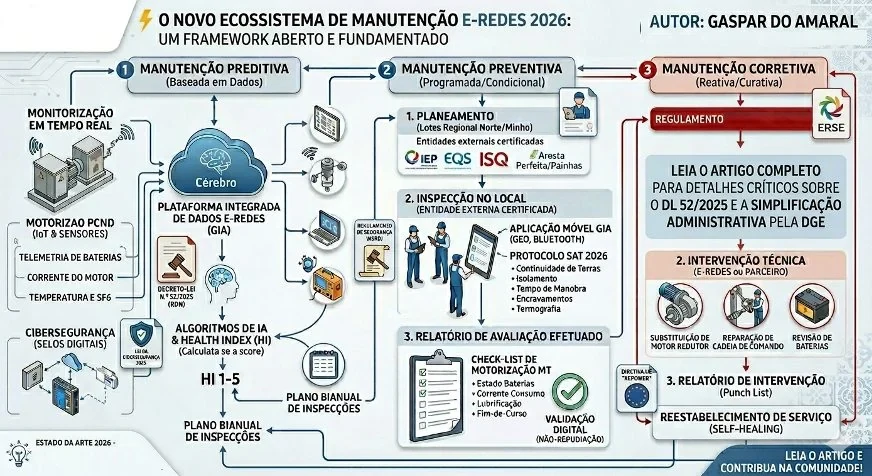
Navigating the Framework: The Visual Executive Summary
If you have read this far, you have understood that the success of this model depends on digital transparency overcoming the temptation of “approximate sampling”.
The map above was designed to be your technical guide. It shows how the DGE (DL 52/2025) removes the bureaucratic “sand”, allowing data gathered with scientific rigour to feed intelligent, frictionless management.
If the problem persists, use the safeguard mechanisms I have detailed in the text.
💬 Space for collaboration: this framework is a living document. I would like to hear your technical opinion in the comments: what have been the practical results of applying the new SAT protocols in your regions? Is the administrative simplification promised by the DGE reaching the ground?
Portuguese engineering has a fundamental voice in building a smarter and more resilient distribution grid.
#Engenharia #EREDES #SmartGrids #Manutenção #Energia #Portugal #LinkedInEngineering #Automação #GestãoAtivos
Methodological note
What this page is. An English translation of the article the author published on LinkedIn on 25 March 2026; the full Portuguese version is on this site. The article contains no calculations of its own; the values (HI 1–5, > 2000 MΩ, ROI in 3 to 5 years) are those of the original.
Changes of form, not substance. The quality-of-service indicators are named as in the original (SARI/SAIDI). The Portuguese bodies and acronyms are explained at first mention: ERSE (energy regulator), E-REDES (distribution system operator), DGE (Directorate-General for the Economy), DGEG (Directorate-General for Energy and Geology), IPAC (Portuguese accreditation body), SIADAP (performance evaluation system of the Public Administration). The hashtags are kept as in the original. The links are those of the original.
The discussion is on LinkedIn (in Portuguese)
Comments on this text are made on LinkedIn, where the article was shared in Portuguese. You are welcome to write in English. Agree, disagree or add data: every well-founded objection receives a reply.
Gaspar do Amaral · Original in Portuguese of 25 March 2026, published on this site; translation issued on 30 October 2026 · Figures and tables © Aprecisa.com · AI-assisted
How to cite: Gaspar do Amaral (2026). O Novo Ecossistema de Manutenção Elétrica 2026: um framework aberto e fundamentado. Zenodo. https://doi.org/10.5281/zenodo.23814345 · Permanent archive on Zenodo.