 ← Grupo Aprecisa · Connecting those who know with those who need
Energy and the electricity system · Article published on LinkedIn on 27 March 2026
Energy Transition in Portugal: The End of Excessive Rents and the Beginning of Integral Responsibility
Two decades of energy transition: the excessive rents, the hidden cost of intermittency and the proposal for integral responsibility
Gaspar do Amaral · 27 March 2026
Translated from the Portuguese original. This version was issued on 27 October 2026.
On this site, this article has been
By: Gaspar do Amaral
Over the last two decades, the Portuguese electricity system has undergone a deep structural transformation. However, this change was often governed by a dogmatic “climate emotion”, to the detriment of rigorous planning and systems architecture. It is imperative to expose the true financial anatomy of this transition: to deconstruct the historical extra costs, to reveal the hidden “iceberg” of intermittency and to propose a legislative disruption in which engineering, the joint integration of infrastructure and the free market set the rules.
The energy transition is not a mere environmental dossier; it is the largest and most complex challenge of integrating cyber-physical networks on a national scale. It demands a level of resilience, redundancy and topological optimisation identical to that required in the joint and critical operation of transport and communications systems (land, sea and air). Based on the economic literature of the Fundação Francisco Manuel dos Santos [1] and on the systematic extraction of data from the recent study by João de Jesus Ferreira [2], it becomes evident that Portugal’s energy future requires an absolute break with the model of blind subsidies.
1. The historical mortgage: anatomy of a design error
Academic and technical experience has long warned us of the risks of administratively fixed tariffs, a phenomenon duly mapped in the studies on economic severity of the Berkeley Energy Institute [3]. In Portugal, the legislative framework (anchored in instruments such as DL 189/88 and DL 99/91, and expanded exponentially by DL 339-C/2001 and DL 240/2004; DL stands for Decreto-Lei, decree-law) guaranteed rents to developer companies through the Special Regime Production scheme (PRE, Produção em Regime Especial).
The original justification — mitigating risk for immature technologies — crystallised into a systemic design error when the technologies became cheaper but the long-term contracts, with very high tariffs, remained unchanged.
- The past bill: as the consolidated data show, corroborated by the regulator in the Report on the Costs of General Economic Interest [4], between 2005 and 2023 this scheme imposed 13.1 billion euros of extra costs on Portuguese consumers (paid through the Network Access Tariffs).
- The surviving bill: for the period from 2024 to 2044, a further 5.2 billion euros is expected to be injected to support the contracts still in force.
2. The systemic “iceberg” and the fallacy of nominal capacity
The true cost of a generation technology does not end with its installation; it lies in its impact on the stability of the overall grid. Technical analysis quickly dispels the illusion of parity between intermittent and dispatchable sources, something exhaustively documented in the ENTSO-E European resource adequacy assessment standard [5].
- The illusion of capacity (ELCC): science shows, through the Effective Load Carrying Capability indicator and as validated by MIT researchers [6], that 100 MW of solar energy guarantee only 5 to 15 MW of “firm capacity”. In contrast, thermal or hydro power stations ensure more than 80 MW.
- “Missing money” and price cannibalisation: the massive injection of renewables pushes market prices to zero in periods of abundance, destroying the viability of conventional power stations [7], [8]. Without these power stations, which guarantee frequency stability to avoid the “blackout” [9], the system collapses.
- The hidden cost of integration: intermittency requires massive transmission networks. The colossal needs described in the Network Development and Investment Plan [10] prove these systemic costs, which add around 10 to 15 €/MWh, projecting a hidden burden of 15.8 billion euros up to 2044.
To this is added the unavoidable mathematics of proportionality: Portugal emits only 0.1% of global greenhouse gases. Compromising the country’s economic sustainability in the name of a statistically marginal climate impact defies rationality.
3. The new paradigm: the Integral Energy Responsibility Law
The answer to this failure is not to fine-tune dogmas, but to establish relentless contractual engineering and the technical solutions advocated by the standards of the International Energy Agency [11]. The adoption of the Lei de Responsabilidade Energética Integral (LREI, Integral Energy Responsibility Law) is proposed, based on four disruptive pillars:
I. Transition to the “System LCOE” and internalisation of risk
The State must abandon the misleading metric of the Levelized Cost of Energy (LCOE). Auctions must adopt the System LCOE, incorporating network and balancing costs. No developer may bid unless the grid reinforcement costs generated by its project are deducted from the price offered, enshrining the “causer pays” principle.
II. Dynamic nodal pricing (Locational Marginal Pricing - LMP)
To avoid blind investment in the grid, the price of energy must reflect the physical congestion of the infrastructure at a specific location. If a developer installs capacity at a node of the national grid that is already saturated, it will receive a lower price. The market will dictate the topological optimisation of the system.
III. Integrated synergy: critical infrastructure and V2G
Dedicated storage has a prohibitive capital cost, with the reference literature demonstrating the economic unviability of lithium-ion batteries for long cycles and the severe thermodynamic losses of other conversion alternatives [12], [13]. The structural solution lies in the joint integration of land transport systems and communications networks. Through bidirectional protocols (V2G), the batteries of the electric vehicle fleet act as a distributed mega-battery. At the same time, the large communications nodes and logistics centres must take part in local Demand Response markets. This advanced orchestration, entirely dependent on rigorous telecommunications requirements (bandwidth, latency and redundancy) and on grid automation standards [14], [15], makes it possible to act on and relieve the system in the critical milliseconds of a failure.
IV. “Zero Bailout” (anti-lobbying) mechanism and capacity markets
In recent auctions, we have witnessed predatory bids. Any request to alter a Contract for Difference (CfD) on grounds of “economic unviability” must result in immediate termination and in the reversion of the assets to the State. At the same time, a Capacity Mechanism designed with mathematical rigour [16] must be established to remunerate strictly the firm capacity of hydro and thermal power stations, prohibiting the State from bailing out failed financial bets of the intermittent sector.
Conclusion: the dictatorship of competition and rigour
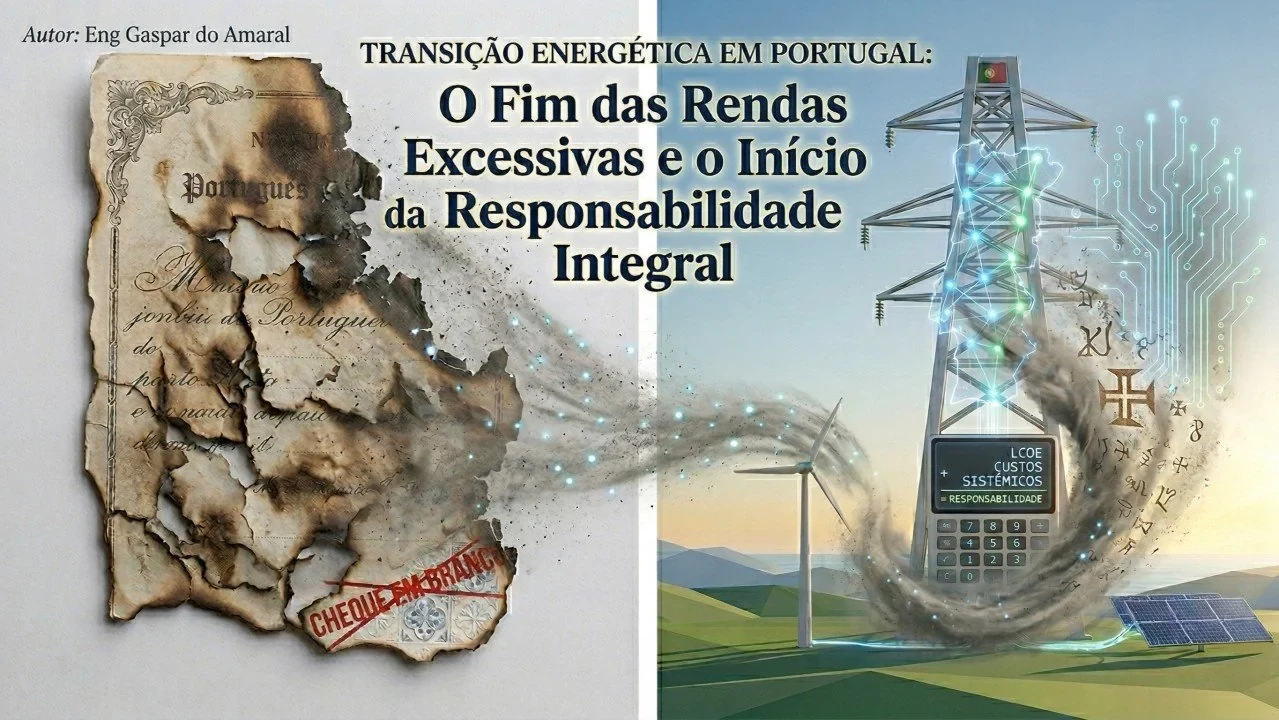
We have reached the end of the blank cheque. The Portuguese energy transition was, for too long, a system designed by emotion and financed by a mortgage at usurious rates. The true transition will only triumph when the market imposes aggressive competition and when technical and scientific rigour proves, conclusively, that every euro invested guarantees the physical robustness of the infrastructure without subjugating the national economy. Ideology projects intentions but, in the face of the irreducible complexity of the real world, it is mathematics that keeps the circuit breakers on.
Bibliographic references and technical relevance
[1] Vasconcelos, J. (2018). A Energia em Portugal: O Sistema Elétrico. Fundação Francisco Manuel dos Santos. [Energy in Portugal: the electricity system]
Relevance: Written by the first president of the Portuguese regulator (ERSE), it offers a macro view of the architecture of the national system, pointing out the historical regulatory failures and the market design errors that favoured political solutions to the detriment of economic rationality.
[2] Ferreira, J. J. (2026). O Regime da Produção de Energia Eléctrica com Remuneração Garantida em Portugal: Evolução, Impacto Tarifário e Perspectivas até 2044. SEDES/OBSIIE. [The regime of electricity production with guaranteed remuneration in Portugal: evolution, tariff impact and prospects up to 2044]
Relevance: It is the quantitative backbone of this manifesto. It dissects the financial anatomy of the PRG contracts (Produção com Remuneração Garantida, production with guaranteed remuneration), factually proving the 13.1 billion euros of past extra costs and the 5.2 billion in the future.
[3] Borenstein, S. (2012). The Private and Public Economics of Renewable Electricity Generation. UC Berkeley.
Relevance: A severe economic critique of 100% guaranteed tariff schemes (feed-in tariffs). It shows how these models shield private developers against all risks, transferring the burden to the State and to consumers.
[4] ERSE (2023). Relatório sobre os Custos de Interesse Económico Geral (CIEG). [Report on the Costs of General Economic Interest]
Relevance: Official document that certifies and audits the way in which subsidies to electricity production (rents) are transferred to households and businesses through the Network Access Tariffs (TAR).
[5] ENTSO-E (2024). European Resource Adequacy Assessment (ERAA).
Relevance: The gold standard of European grid engineering. It documents the Effective Load Carrying Capability (ELCC) methodologies, proving that the “firm capacity” of wind and sun is a tiny fraction of their nominal capacity.
[6] Joskow, P. L. (2011/2017). Comparing the Costs of Intermittent and Dispatchable Electricity Generating Technologies. MIT / American Economic Review.
Relevance: A work that destroys the LCOE fallacy. It shows scientifically that comparing intermittent with dispatchable technologies requires weighting the moment of generation, supporting the urgency of the System LCOE.
[7] Hirth, L. (2013). The market value of variable renewables... Energy Economics.
Relevance: It provides the mathematical proof of the structural devaluation of renewable energies as their penetration in the system increases, justifying the internalisation of profile costs.
[8] Simões, S., et al. (2021). Impact of high renewable energy penetration on the electricity market: A case study of Portugal. Energy Policy, 152.
Relevance: A rigorous study that models the Portuguese scenario, proving the price cannibalisation effect: high intermittent penetration pushes wholesale prices close to zero.
[9] ACER (2022). Decision on the methodology for calculating the Value of Lost Load (VoLL).
Relevance: It establishes the mathematical calculation of the “price of the blackout”, grounding the absolute need for capacity mechanisms and demonstrating the catastrophic cost of a failure for infrastructure.
[10] REN (2023). Plano de Desenvolvimento e Investimento da Rede Nacional de Transporte de Eletricidade (PDIRT 2024-2033). [Development and Investment Plan for the National Electricity Transmission Network]
Relevance: It materialises the “iceberg” of systemic costs, detailing the billions of euros in physical investment needed exclusively to accommodate renewable intermittency.
[11] IEA (2021). Grid Integration of Variable Renewables: Phase 3 and beyond.
Relevance: A world technical manual on frequency stability solutions. It supports the urgency of implementing bidirectional protocols (V2G) and Demand Response markets.
[12] LDES Council & McKinsey & Company (2021). Net-zero power: Long duration energy storage for a renewable grid.
Relevance: It proves that lithium-ion batteries are economically unviable for covering periods without wind and sun longer than 4-8 hours, requiring heavy infrastructure (e.g. pumped-storage hydro).
[13] Albertus, P., Manser, J. S., & Litzelman, S. (2020). Long-duration electricity storage applications, economics, and technologies. Joule, 4(1), 21-32.
Relevance: It dissects the full-cycle efficiency (round-trip efficiency) of pumped hydro storage compared with the thermodynamic losses of electrical-chemical-electrical conversion.
[14] Gungor, V. C., et al. (2011). Smart Grid Technologies: Communication Technologies and Standards. IEEE Transactions on Industrial Informatics, 7(4), 529-539.
Relevance: It maps the rigorous telecommunications requirements (bandwidth, latency, redundancy) needed for grid automation, which are essential if stability is to depend on the reliable routing of data.
[15] IEC (2020). IEC 61850: Communication networks and systems for power utility automation. International Electrotechnical Commission.
Relevance: It confirms that energy planning cannot ignore the digital and communications architecture underlying the control of power systems.
[16] Cramton, P., Ockenfels, A., & Stoft, S. (2013). Capacity Market Fundamentals.
Relevance: An algorithmic and theoretical reference for the design of complex electricity markets, essential for implementing Capacity Auctions able to solve the missing money problem.
Methodological note
What this page is. A translation of the article the author published on LinkedIn on 27 March 2026; the full Portuguese version is on this site. The figures (13.1 and 5.2 billion euros, 15.8 billion euros up to 2044, 10 to 15 €/MWh, 0.1%) are those of the original and of the sources it cites.
Names of laws and bodies. Portuguese decree-laws (DL), schemes (PRE, PRG) and the proposed Lei de Responsabilidade Energética Integral (LREI) are kept in Portuguese, with an explanation in brackets. The titles of the sources are kept in the original; for titles in Portuguese, a translation is given in square brackets.
Changes of form, not of content. The LinkedIn version repeated the title and the byline at the start of the text; the repetition, also present on the Portuguese page, is not reproduced here. Two stray “>” signs (left over from the formatting) in references [4] and [5] were removed, and each “Relevance” appears in its own paragraph, as in the other references. The four pillars of section 3 appear as sub-headings. The original illustration is reproduced with its texts in Portuguese and a translated caption.
The discussion is on LinkedIn (in Portuguese)
Comments on this text are made on LinkedIn, where the article was shared in Portuguese. You are welcome to write in English. Agree, disagree or add data: every well-founded objection receives a reply.
Gaspar do Amaral · Original in Portuguese of 27 March 2026, published on this site; translation issued on 27 October 2026 · Figures and tables © Aprecisa.com · AI-assisted