 ← Grupo Aprecisa · Connecting those who know with those who need
Energy and the power system
400 kV of Trade, Zero Guaranteed Inertia — What the New Minho–Galicia Interconnection Carries — and What It Does Not Replace
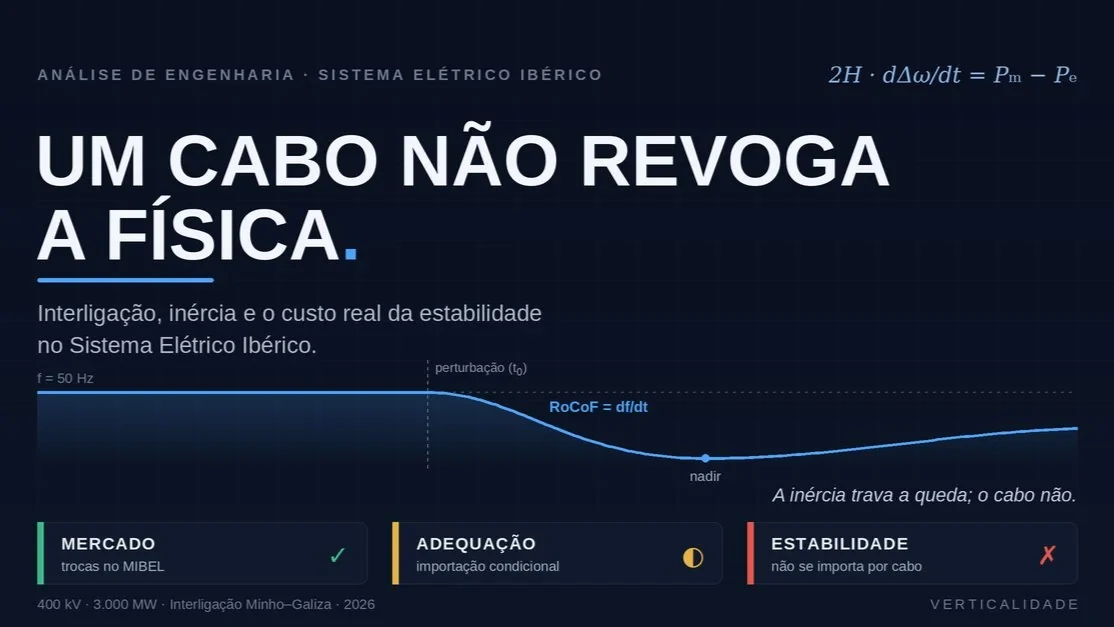
A cable does not repeal physics: interconnection, inertia and the real cost of stability in the Iberian power system
Gaspar do Amaral · 2 July 2026
Translated from the Portuguese original. This version was issued on 27 October 2026.
On this site, this article has been
A Cable Does Not Repeal Physics
Interconnection, inertia and the real cost of stability in the Iberian power system
Looking at the news with a critical mind is the first step to not being held hostage by political rhetoric. Engineering should not be an occult science shut away in offices: what happens on the electricity grid decides the amount of the bill at the end of the month and the basic security of the light coming on when we press the switch.
The short answer to the promise of the ministry in charge — repeated on 2 July 2026 by Maria da Graça Carvalho in Pontevedra, at the inauguration of the new Minho–Galicia interconnection (a double 400 kV overhead line between Beariz, Fontefría and Ponte de Lima, for a minimum commercial capacity of 3,000 MW in both directions) — is this: it is a half-truth presented as an unconditional solution. The Minister credited the new line with the effect of “increasing the stability of the grid” and of reducing the likelihood of a blackout. Now, a new line is excellent for trade and useful for the adequacy of the system, but it does not replace the local dynamic security of the grid; and, in the absence of that security, it may be precisely the path along which a disturbance of external origin spreads.
We must, however, be rigorous about the record. The ENTSO-E factual report of 3 October 2025 concluded that the blackout of 28 April originated in Spain and that the Portuguese grid showed resilience until the total collapse of the Iberian system. Therefore, the government’s attribution — “the problem was in Spain” — was substantiated, not refuted. The real question is not one of hypocrisy; it is one of technical coherence: how can the same interconnection be, in April 2025, the vector through which a Spanish collapse drags us down and, in 2026, the shield we are being sold? The answer is that the interconnection is two-sided — and that neither of the two narratives solves what actually ensures stability. It is into that “engine room” that we shall now go down.
The Motorway of Electrons — what the cable carries (and what it does not replace)
The interconnection is, indeed, a new traffic lane: it relieves grid congestion and expands trading in MIBEL, the Iberian Electricity Market. But there is an inescapable physical correction to make here, or the argument collapses before any system operator.
An interconnection in synchronous alternating current — which is the Iberian case — does not carry only financial flows; it carries synchronising torque. Portugal and Spain operate in the same synchronous area of Continental Europe and are today coupled by several extra-high-voltage lines, managed technically almost as a single grid, with very significant flows of energy between them. In that condition, inertia is shared and the short-circuit power at the border increases. Tying a small system to a much larger synchronous pool tends, in the overwhelming majority of contingencies, to strengthen frequency and angular stability — not to degrade it.
Where, then, does the political promise fail? It is not that the new lane “is of no use for security”. It is that a wider motorway does not save a route whose roadbed is giving way at the same time along the whole corridor. If both grids share the same structural deficit — too much power electronics without grid-forming capability (grid-forming) and a shortage of voltage and reactive power control — then widening the cable does not correct the deficit: it spreads it.
The interconnection improves trade and adequacy; it does not replace local dynamic security (inertia, reactive power, fault current) nor the defence plan that prevents an accident in one lane from spilling into ours. That plan — automatic load shedding and schemes of controlled separation/islanding — is codified in Regulation (EU) 2017/2196 (Network Code on Emergency and Restoration) and in Regulation (EU) 2017/1485 (System Operation Guideline).
Rigid Coupling — it is not the rope, it is the hull
The image of the small vessel moored to the cargo ship still holds, but with the physical vector corrected: in normal conditions, it is precisely the mass of the cargo ship that stabilises the small vessel — its inertia damps the rolling of the smaller one. The lethal scenario is not the rope; it is both hulls having the same unrepaired breach below the waterline. In the power system, that common breach has a technical name: voltage collapse due to insufficient reactive power, made worse by the replacement of synchronous machines by converters without dynamic support. In Systems Theory, the risk is not the coupling itself — it is the common-mode failure.
And here is the example that needs no metaphor, because it happened and is documented. The Iberian collapse of 28 April 2025 was triggered by cascading disconnections of solar, wind and solar-thermal power plants in Spain — more than 2.5 GW of generation lost in less than a minute — many of which absorbed reactive power essential to voltage control, causing a rapid rise in voltage and frequency imbalances that culminated in the loss of synchronism of the Peninsula with the continental system. The most likely cause established by ENTSO-E was a sequence of cascading voltage increases, a phenomenon without precedent on the European grid.
Note the double lesson:
- The rope (the interconnection) was the path along which the sinking spread — Portugal could do little in the face of an event of this magnitude, being operated almost as a single grid with Spain;
- But it was also the interconnections that made it possible to refloat the vessel: restoration relied on creating electrical islands with black-start power plants and on support from the interconnections with France and Morocco.
The interconnection is, therefore, two-sided — a vector of contagion and a means of restoration. Presenting it as a pure liability is as untenable as selling it as a pure shield. What closes the bulkheads in time is not the absence of a rope: it is the automatic separation scheme provided for in the defence plan. In the early hours of 28 April, the bulkhead did eventually seal — the Peninsula separated from Continental Europe — but only after the flooding had already become general.
The Real Shield — frequency and voltage
A clarification that strengthens, rather than weakens, the thesis: the shield is not only synchronous inertia. The 2025 event was primarily one of voltage/reactive power, not of frequency — so the defence has to be two-dimensional:
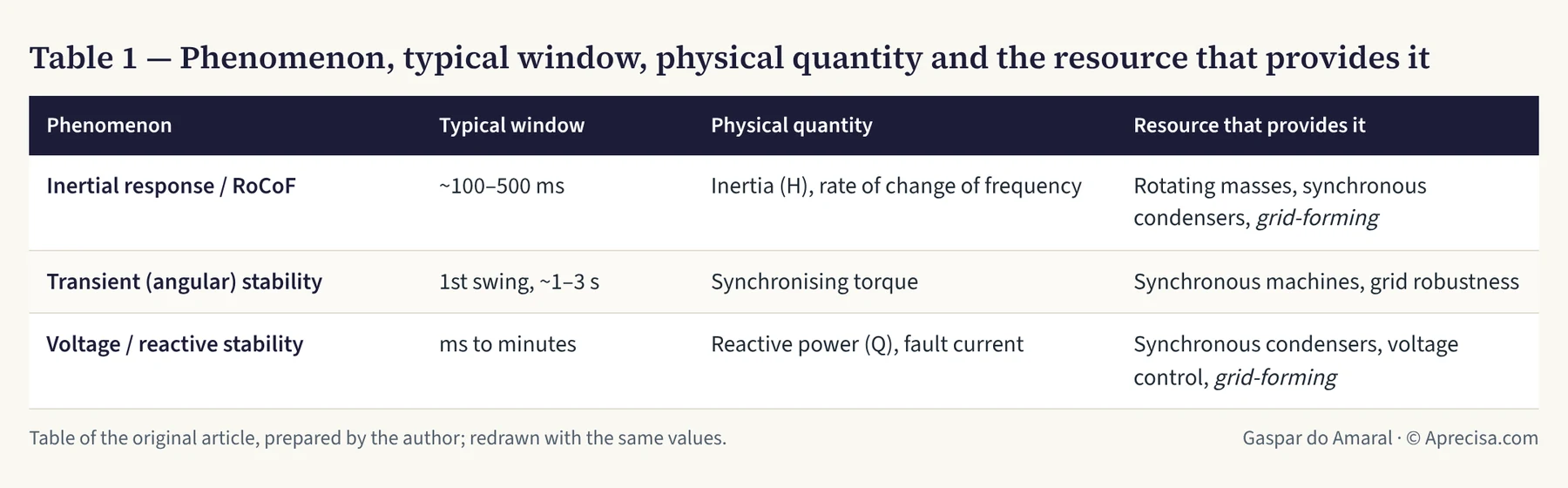
Both axes — frequency and voltage — can be delivered by synchronous machines and synchronous condensers or, increasingly, by grid-forming converters. This is the regulatory foundation of the Lei REI (the “REI Law”, Integral Energy Responsibility Law) that I propose: in November 2025, ENTSO-E published the Phase II Technical Report on grid forming requirements, as part of the revision of the Network Code NC RfG 2.0, which introduces grid-forming capability requirements for non-synchronous and storage modules. In other words: the principle of obliging those who inject unstable energy to install their own shock absorbers is ceasing to be an ethical proposal and becoming a European standard.
Practical Reflection — The Three Frontiers of Assessment
To genuinely protect society, we have to abandon the rhetoric of the easy electron. Judging an energy policy by the momentary price of energy on a trading screen is to mistake one of the three frontiers of the problem for the whole of it. An infrastructure decision is only sound when it answers, separately, three orthogonal questions:
1. Economic frontier — how much does it cost, including integration? The Levelized Cost of Energy (LCOE) at plant level ignores the cost of integrating variable generation into the system. The concept of System LCOE, formalised by Ueckerdt, Hirth, Luderer and Edenhofer (2013), adds three integration components to the generation cost: profile costs (the dispatchable capacity needed to follow the residual load), balancing costs (the deviation between forecast and actual output) and grid costs (reinforcement and extension of the infrastructure). The result is well known and uncomfortable: for high shares of wind and solar (above ~20–40 %), integration costs can reach the same order of magnitude as generation costs, mainly through profile costs. Note, by the way, what the business case of the Minho–Galicia interconnection itself rests on: according to studies cited by REN within the European grid development plan, the project could reduce variable production costs by between €4 and €29 million a year in 2030. It is a real benefit — but expressed in euros of production cost, that is, located on this economic frontier, not on that of stability. The technical justification of the project does not, therefore, rest on the argument with which it is sold to the public.
2. Adequacy frontier — is there enough energy, and when it is needed? Here indicators such as the Loss of Load Expectation (LOLE) and the Expected Energy Not Served (EENS) are assessed, within the European resource adequacy assessment (ERAA) provided for in Regulation (EU) 2019/943. It is on this frontier that the interconnection actually contributes — import capacity counts towards adequacy. But it counts with a decisive caveat: in a system-wide event, the neighbour is equally in difficulty and the interface may open. Adequacy through imports is conditional; it is not firm.
3. Stability frontier — can the grid withstand the shock in the millisecond? This is the frontier that political discourse ignores and that the 2025 blackout exposed. It is measured in inertia and RoCoF (frequency) and in reactive power and fault current (voltage). It is here that the interconnection does not replace local provision — and it is here that the Lei REI acts.
The Lei de Responsabilidade Energética Integral (Integral Energy Responsibility Law, Lei REI) is the instrument that internalises the third frontier (and part of the grid costs of the first): it obliges developers to bear the cost of their own means of stabilisation — grid-forming capability, storage, reactive support — when they inject variable energy into the grid, instead of socialising it in the consumer’s bill. Far from being a brake on the transition, it is its safety condition: it aligns private incentive with collective resilience, in exactly the direction the revision of the NC RfG is taking.
From today, whenever you hear on the television news that a cable has repealed the Laws of Physics, you have the framework needed to separate the three frontiers and recognise the one being silenced.
Resilience is not bought on a trading screen; it is built with concrete, mathematics and Verticalidade (Verticality).
Annex — The unresolved trade-off, in press cuttings
For auditing the sources and the record of statements:
- The “Shield” (2 July 2026): at the inauguration of the Minho–Galicia interconnection, in Pontevedra, the Minister for the Environment and Energy, Maria da Graça Carvalho, credited the new line with the effect of “increasing the stability of the grid” and of reducing the likelihood of a blackout — RTP · Executive Digest.
- The internal tension of the discourse (same day): at the same press briefing, the Minister admitted that localised blackouts remain possible in the face of the overload caused by the heatwave — which exposes the gap between the promise of stability and operational reality.
- The origin in Spain (after the 2025 blackout): “the problem was in Spain” — a position later confirmed by the ENTSO-E factual report.
- Reinforced operation (since April 2025): both operators began to run their grids in reinforced operation mode, with additional means of voltage and frequency control.
Technical coherence demands that we say what none of the statements says: the interconnection is useful on the adequacy frontier, but it does not replace local dynamic security nor the defence plan. Selling the cable as a shield is presenting one of the three frontiers as if it were the only one.
Methodological note
What this page is. A translation of the article the author published on LinkedIn on 2 July 2026; the full Portuguese version is on this site. MIBEL is the Iberian Electricity Market; REN is the operator of the Portuguese transmission grid; ENTSO-E is the European Network of Transmission System Operators for Electricity.
The author’s concepts. The Lei REI (Lei de Responsabilidade Energética Integral, Integral Energy Responsibility Law) is the author’s proposal, and Verticalidade (Verticality) is a concept from his book A Fundação da Verticalidade: Da Engenharia da Soberania à Construção do Futuro. Both keep their Portuguese name, with a translation in brackets.
Table 1. In the original the table has no number or title, and on the Portuguese page of this site its cells appeared run together in a single line of text (an error in the import from LinkedIn). Here it is redrawn as Table 1, with exactly the same three rows and four columns; the title only repeats the names of the columns. No value was changed.
Changes of form, not of content. The decorative symbols (emoji) and the horizontal separator lines of the LinkedIn version were left out. The titles of the sources stay in their original language; only the notes on each source are translated. The links to sources are those of the original.
References
- ENTSO-E — 28 April 2025 Iberian Blackout (relatório factual e painel de peritos) — Primary source on the blackout: it identifies the cascading overvoltage, the disconnections of renewables in Spain (>2.5 GW in less than a minute) and the loss of synchronism of the Peninsula. The central factual basis of this article.
- Regulamento (UE) 2017/1485 — System Operation Guideline (SO GL) — Establishes the secure operation of the interconnected system, contingency analysis (N-1) and the concept of the system defence plan. It frames the operation in a “reinforced state” adopted after the blackout.
- Regulamento (UE) 2017/2196 — Código de Rede de Emergência e Restauro (NC ER) — Defines the defence plan (automatic frequency and voltage load shedding) and the restoration plan. It is the instrument that embodies the “bulkheads” of the analogy — the controlled separation that prevents a disturbance from spreading.
- Regulamento (UE) 2016/631 — Requisitos para Geradores (NC RfG) — Connection requirements by type A–D, including fault-ride-through capability and frequency and voltage ranges. The existing legal basis with which the Lei REI is articulated.
- ENTSO-E — Phase II Technical Report on Grid Forming Requirements (nov. 2025) e revisão NC RfG 2.0 — Introduction of grid-forming capability requirements for non-synchronous modules and storage. It anchors the Lei REI in regulation: internalising dynamic support is becoming a European obligation.
- ENTSO-E — High Penetration of Power Electronic Interfaced Power Sources and the Potential Contribution of Grid Forming Converters (HPoPEIPS, 2017) — Reference technical report: it identifies the reduction of inertia and of short-circuit power, system split and voltage stability as challenges, and the capabilities that grid-forming must deliver (voltage creation, fault current, inertial contribution).
- Regulamento (UE) 2019/943 — Mercado Interno da Eletricidade — Basis for adequacy (European resource adequacy assessment — ERAA), redispatching and curtailment. It supports the argument that the interconnection contributes to adequacy, but does not make it firm.
- Ueckerdt, F., Hirth, L., Luderer, G. & Edenhofer, O. (2013). System LCOE: What are the costs of variable renewables? Energy, 63, 61–75 — Defining source of the System LCOE concept (pre-print: pik-potsdam.de). It formalises integration costs mathematically in three components — profile, balancing and grid — and shows that, at high shares, they can equal generation costs.
- Declaração da Ministra do Ambiente e Energia, Maria da Graça Carvalho (Pontevedra, 2 de julho de 2026) — RTP — Record of the statement that prompted the article (also Executive Digest / SAPO · Observador (inauguration)). The Observador piece documents the project specifications (double 400 kV overhead line, 3,000 MW, ~90 km, of which 72 in Portugal) and REN’s estimate of a reduction in variable production costs of between €4 and €29 million a year in 2030.
The discussion is on LinkedIn (in Portuguese)
Comments on this text are made on LinkedIn, where the article was shared in Portuguese. You are welcome to write in English. Agree, disagree or add data: every well-founded objection receives a reply.
Gaspar do Amaral · Original in Portuguese of 2 July 2026, published on this site; translation issued on 27 October 2026 · Figures and tables © Aprecisa.com · AI-assisted