 ← Grupo Aprecisa · Connecting those who know with those who need
Energy and the power system · Article published on LinkedIn on 29 April 2026
The Illusion of Wilful Blindness: When SMRs Are Mistaken for “UFOs”
Small modular reactors are not UFOs: what engineering sees on the ground and on the system’s bill
Gaspar do Amaral · 29 April 2026
Translated from the Portuguese original. This version was issued on 30 October 2026.
On this site, this article has been
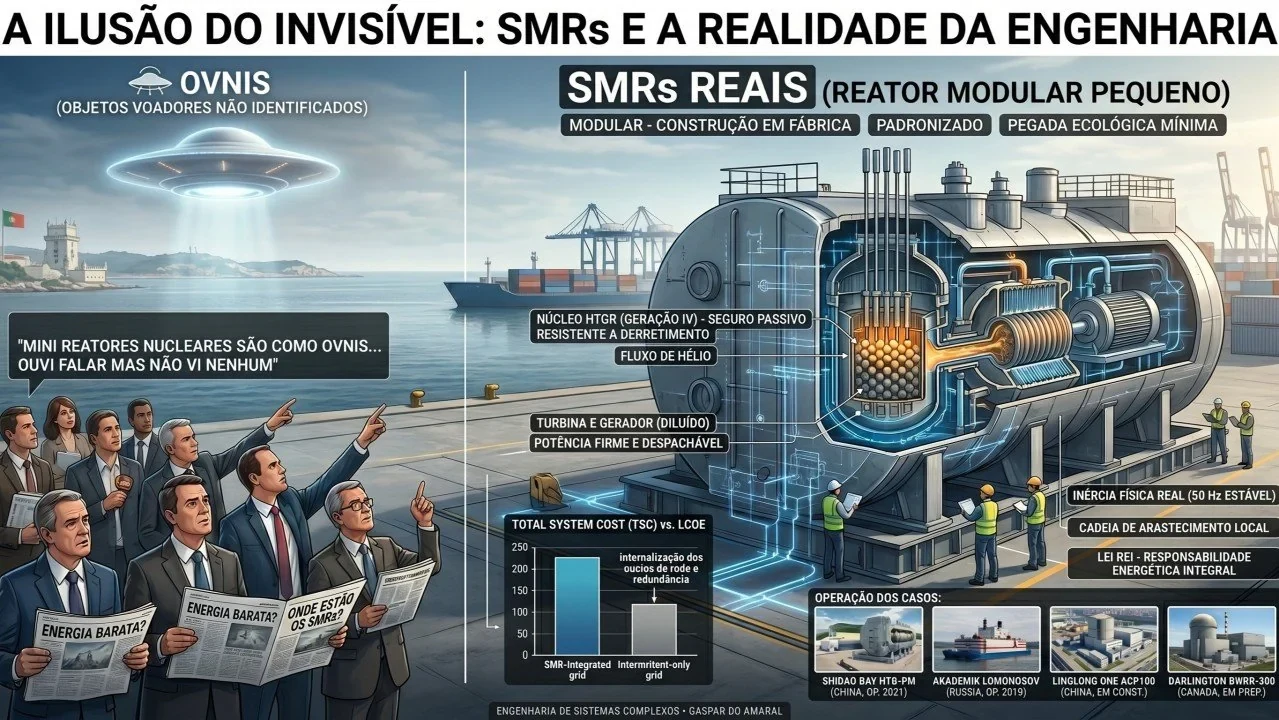
Irony is a tempting rhetorical tool, but it becomes dangerous when it runs into the reality of physical engineering and thermodynamics. Recently, in statements to the Jornal de Negócios, it was claimed that Small Modular Reactors (SMR) “are like UFOs: I have heard of them but never seen one”.
In Systems Engineering we do not look to the skies in search of science fiction; we look at the ground, at reinforced concrete and at the bill for the Effective System Cost (System LCOE). Calling this technology a “UFO” is not just an unfortunate metaphor; it is a public confession of the industrial illiteracy that governs our energy planning.
So that “seeing” does not depend on beliefs, let us decode these reactors with facts and geography:
1. The False Novelty: Naval Propulsion
The claim that a small reactor has “never been seen” reveals a deep industrial amnesia. The navies of the great powers have operated fleets of nuclear submarines and aircraft carriers for seven decades. The reactor of a nuclear submarine is, in essence, an SMR: a pressurised water reactor (PWR), modular and compact, operating in extremely hostile environments without emitting a single gram of CO2. The civil SMR is not “new physics”; it is the transfer of a mature and highly safe military technology to the commercial grid.
2. In the East, the “Hardware” Is Already Earning
The UFO argument only survives inside the European bubble of Inércia Síncrona Administrativa (Administrative Synchronous Inertia). In the East, these machines are already connected to the grid, producing electrons and generating revenue:
🔹 Shidao Bay (China): the world’s first commercial Generation IV SMR (HTGR) entered full operation in December 2023. It produces 200 MWe and is physically immune to core meltdown. 🔗 Details of the operation
🔹 Akademik Lomonosov (Russia): a floating nuclear power plant equipped with two 35 MW SMRs. It has supplied heat and electricity to the grid in the Arctic since 2019. 🔗 IAEA - Lomonosov
3. Concrete and Certification in the West
While Portugal hesitates, others are moving ahead to secure their energy sovereignty:
🔹 NuScale Power (USA): the design of its SMR (VOYGR) was formally certified by the NRC in 2023. The world’s most rigorous regulator does not audit “unidentified objects”; it audits mathematics and passive safety. 🔗 NRC certification
🔹 Darlington (Canada): Ontario Power Generation has begun physical site preparation to install GE Hitachi’s SMR (BWRX-300) in 2028. 🔗 Darlington project
The Verdict of Engineering: the Abismo do Rigor (Abyss of Rigour)
The underlying problem is not whether the technology exists, but the refusal to account for its systemic value. As masters such as Vaclav Smil and Dieter Helm warn, the economy is a subsystem of thermodynamics. Focusing only on the LCOE of intermittent sources is a design error: 100 MW of solar power guarantee only 5 to 15 MW of “firm capacity”.
Without the Physical Inertia and the dispatchable power that nuclear provides, the grid becomes stochastic and fragile. Trying to run a modern electricity system without physical ballast is to plunge the country into the Abismo do Rigor.
Conclusion: the Urgency of the Lei REI
The time has come to abandon “climate emotion” and adopt scientific rigour. I propose the immediate implementation of the Integral Energy Responsibility Act (Lei de Responsabilidade Energética Integral, REI). No developer should inject variable energy into the grid without taking full responsibility for the stabilisation costs that its intermittency imposes.
We are not facing UFOs. We are facing an industrial revolution that the West has decided to ignore. And in the end, the bill for this wilful blindness will be issued by Physics and paid by the consumer.
References and Scientific Grounding
- IAEA (2024): Advances in Small Modular Reactor Technology Developments. The official, audited catalogue of the International Atomic Energy Agency (updated iteratively in the ARIS repository). 🔗 aris.iaea.org/Publications/SMR_Book_2022.pdf
- Jacopo Buongiorno (MIT): The Future of Nuclear Energy in a Carbon-Constrained World. The exhaustive study by the MIT Energy Initiative on crushing CAPEX through the standardisation of SMRs. 🔗 energy.mit.edu
- Ueckerdt et al. (2013): System LCOE: What are the costs of variable renewables? The scientific paper (ScienceDirect / Elsevier) that proves mathematically the distortion of stand-alone LCOE and grounds the need to internalise grid costs. 🔗 doi.org/10.1016/j.energy.2013.10.051
- Vaclav Smil: Energy and Civilization: A History. The reference work published by MIT Press documenting energy density as the true physical engine of GDP and of modern civilisation. 🔗 mitpress.mit.edu
- Paul L. Joskow (MIT): Comparing the Costs of Intermittent and Dispatchable Electricity Generating Technologies. The paper in the American Economic Review that demolishes the economic fallacy of directly comparing intermittent electrons with firm, dispatchable electrons. 🔗 doi.org/10.1257/aer.101.3.238
📖 Other articles by Gaspar do Amaral:
- “The Accounting Illusionism of the Energy Transition…”
- “The Abyss of Rigour III: The Parcelling of the System…”
- “The Farewell Bill: The Abyss of Rigour…”
- “Energy Transition in Portugal: The End of Excessive Rents…”
Gaspar do Amaral
Methodological note
What this page is. A translation of the article the author published on LinkedIn on 29 April 2026; the full Portuguese version is on this site. The article has no calculations of its own: the figures (200 MWe, two 35 MW SMRs, 100 MW of solar for 5 to 15 MW of firm capacity, the dates) are those of the sources it cites, exactly as in the original.
The author’s concepts. Abismo do Rigor (Abyss of Rigour), Inércia Síncrona Administrativa (Administrative Synchronous Inertia) and the Lei REI (Integral Energy Responsibility Act) keep their Portuguese names, with a translation at the first occurrence.
Changes of form, not of content. The section headings, which are bold paragraphs in the original, appear as headings. The links in «Other articles» now lead to the translations on this site instead of LinkedIn; the hashtags were left out. The original illustration is reproduced with its Portuguese texts and a translated caption.
The discussion is on LinkedIn (in Portuguese)
Comments on this text are made on LinkedIn, where the article was shared in Portuguese. You are welcome to write in English. Agree, disagree or add data: every well-founded objection receives a reply.
Gaspar do Amaral · Original in Portuguese of 29 April 2026, published on this site; translation issued on 30 October 2026 · Figures and tables © Aprecisa.com · AI-assisted
How to cite: Gaspar do Amaral (2026). A Ilusão da Cegueira Voluntária: Quando os SMRs são Confundidos com "OVNIs". Zenodo. https://doi.org/10.5281/zenodo.23814380 · Permanent archive on Zenodo.