 ← Grupo Aprecisa · Connecting those who know with those who need
Energy and the electricity system · Article published on LinkedIn on 23 April 2026
The Farewell Bill: the Abismo do Rigor (Abyss of Rigour) and the Death of Administrative Synchronous Inertia
An order on guarantees of origin and a chronic provisional state: administrative inertia also has to be paid for
Gaspar do Amaral · 23 April 2026
Translated from the Portuguese original. This version was issued on 27 October 2026.
On this site, this article has been
By: Gaspar do Amaral
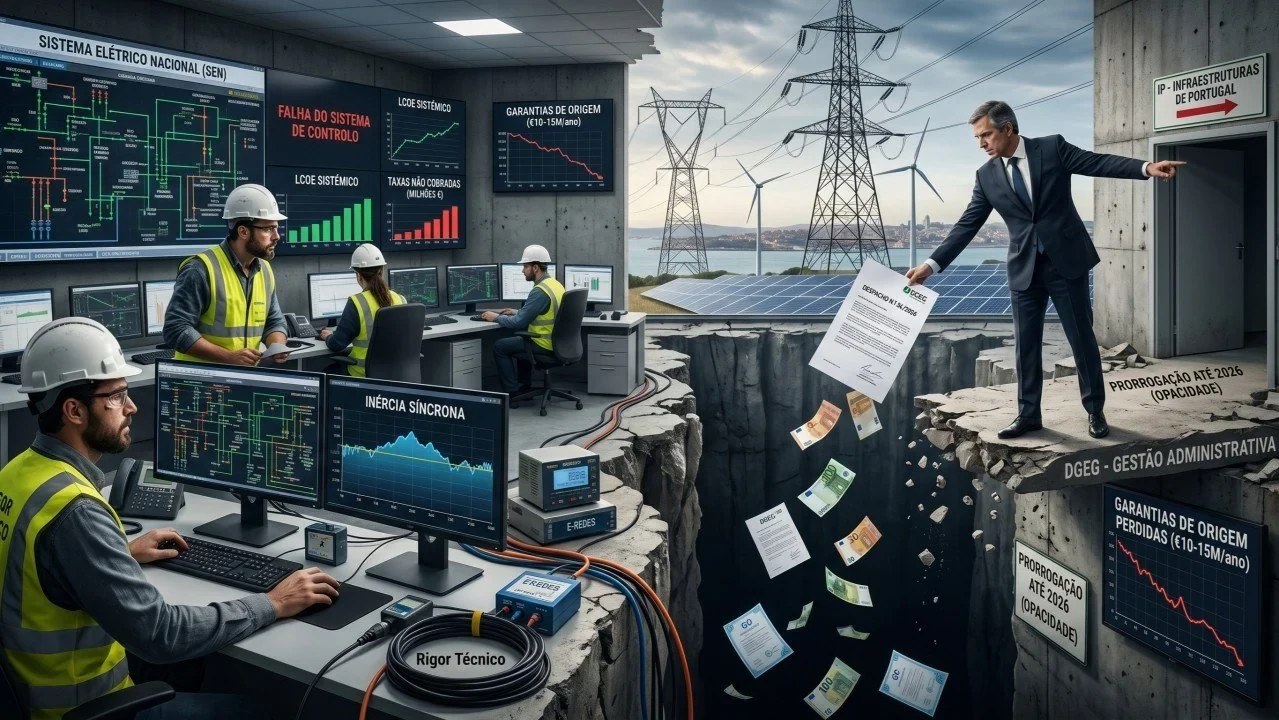
At a time when Portuguese energy regulation is witnessing the move of the Director-General of the DGEG (Direção-Geral de Energia e Geologia, Portugal’s Directorate-General for Energy and Geology) to the presidency of Infraestruturas de Portugal (IP), Despacho n.º 34/2026 (Order No. 34/2026) is not merely a technical detail about Guarantees of Origin (GO), but the epilogue of a chronic provisional state. By perpetuating a cycle of exemptions that began on 12 January 2022 and was systematically renewed through Orders No. 7/2024 and No. 008/2025, this measure even ignores the warnings of Informação n.º 3/DSEE/2024 (Information Note No. 3/DSEE/2024) which, as early as January 2024, confirmed the absence of a legal framework for such exemptions (this information is public on the DGEG website, see: https://www.dgeg.gov.pt/pt/repositorio/atos/). Under the pretext of an eternal stabilisation of the system, we are witnessing the collapse of Administrative Synchronous Inertia: the death certificate of regulatory Verticalidade (verticality) that throws the sector into the Abismo do Rigor (Abyss of Rigour).
1. The proof of concept: where are our millions?
Guarantees of Origin are not mere “papers”; they are the digital asset that certifies the environmental value of our energy. In the Iberian market, managed by OMIP, the value of 1 MWh of renewable energy has ranged between €1.50 and €2.30.
- The calculation of the accumulated abyss: by extending, for the fifth consecutive year, the exemption from mandatory registration with the EEGO (Entidade Emissora de Garantias de Origem, the issuing body for guarantees of origin) for units of up to 1 MW and for self-consumption units (UPAC), we leave in limbo an accumulated volume estimated at between 10 and 15 TWh (2 to 3 TWh/year).
- Impact on the consumer: this exemption amounts to a waiver of revenue belonging to the National Electricity System (SEN) itself which, in the 2022-2026 cycle, we estimate to exceed 50 million euros. By legal imperative, this sum should mitigate the tariff deficit borne by households and businesses, acting as the network’s financial shock absorber, which this order now drains to feed opacity.
- The paradox: the consumer finances the subsidy to renewables through the bill, but the State gives up charging for the certificate of value that this same subsidy generates. It is a net, silent transfer of wealth from the public sphere to the private sphere.
2. Cross-reference: from the “Skoda” to the “Ferrari”
Recently, in a statement that echoed the state of our administration, the outgoing Director-General compared the State to a “Skoda” and the private sector to a “Ferrari”. Order 34/2026 is the materialisation of this prophecy:
- The “revolving door”: the regulator signs a technical and financial release from responsibility for a sector that he himself should supervise, precisely at the moment he moves to the management of the country’s largest strategic infrastructure — IP — where he will come to put into operation benefits and efficiencies arising from the technical deregulation that he himself, as supervisor, signed on the eve of his farewell. In other words, by validating the financial viability of an infrastructure through the deliberate omission of negative externalities and of the costs of systemic stability, the regulator uses the office as an instrument to establish a “made-to-measure” regulatory framework from which he will benefit directly on moving to its executive management. On leaving the DGEG to manage Infraestruturas de Portugal, he takes command of the largest energy consumer and manager of rail and road networks, benefiting from an ecosystem of costs and rules that he himself designed, ignoring the technical rigour that the country’s systemic stability demanded.
- Administrative Synchronous Inertia: in electrical engineering, inertia is what stabilises the grid in the face of transients; in public administration, Verticalidade is our ethical inertia. This order is the “ballast” that is thrown overboard to guarantee a soft landing in a sector that is Public in Form, but Private in Logic, leaving the State unable to respond to the collapse of the frequency of the common interest.
3. The fallacy of “system stabilisation”
Justifying the postponement with the “need to stabilise the platform”, after 4 years, is technically offensive to any communications engineer.
- The technical reality: in a digital sovereignty ecosystem, based on Directive (EU) 2018/2001 (RED II), the issuing of GOs should be an algorithmic, deterministic and auditable process, based on real-time telemetry from Smart Meters. What this order protects is not a “platform being stabilised”, but rather the maintenance of administrative discretion over an asset that should be traded in an automated and transparent way.
- The fact: what is missing is not software; it is the will to impose Scientific Rigour over the rhetoric of convenience. The money that is “forgiven” in these exemptions would pay ten times over for the development of an inviolable digital sovereignty platform.
4. Conclusion: the Abismo do Rigor
There is no energy transition without Digital Sovereignty. As long as we treat energy as a counter for last-minute orders — even ignoring the internal admission of the Directorate-General itself in Information Note No. 3/DSEE/2024, which confirmed the absence of a legal framework for these exemptions after Directive No. 17/2023 of ERSE (Entidade Reguladora dos Serviços Energéticos, Portugal’s energy services regulator) — we will go on paying for the fuel of someone else’s Ferrari with the sacrifice of those who drive the Skoda.
This perpetuation of opacity, which has already taken away from the National Electricity System accumulated revenue of more than 50 million euros between 2022 and 2026, amounts to a conscious technical disobedience of regulatory rigour.
As in the article “O Abismo do Rigor: A Ilusão da Energia Barata” (The Abyss of Rigour: The Illusion of Cheap Energy), what is not measured cannot be managed. And what is hidden under “transitional periods” is, in truth, the privatisation of benefits and the socialisation of systemic risk, paid invariably by the taxpayer through the inflation of the hidden systemic LCOE that no one dares to count in the official spreadsheets.
It is time to demand Verticalidade. It is time to get out of the abyss.
#Energia #DGEG #Engenharia #Rigor #GarantiasDeOrigem #SoberaniaDigital #LCOE #InerciaSincrona #Portugal2026
Methodological note
What this page is. A translation of the article the author published on LinkedIn on 23 April 2026; the full Portuguese version is on this site. The estimates in the article (10 to 15 TWh accumulated and more than 50 million euros between 2022 and 2026) are the author’s, as in the original.
Names of instruments and bodies. Portuguese orders (despachos), the DGEG information note and the names of Portuguese bodies (DGEG, EEGO, ERSE, IP, SEN, UPAC) have no official English translation; they are kept in Portuguese or with their Portuguese acronym, with an explanation in brackets on first use. The EU Directive is cited by its official name, Directive (EU) 2018/2001 (RED II).
The author’s concepts. Abismo do Rigor (Abyss of Rigour) and Verticalidade (verticality) are the author’s own terms and keep their Portuguese name.
Changes of form, not of content. The original illustration is reproduced with its texts in Portuguese and a translated caption. The LinkedIn hashtags are kept as in the original, in Portuguese. A doubled full stop at the end of a sentence in the Portuguese page was not reproduced. The links to sources are those of the original.
The discussion is on LinkedIn (in Portuguese)
Comments on this text are made on LinkedIn, where the article was shared in Portuguese. You are welcome to write in English. Agree, disagree or add data: every well-founded objection receives a reply.
Gaspar do Amaral · Original in Portuguese of 23 April 2026, published on this site; translation issued on 27 October 2026 · Figures and tables © Aprecisa.com · AI-assisted