 ← Grupo Aprecisa · Connecting those who know with those who need
Communications · Article published on LinkedIn on 6 April 2026
How the Lack of Optical Fibre in Northern Portugal Threatens the Iberian Energy Transition
The systemic risk of digital macrocephaly: international gateways concentrated in Lisbon and Sines
Gaspar do Amaral · 6 April 2026
Translated from the Portuguese original. This version was issued on 30 October 2026.
On this site, this article has been
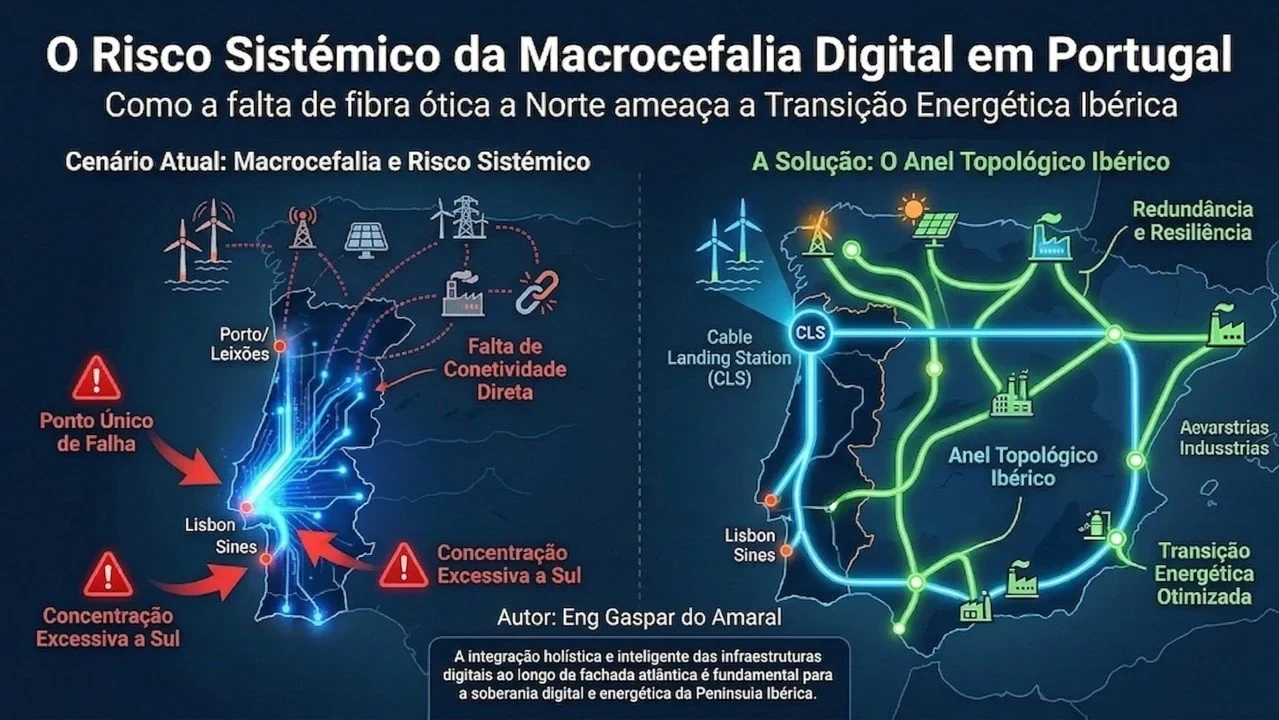
The Systemic Risk of Digital Macrocephaly in Portugal: How the Optical Asymmetry in the North Threatens the Energy Transition and Iberian Resilience
Over more than 35 years of experience accumulated on the front line of Communications Engineering, devoted to the joint integration of land, sea and air transport and communications systems, the macrocephaly that concentrates the very-high-capacity international gateways on the Lisbon–Sines axis appears to me as one of the most severe structural constraints on the national landscape. As amply documented by the researcher Nicole Starosielski in her cartography of undersea infrastructure, and echoed by the network sociology of Manuel Castells, control of the physical nodes dictates the competitiveness and sovereignty of macro-regions in the global “space of flows”.
More than a mere geographical imbalance, this asymmetry is a systemic risk for the whole Iberian Peninsula. An energy transition built on a digital network that is topologically deficient in the North compromises the operational resilience of the whole Iberian market. The literature on the vulnerability of complex networks, notably the postulates of Albert-László Barabási, shows that systems anchored on a single super-node (Lisbon/Sines) are catastrophically fragile to critical ruptures.
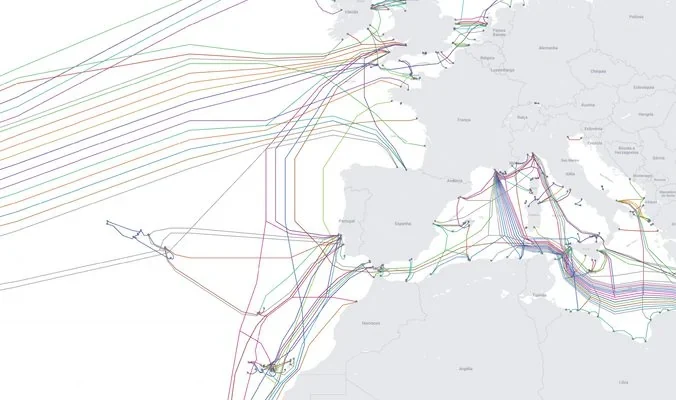
North of the latitude of Lisbon, the infrastructure suffers from a serious topological asymmetry, violating the basic principles of architectural redundancy defined by engineers such as Larry L. Peterson and Bruce S. Davie. From the standpoint of network engineering and of the Iberian integration strategy, this constraint crystallises into three critical vulnerabilities:
1. The Industrial Paradox and the Bottleneck of Iberian Latency
The North and Centre of Portugal operate as the industrial and export engine of the Peninsula. Yet, as far as international data transit is concerned, this macro-region is a node subordinate to the South. In the absence of direct Cable Landing Stations (CLS) in the North, all industrial traffic is forced to drain along terrestrial backhaul routes to Lisbon. As Andrew Blum explains in exposing the physicality of the internet, and as the telemetry data of Alan Mauldin (TeleGeography) corroborate, adding physical terrestrial kilometres critically penalises latency.
Analytical studies by CBRE (2021/2022) and infrastructure policy analyses such as those of Christian Sandvig stress that the absence of topological diversity degrades logistical efficiency. Industry 4.0 demands deterministic paths for intermodal operations, and this absence introduces Single Points of Failure (SPOF) into the peninsular backbones.
2. The Blocking Factor of the Energy and Ocean Transition
The coastline north of Portugal hosts offshore wind generation hubs. Orchestrating this infrastructure requires real-time telemetry, vital for balancing the grid, as has been systematically investigated and championed in the field of smart grids by João Peças Lopes and, on the plane of strategic innovation in the electricity sector, by António Vidigal.
If processing at the edge of the network has to be routed to the South — violating the edge computing optimisation premises advocated by Nicholas Carr —, the system loses effectiveness. Rigorous studies of the vulnerabilities of open-sea systems, led by Michael Sechrist, prove that the joint integration of autonomous maritime assets requires local optical density.
3. False National Redundancy and the Regulatory Warning
Should a disruptive event isolate the southern landing corridor, it is not only Portugal that loses connectivity; the transit routes that feed the interior of Spain collapse. The internet pioneer Vint Cerf and the creator of the Spanning Tree Protocol, Radia Perlman, have warned for decades of the limits of software redundancy over structural physical failures.
The fragility of the longitudinal Portuguese–Spanish paths, analysed from the standpoint of political economy by Dwayne Winseck and of interconnection resilience by David Newman, was demonstrated recently. The President of ANACOM (the Portuguese communications regulator), Sandra Maximiano, publicly highlighted the unacceptability of this cascade effect, showing that merely theoretical redundancy in the South does not shield the North.
The Path to Systemic Mitigation: Completing the Iberian Topological Ring
To comply with the vectors of resilience, the development of new optical corridors in the North is imperative. In a pivotal intervention, the CEO of Altice Portugal, Ana Figueiredo, committed to investing in a new landing point in the Porto basin, a move aligned with the theses of Atlantic decentralisation of the former minister and researcher Manuel Heitor.
Carrying out this technological planning puts into practice the digital sovereignty guidelines laid down by European Commissioners such as Thierry Breton, closing the Iberian ring according to the resilient-infrastructure optimisation models of Javier Salmeron.
Experience dictates: an impenetrable system requires a holistic distribution of Atlantic gateways. A system that is not topologically balanced will always be a system on the verge of rupture.
Author: Eng. Gaspar do Amaral
References and Grounding
This section maps the bibliographical and institutional contributions that underpin the scientific and analytical rigour of the Author’s manifesto:
- Nicole Starosielski — The Undersea Network (2015): validates Gaspar do Amaral’s premise that the physical concentration of cables at few points creates systemic geopolitical vulnerabilities.
- Albert-László Barabási — Network Science (2016): the theory of scale-free networks demonstrates mathematically the warning in the text: excessively centralised networks (as in Sines) are catastrophically fragile to ruptures in that super-node.
- Manuel Castells — The Rise of the Network Society (1996): supports the author’s socio-technical view, showing how peripheral industrial macro-regions lose capacity for action if they do not control the physical nodes of the “space of flows”.
- Larry L. Peterson & Bruce S. Davie — Computer Networks: A Systems Approach: as standard works of telecommunications engineering, they enshrine the principles for designing topologies immune to Single Points of Failure invoked throughout the article.
- Andrew Blum — Tubes: A Journey to the Center of the Internet (2012): demystifies the intangibility of data networks, in line with Eng. Gaspar do Amaral’s field-engineering stance on the crucial importance of the physicality and geography of fibre routes.
- Alan Mauldin — TeleGeography Network Reports: the empirical data produced by Mauldin’s teams on global routes corroborate the “Industrial Paradox”, quantifying how traffic detours degrade latency.
- CBRE Data Center Solutions — European Data Centres Reports: this group’s audits cement the article’s economic argument, illustrating how capital flees logistical regions lacking redundant optical backbone exits.
- Christian Sandvig — The Internet as Infrastructure: deepens the critique of public technological development policies, supporting the urgent need for the structural corrective intervention in Portugal stressed in the text.
- João Peças Lopes — Integration of Wind Energy and Smart Grids: grounds the energy transition section, showing how modern electricity grids depend entirely on deterministic, local response communications (without latency imposed by distant backhauls).
- António Vidigal — Innovation in the Electricity Sector: his historical and strategic perspective on the digitalisation of energy attests that the electrical vector and the communications vector (as the Author argues) are today inseparable.
- Nicholas Carr — The Big Switch / Edge Computing: supports the argument that forcing edge routing from the North of the country to Sines cancels the algorithmic advantage essential to Industry 4.0.
- Michael Sechrist — Vulnerabilities in Undersea Communications Cable Networks (Harvard, 2012): unequivocally documents the risks of interdiction (maritime and geophysical) that Gaspar do Amaral points out in infrastructure clustered on a single coastal vector.
- Sandra Maximiano — Presidency of ANACOM: her public positions validate the regulatory warning in the text that natural disasters destroy theoretical redundancies lacking real geographical diversity.
- Vint Cerf — Internet Architecture and Resilience: his foundations of the web’s base protocols anchor Gaspar do Amaral’s urgency for routing diversity between the North and Europe.
- Radia Perlman — Interconnections: Bridges, Routers, Switches: the engineer who solved the initial logistical problem of software redundancy indirectly corroborates that no algorithm saves a blind, absolute cut in a transmission medium that is not physically mitigated.
- Dwayne Winseck — The Political Economy of Global Submarine Cables: frames the warning about “Iberian Sovereignty”, mapping how technical concentration empties bargaining power and national security vis-à-vis the outside world.
- David Newman — Assessing the Vulnerability of Network Infrastructure: provides the scientific basis for reliability metrics for cascading events, the exact failure mechanism the Author fears and warns of.
- Ana Figueiredo — MEO Expansion Strategy / Atlantic Convergence: the capital, executive example in the text, which shows how the market finally and empirically recognises the serious flaw identified and acts accordingly (Porto CLS).
- Manuel Heitor — Atlantic Strategy for Knowledge Networks: his mandates and reflections validate the need to see Portugal not as an end point (Sines), but as an integral continental façade, as the proposed Iberian Ring advocates.
- Thierry Breton — European Digital Compass / Digital Sovereignty: the European primer promoted under his tutelage supports Gaspar do Amaral’s final doctrine that the cohesion of the peninsular market requires polycentric, defensible data infrastructure.
- Javier Salmeron — Optimization of Infrastructure Resilience: his work on military and civilian infrastructure mathematically justifies closing the Iberian Peninsula into a ring as the only topological matrix able to absorb primary impacts in Sines or Lisbon.
Annex: Strategic and Regulatory Alignment with the European Commission’s Guidelines (2024–2025)
The thesis defended here by Gaspar do Amaral on the systemic risk of the “digital macrocephaly” in the South and the urgency of establishing an “Iberian Topological Ring” in the North of Portugal is not only a national engineering need, but reflects exactly and coherently the most recent directives and security standards of the European Commission.
Below is shown the direct correspondence between the Author’s warning and the European regulatory framework established by the EU Action Plan on Cable Security (JOIN(2025) 9 final) and by the Report of the Expert Group on the Security and Resilience of EU Submarine Cable Infrastructures (2025).
1. The Risk of Single Points of Failure (SPOF) and the Lack of Route Diversity
- Gaspar do Amaral’s proposal: the author warns of the fragility of networks anchored on a single super-node (the Lisbon–Sines axis), stating that topologically deficient infrastructure violates the principles of redundancy and introduces critical vulnerabilities (SPOF).
- Validation by the European Commission: the consolidated risk analysis of the EU Expert Group fully corroborates this thesis. In mapping European vulnerabilities and dependencies, the Commission formally classifies the “lack of route diversity” (Dependency D14) and the existence of “chokepoints” (Dependency D15) as very serious security risks for the European Union. The EU warns that systemic disruptions on these axes may have “particularly serious consequences in the event of coordinated attacks”.
2. The Inseparable Interdependence of the Energy and Digital Transitions
- Gaspar do Amaral’s proposal: this article shows that the energy transition, especially offshore wind generation in the North of Portugal, requires real-time telemetry and local edge computing, on pain of operational blockage if the data have to transit to the South of Portugal.
- Validation by the European Commission: European regulation assumes the same inseparability between the electrical and the digital vectors. The EU Action Plan stresses that power and communications cables share the same strategic ecosystem and are fundamental to “bring ashore energy from offshore renewable sources”. The EU explicitly requires risk assessments to consider the interrelations between submarine cables, electricity grids and “offshore renewable energy installations”.
3. Financing the Solution: The Iberian Ring as a “Cable Project of European Interest” (CPEI)
- Gaspar do Amaral’s proposal: to mitigate the false national redundancy, the author argues for new optical corridors in the North of Portugal (Porto basin), materialising an “Iberian Topological Ring” to shield the infrastructure.
- Validation by the European Commission: the EU Action Plan created the ideal instrument to finance the author’s vision: the Cable Projects of European Interest (CPEI). The European standard dictates that priority and fast-tracked funding (through the Connecting Europe Facility, CEF) will go to projects designed specifically to “fill strategic gaps and establish new links that increase resilience and minimise risks”. The Commission’s criteria require these projects to demonstrate the “filling of a gap” in topology and the “need to create new or alternative secure routes”, matching exactly the diagnosis and the solution of the northern corridor advocated by the author.
Conclusion of the Regulatory Audit
Gaspar do Amaral’s argument anticipates and aligns perfectly with the European Commission’s regulatory urgency. The diagnosis that Portugal suffers from a “digital macrocephaly” in Sines/Lisbon translates, in EU technical jargon, into a dangerous chokepoint (D15). The proposed solution — the development of the northern pole and of the Iberian Ring — meets the exact eligibility requirements set out by Brussels for the new Projects of European Interest (CPEI), guaranteeing true route diversity and the intermodal energy and digital sovereignty of the European Union.
Methodological note
What this page is. An English translation of the article the author published on LinkedIn on 6 April 2026; the full Portuguese version is on this site. The article contains no calculations of its own. The quotations from the EU documents in the annex are translated from the Portuguese of the original; the official English wording may differ.
Changes of form, not substance. The tracking parameters LinkedIn added to some links have been removed, and the two links in the annex, which went through a Google redirect, now point directly to their destination (EUR-Lex and the Commission’s digital strategy site). A stray number in the reference list (“& 5.”) and a typo (“atânticas”) have been corrected. ANACOM is the Portuguese communications regulator.
The discussion is on LinkedIn (in Portuguese)
Comments on this text are made on LinkedIn, where the article was shared in Portuguese. You are welcome to write in English. Agree, disagree or add data: every well-founded objection receives a reply.
Gaspar do Amaral · Original in Portuguese of 6 April 2026, published on this site; translation issued on 30 October 2026 · Figures and tables © Aprecisa.com · AI-assisted
How to cite: Gaspar do Amaral (2026). Como a falta de fibra ótica a Norte de Portugal ameaça a Transição Energética Ibérica. Zenodo. https://doi.org/10.5281/zenodo.23814368 · Permanent archive on Zenodo.