 ← Grupo Aprecisa · Connecting those who know with those who need
Energy and the power system · Article published on LinkedIn on 2 May 2026
Avoiding “Systemic Silence” with the Law of Integral Energy Responsibility
The contribution to the DGEG public consultation and the proposed Lei REI: integral energy responsibility
Gaspar do Amaral · 2 May 2026
Translated from the Portuguese original. This version was issued on 27 October 2026.
On this site, this article has been
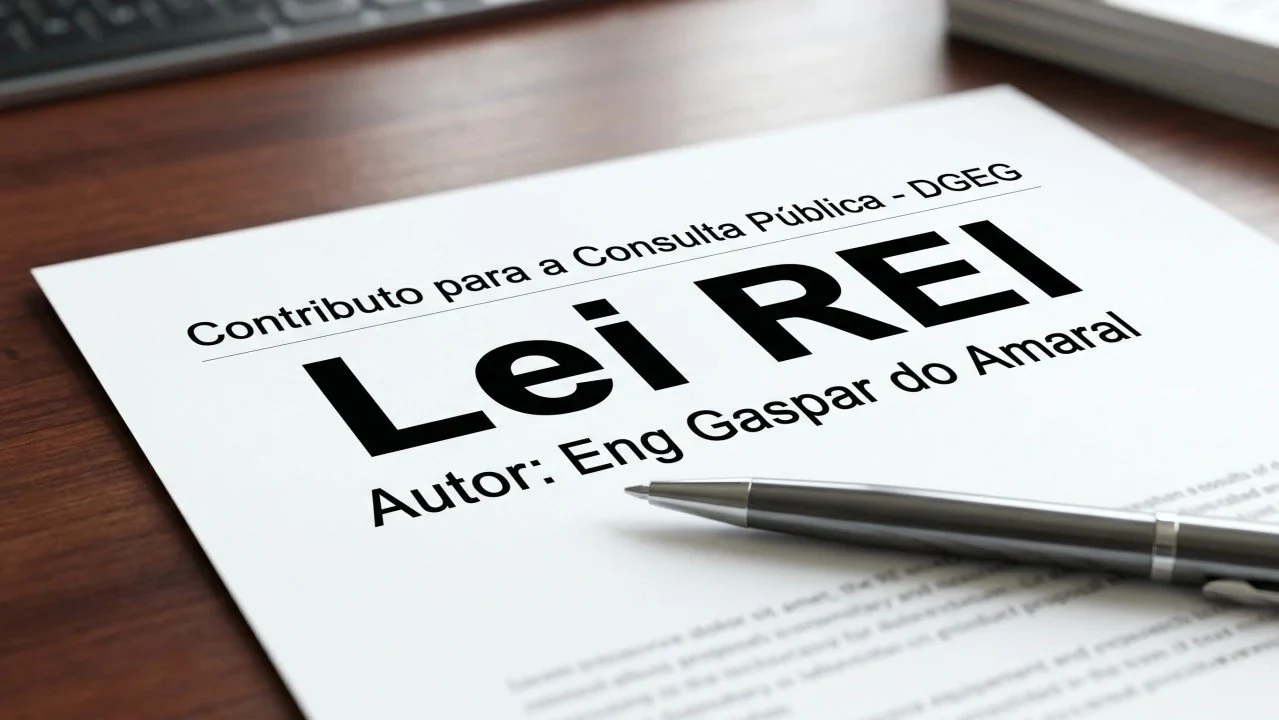
Today I took a step that I consider vital for the Energy and Cyber-Physical Sovereignty of our country.
I formally submitted to the Direção-Geral de Energia e Geologia (DGEG, Portugal’s Directorate-General for Energy and Geology) my structural contribution to the Terms of Reference of the Study on the Total System Costs (CTS, Custos Totais do Sistema). Let each of us do the same.
After many years of dedication to Systems Engineering and to the integration of critical communications infrastructure, I cannot be complacent about a model of energy transition that ignores Physics and Thermodynamics in favour of mere “flow accounting”.
In this document, I formally notified the supervising ministry of the overriding need to implement the Lei REI (Responsabilidade Energética Integral, the Law of Integral Energy Responsibility). The current paradigm of intermittent injection without any guarantee of firmness, which socialises the costs of instability on consumers’ bills, leads us dangerously towards what I call “Silêncio Sistémico” (Systemic Silence).
To ensure Structural Reliability and the Guarantee of Operational Safety, I proposed to the administration four non-negotiable pillars for this study:
1. Governance by Triangulation: The metrological validation of the CTS cannot be left in the hands of the grid monopoly (REN). An independent Systemic Integrity Commission must be created, involving DG ENER (European Commission), experts from AEMO (Australia) and EirGrid (Ireland), and independent academia (e.g. INESC TEC).
2. Digital Sovereignty (IEC 61850): The end of managing the grid as a passive infrastructure. Mandatory quantification of the implementation of the IEC 61850 standard, which has existed since 2003, at every injection node, giving the SEN (Sistema Elétrico Nacional, the National Electricity System) a true Digital Nervous System with a response in milliseconds.
3. Valuing Physical Firmness: The cost of Apparent Guaranteed Power and of Synthetic Inertia must be internalised by whoever consumes or compromises it (the Cyber-Physical Polluter-Pays Principle), treating storage as Active Neurons of the grid.
4. Duty of Transparency: Mandatory provision of raw operating data (raw data) within 5 working days, failing which it is presumed that no technical restriction exists.
It is imperative to move from “flow accounting” to “integrity accounting”.
The full document is already with the DGEG services. I invite my network — engineers, decision-makers, regulators and academics — to reflect deeply on the future of our National Electricity System. The time for legislative semantics is over; Engineering is what is required.
#LeiREI #IntegridadeSistemica #AbismoDoRigor #SoberaniaEnergetica #SoberaniaDigital #CTS2026 #EngenhariaDeSistemas #IEC61850 #TransicaoEnergetica
Methodological note
What this page is. A translation of the article the author published on LinkedIn on 2 May 2026; the full Portuguese version is on this site. The contribution itself was submitted to the DGEG on the same day.
Names and concepts. Portuguese bodies and terms are given in Portuguese with an explanation in brackets: DGEG (Direção-Geral de Energia e Geologia), CTS (Custos Totais do Sistema, total system costs), REN (the transmission system operator) and SEN (Sistema Elétrico Nacional). DG ENER is the European Commission’s Directorate-General for Energy; AEMO is the Australian Energy Market Operator; EirGrid is the Irish transmission system operator; INESC TEC is a Portuguese research institute. The author’s own concepts keep their Portuguese name, with a translation in brackets: Lei REI (Law of Integral Energy Responsibility) and Silêncio Sistémico (Systemic Silence).
Changes of form, not of content. The decorative symbols (emoji) at the start of each paragraph of the LinkedIn version were left out. The LinkedIn hashtags are kept as in the original, in Portuguese. The original illustration is reproduced with its texts in Portuguese and a translated caption.
The discussion is on LinkedIn (in Portuguese)
Comments on this text are made on LinkedIn, where the article was shared in Portuguese. You are welcome to write in English. Agree, disagree or add data: every well-founded objection receives a reply.
Gaspar do Amaral · Original in Portuguese of 2 May 2026, published on this site; translation issued on 27 October 2026 · Figures and tables © Aprecisa.com · AI-assisted