 ← Grupo Aprecisa · Connecting those who know with those who need
Energy and the electricity system
The Dogma of Powdered Electricity: How DL 15/2022 Repealed Physics by Decree
The illusion of “Contingent Connectivity” and the systemic bill that Administrative Inertia threw at the consumer.
Gaspar do Amaral · 30 April 2026
Translated from the Portuguese original. This version was issued on 27 October 2026.
On this site, this article has been
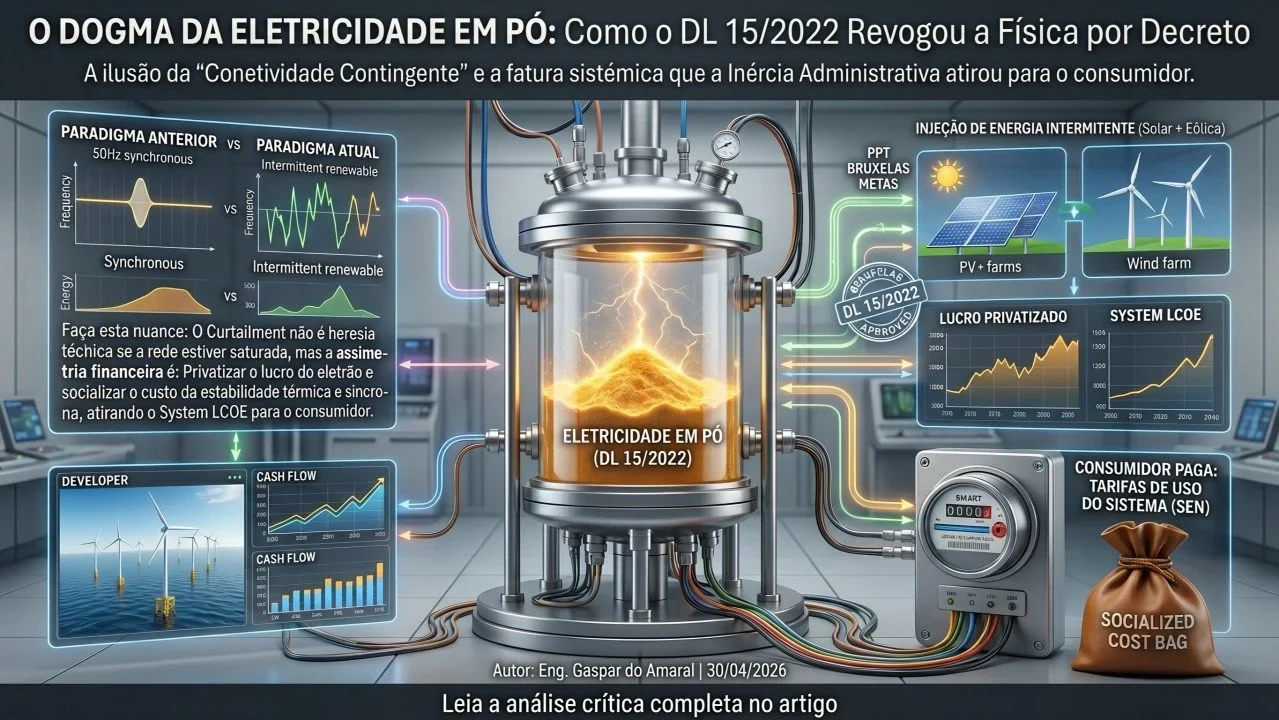
The energy transition is, first of all, a challenge of physics, thermodynamics and systemic rigour. Yet in Portugal, the eagerness to meet political targets and speed up the installation of intermittent power stations led to a profound legislative change. The legislator decided to treat engineering as a mere bureaucratic obstacle, creating an administrative fiction that, among engineers, we call the theory of “powdered electricity”.
At the centre of this Abismo do Rigor (the Abyss of Rigour) lies Decree-Law No. 15/2022. To understand the redundancy bill that we all pay today in the electricity tariff, we must go down to the engine room, explain the physics of the grid and give a voice to those whom institutional silence tried to erase: the engineers who keep the country’s lights on.
The Previous Paradigm: The Rigour of the Physical Cable
Before 2022, Decreto-Lei n.º 29/2006, de 15 de fevereiro (Decree-Law No. 29/2006 of 15 February), the Basic Law of the SEN (the National Electricity System), was for more than a decade the pillar of the sector’s organisation, complemented by Decreto-Lei n.º 172/2006, de 23 de agosto (Decree-Law No. 172/2006 of 23 August), which set out in detail the legal regime for licensing generation and respected the golden rule of planning the National Electricity System (SEN), which was strictly deterministic. Licensing was governed by the principle of guaranteed evacuation capacity.
If a developer wanted to install a 100 megawatt (MW) power station, the State and REN only issued the licence if the cables, the transformers and the high-voltage lines had the thermal and physical capacity to absorb those 100 MW at their maximum peak, without melting through the Joule effect and without destabilising the frequency. Physics dictated the law.
The Current Paradigm: DL 15/2022 and the Generation of “Powdered Electricity”
In January 2022, to speed up licensing and to show off PowerPoint gigawatts in Brussels, the State profoundly changed this principle through Decreto-Lei n.º 15/2022 de 14 de janeiro (Decree-Law No. 15/2022 of 14 January), establishing “Contingent Connectivity” (or conditional access).
The law began to allow power stations to be connected to the grid even when it is known in advance that the infrastructure does not have the thermal capacity to carry all that energy at the moments of peak production. The legislator acted as if the surplus energy could be turned into “powder”, kept in a jar on a shelf and dissolved later. But electricity is not powdered milk, nor is it a cheese to be kept in the cold room.
The Technical Detail: Replacing Physics with Probability
In the current paradigm, the licence is no longer a certificate of absolute physical feasibility but has become an exercise in congestion management. The detail lies in the following mechanisms:
- Access with Restriction (Curtailment): Unlike the previous regime, where the “cable” was the limit, a developer can now obtain a licence for 100 MW at a point of the grid that can only take 60 MW under safe conditions. The commitment is legal: the developer accepts being “cut” (a forced reduction of injection) whenever production exceeds the physical capacity of the line.
- The Abandonment of Firm Capacity: System planning moved from Firm Capacity (guaranteed 100% of the time) to Non-Firm Capacity. This means that the security of the system no longer rests on the cross-section of the conductor, but on the effectiveness of real-time control algorithms that must act before the thermal inertia of the materials causes catastrophic failure.
- The Illusion of Virtual Storage: The legislator introduced the idea that oversizing the installed capacity relative to the grid will be solved by future batteries or by conversion into green hydrogen. However, until that “jar” (real storage) is installed and economically viable, the system lives on the threshold of technical waste: electrons are produced that the grid, by the simple dictate of thermodynamics, is unable to accept.
This new paradigm replaces the Rigour of the Engineer with the Convenience of the Regulator. Where the grid used to be sized to withstand the maximum load, today the system is licensed in the hope that the production peaks of different sources never coincide — a statistical bet that ignores climatic simultaneity and places the stability of the SEN in critical dependence on automatic cut-off systems and on the resilience of assets under constant thermal stress.
The Physical Truth and the Pain in the Dispatch Room
This is where the political rhetoric of 2022 collides violently with thermodynamics, and this is where the daily anguish of the SEN’s technicians and engineers lies, forced into institutional silence.
The electricity grid is not a bucket into which electrons are poured. It is the largest synchronous machine ever built by humanity. For the lights to stay on, the injection of energy and consumption have to be exactly equal every millisecond. The “heartbeat” of this machine is 50 hertz (Hz).
In the traditional paradigm (hydro, gas, nuclear), the stability of the 50 Hz is guaranteed by Synchronous Inertia: colossal mechanical masses (rotors of hundreds of tonnes) physically spinning. If there is a disturbance in the grid, the kinetic energy of these masses acts as a “shock absorber”, giving time (vital seconds) for the automatic systems to react.
Solar and wind power stations do not have this physical inertia. They inject energy through inverters (power electronics). They are stochastic. When the grid saturates because there is excess solar injection into a cable that cannot carry it, the “Contingent Connectivity” of DL 15/2022 requires the operator to cut the injection (so-called curtailment).
What the politician ignores, but the technician knows:
Suddenly cutting 50 MW of injection from a solar power station is not a clean way of “keeping powder”. It is to provoke a violent jolt in the grid. In the System Operator’s dispatch room, when the cut happens, the frequency oscillates. The engineers, eyes fixed on their monitors, break into a cold sweat. To compensate for this forced “flexibility”, the grid has to mobilise, immediately, very expensive regulation reserves (often gas-fired or pumped-storage stations) to keep the ship afloat.
These technicians, true anonymous heroes of Synchronous Inertia, are silenced by an “administrative synchronous inertia”. When they try to warn of the technical precipice, they are labelled velhos do Restelo (the old men of Restelo — the Portuguese byword for naysayers who oppose every voyage) or brakes on the climate transition.
The Flight from Responsibility (System LCOE)
It must be made clear that the rigour of systems engineering is not blind to economic efficiency. Sizing cables and transformers to accommodate an absolute production peak that occurs, perhaps, in less than 5% of the hours of the year would require a monumental capital investment (CAPEX) in idle infrastructure, inflating the tariff to unbearable levels.
For this reason, “Contingent Connectivity” and the occasional use of curtailment to optimise the existing grid are not, in essence, a technical heresy. The real collapse of rigour — the systemic failure — lies in the financial asymmetry that has been established: the law allows congestion management, but exempts the private developer from bearing the systemic bill that its intermittency imposes on the grid. The problem is not the existence of the physical cut; the problem is privatising the profit of the electron and socialising the cost of thermal and synchronous stability.
DL 15/2022 was sold to the public by the ministry and by the sector’s associations as the miracle of the “cheap electron”, which they still insist on preaching every day. But that electron is only cheap because the law allowed private developers to escape the physical responsibility of paying for the instability that their product causes, on top of the systematic exemption, from 2022 to 2026, from guarantees of origin.
They install the panels, inject when the sun shines, and when the grid saturates and sways, the problem is no longer theirs. The cost of resolving that instability — the true Effective System Cost (System LCOE) —, through synchronous compensators, congestion management and backup networks, is thrown onto the consumer’s bill through the System Use Tariffs. They privatised the sun and socialised the storm.
This narrative of the “cheap electron” did not arise by chance. It was actively built and promoted by the highest political levels of the ministry and by the main associations representing the renewables sector. On multiple fronts, from conferences to official statements, the banner of the “urgency of decarbonisation” was used not as a technical objective to be integrated, but as a rhetorical shield to protect DL 15/2022 from any synchronous scrutiny. By silencing the technical warnings about the physical inertia of the grid, public and private leaders legitimised the “Abismo do Rigor”, where the SEN is managed by political and associative convenience, discarding the Principle of Technological Precaution in favour of an immediate perception of success.
Conclusion: The Urgency of the Lei REI
Physical reality does not accept adjectives, is not moved by dogmas and is not repealed in the Diário da República (Portugal’s official gazette). Electrical energy demands Verticalidade (verticality) and is not sold in powder.
To restore the balance that our grid engineers demand and deserve, the answer is the implementation of the Lei de Responsabilidade Energética Integral (REI) (the Integral Energy Responsibility Law, Lei REI), based on the Causer-Pays principle (whoever causes the cost pays it) and on compliance with the European directives. No developer should be able to inject a single gigawatt of intermittent energy without taking full responsibility, physical and financial, for the costs of stabilisation, redundancy and mechanical inertia that its operation requires.
As long as we legislate on the basis of the fiction of “powdered electricity”, we will keep pushing the grid towards the Abismo do Rigor, paying through the nose for a bill that, in the end, physics will present to us relentlessly.
Gaspar do Amaral
Methodological note
What this page is. A translation of the article the author published on LinkedIn on 30 April 2026; the full Portuguese version is on this site. The opening sentence of the original, in italics, is used here as the subtitle.
Names of laws and concepts. Portuguese decree-laws are cited by their official Portuguese names, with an English explanation in brackets; SEN is the Sistema Elétrico Nacional (National Electricity System) and REN the company that operates the transmission grid. The author’s own concepts keep their Portuguese names: Abismo do Rigor (the Abyss of Rigour), Lei REI (the Integral Energy Responsibility Law that the author proposes) and Verticalidade (verticality). The link on the Lei REI is the one in the original (the author’s LinkedIn activity).
Changes of form, not of content. The original illustration is reproduced with its texts in Portuguese and English and a translated caption. The Portuguese idiom “manter o barco a flutuar” (“keep the boat afloat”, with an obvious typing slip in the original) is rendered as “keep the ship afloat”. The expression velhos do Restelo is kept with a short explanation, because it has no English equivalent.
The discussion is on LinkedIn (in Portuguese)
Comments on this text are made on LinkedIn, where the article was shared in Portuguese. You are welcome to write in English. Agree, disagree or add data: every well-founded objection receives a reply.
Gaspar do Amaral · Original in Portuguese of 30 April 2026, published on this site; translation issued on 27 October 2026 · Figures and tables © Aprecisa.com · AI-assisted