 ← Grupo Aprecisa · Connecting those who know with those who need
Energy and the power system
The End of Improvisation: The Imperative of Systemic Rigour in the New Electric Mobility
Portaria 128/2026/1 and electric mobility: charging a car brings together transport, power and communications, and that demands rigour
Gaspar do Amaral · 27 March 2026
Translated from the Portuguese original. This version was issued on 27 October 2026.
On this site, this article has been

The integration of electric charging infrastructure into distribution grids goes beyond simply connecting new loads. We are facing the definitive and complex fusion of transport systems, power systems and land communications networks. This metamorphosis allows no regulatory hesitation. It demands a sceptical approach, grounded in mathematics and focused on the absolute safety of the systems.
When dissecting the new Portaria n.º 128/2026/1 (a ministerial order), which comes into force today, 27 March 2026, what emerges is not just a regulation, but a warning. The effectiveness of this decentralised transition depends on the technical rigour that can be imposed, turning documentary evidence into uncompromising operational requirements.
In this article, we will carry out a factual and in-depth audit of the new legal framework. We will describe the documentary evolution that has brought us here, carry out a factual X-ray of the technical parameters of the Portaria and, crucially, identify the operational void that the regulation has left open, propose the mandatory requirements that must be monitored and promoted, and draw up the proposals to be sent to the ERSE (Entidade Reguladora dos Serviços Energéticos, Portugal’s energy services regulator) in the next 60 days.
I. The Documentary Evolution: From the Macro-Objective to Action on the Ground
The legal architecture that culminates in the present technical regulation results from a progression of legal instruments that restructured the foundation of the energy and mobility market. To understand the present, it is imperative to trace the primary sources of this evolution:
- The Vision (2019/2024): Resolution of the Council of Ministers No. 107/2019 of 1 July, which approved the Roadmap for Carbon Neutrality 2050 (RNC 2050), and its update through Resolution of the Council of Ministers No. 149/2024 of 30 October (PNEC 2030, the National Energy and Climate Plan), set the destination: a deep and binding reduction in emissions, requiring the massive electrification of the vehicle fleet.
- The Disruption (2025): The new Legal Framework for Electric Mobility (Decreto-Lei n.º 93/2025, a decree-law) abolished the centralised management of the network, creating the Data Aggregating Entity for Electric Mobility (EADME) and opening the door to the autonomy of the delivery points.
- The Materialisation (2026): The present Portaria n.º 128/2026/1 gives effect to Article 22 of the RJME (the Legal Framework for Electric Mobility), putting an end to regulatory obsolescence by repealing the old Portarias of 2016 and imposing compliance with the European specifications (the AFIR Regulation, on alternative fuels infrastructure).
II. The Factual X-Ray of Portaria n.º 128/2026/1
Regulatory mechanics are only valid when supported by exact quantities. From the structured reading and systematic extraction of data from Portaria n.º 128/2026/1, which comes into force today, 27 March 2026, the following numerical and engineering dogmas that govern the physical infrastructure are extracted:
1. Power Sizing and Topology
The legal instrument establishes the non-negotiable minimum parameters for design and execution:
- Mandatory Minimum Power: The lowest acceptable level per connection point is strictly set at 3680 VA.
- Relentless Simultaneity: In the allocation of total power for car parks, the legislator imposes the application of a mandatory simultaneity factor of 1.00 to the sum of the individual powers.
- Equations of Minimum Infrastructure (N): The minimum number of spaces equipped with infrastructure (N) in new installations follows strict mathematical models (rounded up to the next whole number).
2. The Mechanics of Load Management and Safety
The standard requires the physical installation of a Load Control System (SCC) in multi-family buildings, whose action must allow:
- Total load shedding (binary); or
- Dynamic regulation of the current intensity (analogue – Modes 3 and 4).
The whole installation strictly complies with Section 722 of the Technical Rules of Portaria n.º 949-A/2006 of 11 September, which approves the Technical Rules for Low-Voltage Electrical Installations (RTIEBT) and requires the connection of a smart meter at the boundary (in accordance with Portaria n.º 231/2013 of 22 July).
III. The Operational Void: The Imperative of a Technological Maturity Model
The audit of the legal instrument reveals a critical gap that we cannot ignore: Portaria n.º 128/2026/1 does not settle the operational detail. The real systems engineering has been delegated to a “technical guide” to be published by the Directorate-General for Energy and Geology (DGEG) within the tight deadline of 60 days.
The temptation to demand, from day zero, a laboratory-grade and deterministic rigour — typical of isolated critical infrastructure — from a civilian mass network is a systemic error. Blind rigour fractures the market; modular and planned rigour scales. To ensure the resilience of low-voltage (LV) grids and economic feasibility, Engineering must promote the adoption of a three-level Technological Maturity Model, to be included in the future technical guide:
Level I: Foundational Safety and Protection of the Boundary (Year 0 to Year 2) The immediate focus is to avoid the physical collapse of the grids and to make the investment (CAPEX) of families and developers viable.
- Primary Load Control: A requirement for a Load Control System (SCC) that guarantees, statically or with simple dynamics, that the sum of the charging loads never exceeds the contracted power at the boundary.
- Graceful Degradation (Transitional Fail-Safe): If telemetry is lost between the SCC and the charging point, the system must not impose an abrupt cut-off (which penalises the user for trivial communication failures), but an automatic step-down to a safety profile (e.g. 10 A).
- Basic Protection: A requirement for inviolable time and current selectivity in the electrical design, guaranteeing that faults in the branch circuit do not affect the building.
Level II: Logical Integration and Open Telemetry (Year 2 to Year 4) The focus moves on to grid intelligence, treating the vehicle as a node of a wider communications system.
- Mandatory Interoperability: All new hardware must support open protocols (OCPP 1.6-J with a guaranteed upgrade path to 2.0.1). The HAN interface of the smart meter (ORD, the distribution system operator) becomes the master that gives the orders for load modulation.
- Pragmatic Modulation: Load variation (ramps up and down) must be managed in macroscopic steps (e.g. 6A, 10A, 16A), optimising computing resources and avoiding grid instability (hunting), without requiring unit resolutions that are unnecessary at building scale.
Level III: The Abismo do Rigor (Abyss of Rigour) and Systemic Sovereignty (Year 5 onwards) The phase of total convergence between transport, power and data. Pure mathematical rigour comes into play.
- Bidirectionality and Power Quality: The ISO 15118 standard (V2G, vehicle-to-grid) becomes mandatory. The vehicle becomes an asset for stabilising the grid.
- Zero Tolerance: Strict compliance with limits on harmonic injection (THDi < 8% at full load) and active power factor correction (> 0.95), moving the management of harmonic pollution to a distributed and mature level.
Conclusion and Proposal for Action: The 60-Day Maturity Road Map
The decentralised transition of electric mobility leaves no room for improvisation, but nor will it survive hasty regulatory suffocation. Engineering is not just the imposition of pure mathematics; it is the art of optimising between tolerable risk, admissible cost and operational effectiveness on the ground.
By phasing in the technological requirements, we ensure that the adaptation of the infrastructure in 2026 is financially viable for society, we give industry predictability to structure its value chains, and we deliver real long-term systemic sovereignty to the State.
Proposal for Action – Next 30 Days: To ensure that the DGEG guide is born anchored in achievable rigour, the following action plan should be carried out:
- Transition Audit: Carry out the technical cross-check of the topological diagrams proposed by the ERSE with the models for the evolution of the SCC, validating the Fail-Safe profiles for telemetry failures in Low Voltage.
- Harmonisation of the Data Layer: Lock down the technical reference for the HAN port, ensuring that the interoperability timetable with the ORD supports a smooth transition to Level II (OCPP and open industrial protocols).
- Responsibility Matrix (RACI): Define in the new guide, with surgical precision, the limits of legal responsibility between the designers (Electrical Engineers), the ORD and the EADME, focusing on the approval and inspection of the logical and power integrations.
Rigour in systems engineering is the only way. When properly phased, it stops being a bureaucratic obstacle and becomes the foundation of a safe, resilient and globally applicable electric mobility.

Annex A – The End of Improvisation: The Imperative of Systemic Rigour in the New Electric Mobility
The integration of charging infrastructure into our distribution grids is not just “connecting cables”. It is the definitive fusion of transport systems, power systems and communications networks.
On 27 March 2026, Portaria n.º 128/2026/1 came into force. More than a regulation, it is a warning: the effectiveness of this transition depends on the technical rigour we are able to impose.
“Improvisation” is over. To guarantee the resilience of our Low-Voltage grids and the safety of users, I propose the adoption of a 3-Level Technological Maturity Model for the future DGEG Technical Guide:
- Level I: Foundational Safety (Year 0-2) – Focus on the physical protection of the grid and on the implementation of Fail-Safe (graceful degradation to 10A if telemetry is lost).
- Level II: Logical Integration (Year 2-4) – Mandatory interoperability (OCPP 2.0.1) and load modulation via the HAN interface of the smart meter.
- Level III: Systemic Sovereignty (Year 5+) – The era of V2G (ISO 15118) and strict control of Power Quality (THDi < 8%).
Responsibility Matrix (RACI): Clear Legal Limits Systemic rigour requires that the boundaries of action leave no room for legal or technical improvisation. Without explicit limits of civil and operational liability, there is no safety.
Here is the governance architecture that should frame the new Technical Guide:
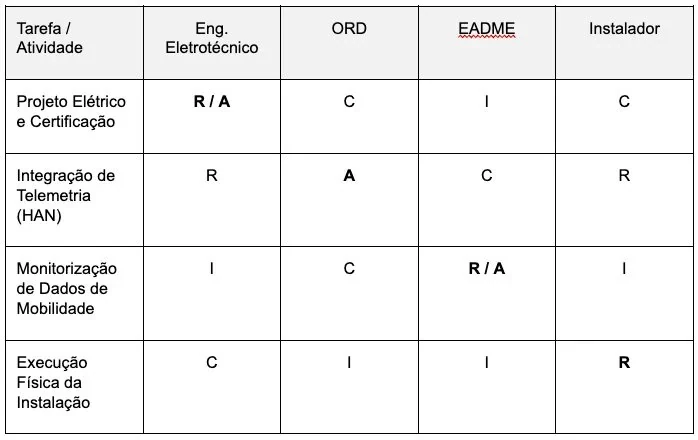
Key to Figure No. 3: R = Responsible | A = Approver | C = Consulted | I = Informed
Engineering is not the dictatorship of pure mathematics, but the art of optimising risk and effectiveness. We cannot suffocate the market, but nor can we give up systemic safety.
Conscious rigour is the only way to an electric mobility that is, in fact, the cornerstone of our energy future.
#MobilidadeElétrica #RedesBT #Portaria128_2026 #EngenhariaEletrotécnica #RigorSistémico #MaturidadeTecnológica #PowerQuality #SegurançaElétrica #EEP
Methodological note
What this page is. A translation of the article the author published on LinkedIn on 27 March 2026, the day Portaria n.º 128/2026/1 came into force; the full Portuguese version is on this site. The article has no calculations of its own: the values (3680 VA, simultaneity factor 1.00, 10 A, 6A/10A/16A, THDi < 8%, power factor > 0.95, 30 and 60 days) are those of the legal instrument or of the author’s proposal, exactly as in the original.
Names and terms. Portuguese legal instruments with no official English translation keep their Portuguese names (Portaria, ministerial order; Decreto-Lei, decree-law), with an explanation in brackets at their first occurrence; the Resolutions of the Council of Ministers are given in English. ERSE, DGEG, ORD, EADME, RJME, AFIR, RTIEBT, SCC, HAN and V2G are explained where they first appear. The author’s own concept Abismo do Rigor (Abyss of Rigour) is kept in Portuguese. The LinkedIn tags (hashtags) at the end are kept as in the original.
Changes of form, not of content. The decorative symbols (emoji) and the horizontal rules of the LinkedIn version were left out; the three items of Level I, II and III in Annex A, which in the original are paragraphs opened by a symbol, appear as a list. Chapters I, II and III appear as section headings and points 1 and 2 as sub-headings. The three original images (the cover illustration, Figure No. 2 and Figure No. 3) are reproduced with their texts in Portuguese and a translated caption. The links to sources are those of the original (Diário da República, in Portuguese).
The discussion is on LinkedIn (in Portuguese)
Comments on this text are made on LinkedIn, where the article was shared in Portuguese. You are welcome to write in English. Agree, disagree or add data: every well-founded objection receives a reply.
Gaspar do Amaral · Original in Portuguese of 27 March 2026, published on this site; translation issued on 27 October 2026 · Figures and tables © Aprecisa.com · AI-assisted