 ← Grupo Aprecisa · Connecting those who know with those who need
Energy and the power system
Spot Price vs. System LCOE
The green map of wholesale prices and the tactic of cognitive anchoring: why the spot price is not the cost of the system
Gaspar do Amaral · 4 May 2026
Translated from the Portuguese original. This version was issued on 27 October 2026.
On this site, this article has been
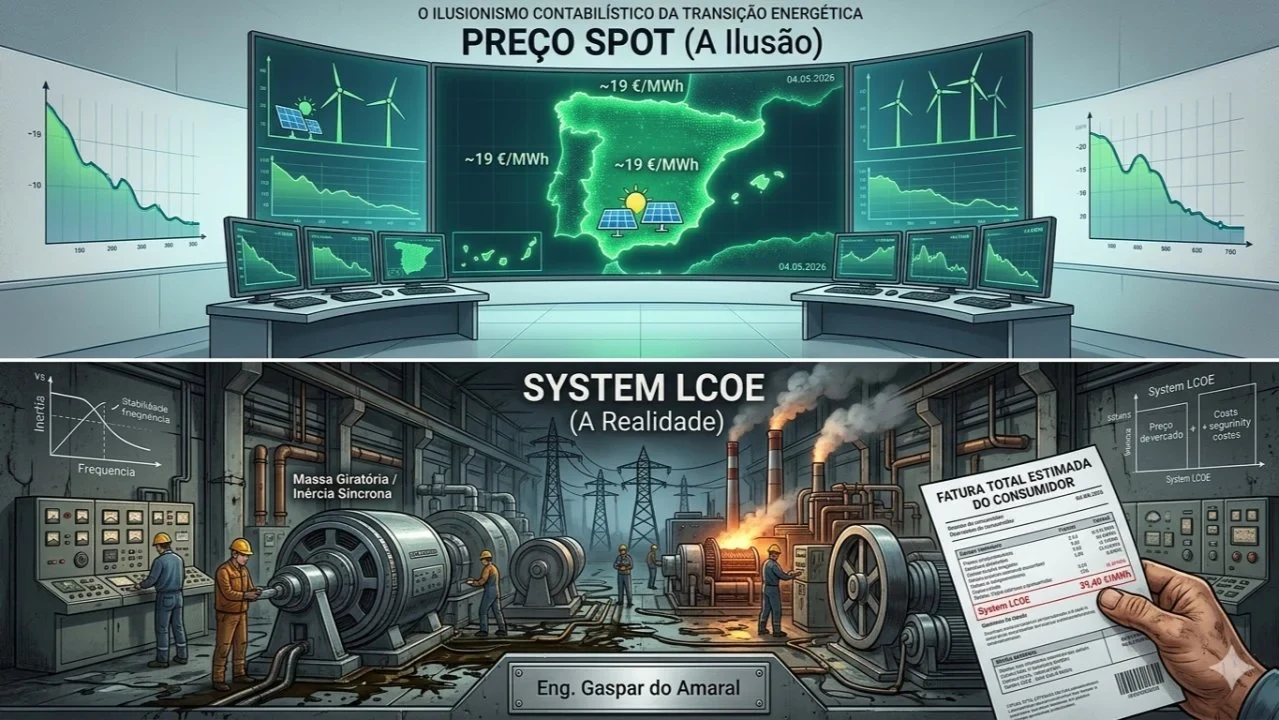
Accounting Illusionism and the Tactic of Cognitive Anchoring: From the Trading Screen to the Consumer’s Bill
Anyone who follows the energy debate in Portugal comes across a curious statistical choreography every day: the repeated publication of European maps of wholesale (spot) prices, in which the Iberian Peninsula invariably appears painted a triumphant green.
At first sight, this exercise looks like an act of market literacy and transparency. However, to the eyes of someone who has for years applied the rigour of complex Systems Engineering (on Land, at Sea and in the Air), this cadence of posts is not innocent. It is a premeditated tactic of cognitive anchoring.
To understand this accounting illusionism, we have to come down from the financial spreadsheet to the real engine room.
1. Conditioning the “Total System Costs” Study and the European Commission
The aim of flooding the professional network with the daily “snapshot” of the spot market is clear: to condition public opinion and political decision-makers even before the promised study of the Total System Costs (TSC) by the DGEG (Direção-Geral de Energia e Geologia, Portugal’s Directorate-General for Energy and Geology) goes ahead, whose deadline ends tomorrow (05.05.2026).
By creating the optical illusion that the current Iberian model is an absolute success, an attempt is made to crystallise a false premise. In this way, when a serious metrological study dares to account for the true bill for stability and Synchronous Inertia, it will look, in the eyes of the public, like an unfounded attack. It is the defence of easy profit by way of statistical saturation.
But rigour demands facts, and reality contradicts the optimism: it recently became public that the European Commission gave Portugal only two months to respond for non-compliance and flaws in the design of the electricity market and the transposition of directives (Source: https://zap.aeiou.pt/comissao-europeia-processa-portugal-renovaveis-740208, in Portuguese).
What was the response of the author of those green maps to this European procedure? The casualness of someone who says he “did not know”.
How can this system be a successful case study if the European Commission itself opens infringement procedures over the rules and flaws of our electricity market? Celebrating the marginal price of the electron while ignoring Brussels’ severe notifications about the deregulation of the system is the epitome of accounting illusionism and of the evasion of technical responsibility.
2. The Physical Reality: Spot Price vs. System LCOE
The narrative that we are living in an era of superabundance and free energy rests on a serious error: the confusion between the wholesale price (spot market) and the Effective Cost of the System (System LCOE). When the market sets zero or negative prices, this does not reflect real abundance, but the collapse of the market in buying physical security. It means that the System Operators (TSOs) are intervening outside the market to save the grid, paying fortunes to keep thermal power stations (gas or coal) running solely and exclusively as the system’s security guards.
For example, to have some distance in time, the European structural data I compiled for 6 April 2026 are unequivocal. In Portugal and Spain, the attractive ~19 €/MWh on the screen masked an estimated System LCOE of ~39 €/MWh. This difference of 20 €/MWh represents the security surcharge: we have a lot of renewables, but the system still requires expensive thermal support that adds total cost. The most extreme case of European distortion was Poland: it showed a glorious -3 €/MWh in the market price, but hid a System LCOE of ~42 €/MWh, leveraged by capacity mechanisms paid for separately.
As that analysis of 06.04.2026 concludes: the market price (OMIE) is for the trader; the System LCOE is for the country.
The full dissection of these grid pathologies and the detailed System LCOE matrix for 18 European countries do not fit in a daily post. I leave the relentless scrutiny of Systems Engineering documented in this article, for the record: “The Accounting Illusionism of the Energy Transition: From the Trading Screen to the Consumer’s Bill”.
3. The Privatisation of the Electron and the Socialisation of Physics
The fundamental flaw of the current model is that optimising a sub-subsystem (the production of electrons at zero marginal cost) inevitably leads to the sub-optimisation of the global system, resulting in an explosion of logistical, grid and inertia costs. The daily map is green, but the physical bill for the blind injection of intermittency is pushed, opaquely, onto the final consumer’s bill through the Grid Access Tariffs and the Costs of General Economic Interest (CIEG). The private developer bills the energy on the trading screen; the Portuguese taxpayer pays for the inertial void so that the system does not collapse.
4. The Only Vaccine: the Lei REI and IEC 61850
In this narrative defending the status quo, it is also argued that interconnections solve the problem. Another physical error. High-voltage cables carry financial flows, but they do not carry transient stability over hundreds of kilometres.
It is to stop this systemic silence that I submitted to the competent ministry the Integral Energy Responsibility Act (Lei da Responsabilidade Energética Integral, Lei REI; article in Portuguese). The solution requires the Cyber-Physical Causer-Pays Principle. Whoever injects intermittency must install Active Neurons (BESS, battery energy storage systems, in Grid-Forming mode) at their own injection node, supported by the end-to-end metrology of the IEC 61850 standard.
The real transition will only succeed when the rigour of Systems Engineering replaces financial pyrotechnics.
The mathematics of synchronous inertia does not forgive illusionism. It demands Verticalidade (Verticality).
Gaspar do Amaral
Methodological note
What this page is. A translation of the article the author published on LinkedIn on 4 May 2026; the full Portuguese version is on this site. The article has no calculations of its own beyond those it quotes from the analysis of 06.04.2026 (~19 €/MWh + 20 €/MWh ≈ ~39 €/MWh in Portugal and Spain; -3 €/MWh and ~42 €/MWh in Poland), which are set out, country by country, in the article “The Accounting Illusionism of the Energy Transition: From the Trading Screen to the Consumer’s Bill”.
Names and terms. The author’s own concepts are kept in Portuguese with a translation in brackets at their first occurrence: Lei REI (Integral Energy Responsibility Act), a proposal submitted by the author, and Verticalidade (Verticality). DGEG, OMIE, TSO, CIEG and BESS are explained where they first appear.
Changes of form, not of content. The decorative symbols (emoji and flags) of the LinkedIn version were left out. The four numbered headings, which in the original open their paragraphs in bold, appear as section headings. The link to the article of 6 April 2026, which in the original showed its LinkedIn address, now leads to the translation of that article on this site and shows its title. The original illustration is reproduced with its texts in Portuguese and a translated caption. The links to sources are those of the original.
The discussion is on LinkedIn (in Portuguese)
Comments on this text are made on LinkedIn, where the article was shared in Portuguese. You are welcome to write in English. Agree, disagree or add data: every well-founded objection receives a reply.
Gaspar do Amaral · Original in Portuguese of 4 May 2026, published on this site; translation issued on 27 October 2026 · Figures and tables © Aprecisa.com · AI-assisted