 ← Grupo Aprecisa · Connecting those who know with those who need
Energy and the electricity system · 2nd edition · 25 October 2026
Who covers the worst week?
What changed in 2026 in the insurance against windless weeks — and what nobody has decided yet
Gaspar do Amaral · 16 October 2026
Translated from the Portuguese original. This version was issued on 27 October 2026.
On this site, this article has been
2nd edition · 25 October 2026 · Critical review and technical contributions: João de Jesus Ferreira
2nd edition, 25 October 2026. This edition incorporates the critical review by João de Jesus Ferreira (19 October), a factual correction and new data on reservoirs and prices. New or changed passages are marked R1 to R12; the full log, with what changed and why, is in Table 5, at the end. The 1st edition, of 16 October, remains available at the original link.
Preliminary note. This article is essentially meant to inform the general public. It deliberately uses simplified language and analogies to make complex technical concepts understandable, without seeking to replace their scientific grounding, which lies in the sources listed in the Annotated references.
Between 10 and 12 October 2026, wind in mainland Portugal stood, on average, at 7.6% of installed wind capacity. The country’s average demand was about 5.2 GW; on average, 2.8 GW came from Spain: 54% of consumption. In one of those hours, imports reached 4.4 GW and covered 96% of what the country was using. The gas power stations, with nearly 3.9 GW installed, never went above 0.8 GW.
Nobody noticed. The lights stayed on and Spanish electricity was cheaper than starting up our own power stations. It was a market choice, not a lack of machines. But that is where the question of this article is born: if one day the calm catches the whole Peninsula and Spain needs its own electricity, who covers our worst week — and who pays for that someone to be there?
R1 The question is not whether Portugal has enough power stations on paper. It is whether it has capacity that is actually available when it is needed, for as long as it is needed and at a cost that is worth paying. That insurance always costs something, whatever the technology. The question is which one costs the whole country least, and who pays for it.
In “A pior semana” (The worst week), written with João de Jesus Ferreira, we worked out the price of that insurance. This text does something else: it tells what changed in 2026. The yardstick the country uses to measure risk changed, the official report that measures that risk came out, the Government announced a mechanism to pay for it, and a battery auction was scheduled and postponed. A second article, co-authored, will deal with what to do.
In practice. Think of an apartment block with a diesel generator in the basement that nobody pays to maintain. Until now it has worked because the owner used it for other things and it paid him to keep it tuned. When it no longer pays, the generator stands idle and rusts — and you only find out on the day of the power cut. This article is about that generator.
I. Who covers it today: power stations nobody pays to be there
In a week without wind, electricity has to come from four places: from the dams, from gas burnt here at home, from Spain, or from consumers who agree to stop. The sun helps during the day and little at night, and in winter the days are short.
R2 Water has known limits. Dams with pumped storage are a tank: they give back the water that was put in, minus the losses, and they do not make new energy. To know how much they help in a hard week, it is not enough to count the megawatts of the turbines; you need to know how much energy is stored and whether it can be replenished over several days. And there is a surprising fact: stored, there is a lot. At the end of September 2026, Portuguese reservoirs held about 1.6 TWh, more than a week and a half of the country’s consumption. But in the windless weeks since 2015 the level hardly fell: water covered between 0% and 9% of what was missing. It is kept for the winter, for irrigation and for the most expensive hours of the day. The security of the whole week has come from somewhere else.
That somewhere else is, today, four combined-cycle gas power stations, with 3.9 GW in total (Table 1). Coal left the system in 2021, when Sines and Pego closed. Three of these power stations are in the market: they are paid for the energy they sell and for the services they provide to the grid, but nobody pays them for being available in the week they are needed. The fourth, Tapada do Outeiro, lives on a transitional agreement that ends on 31 December 2026.
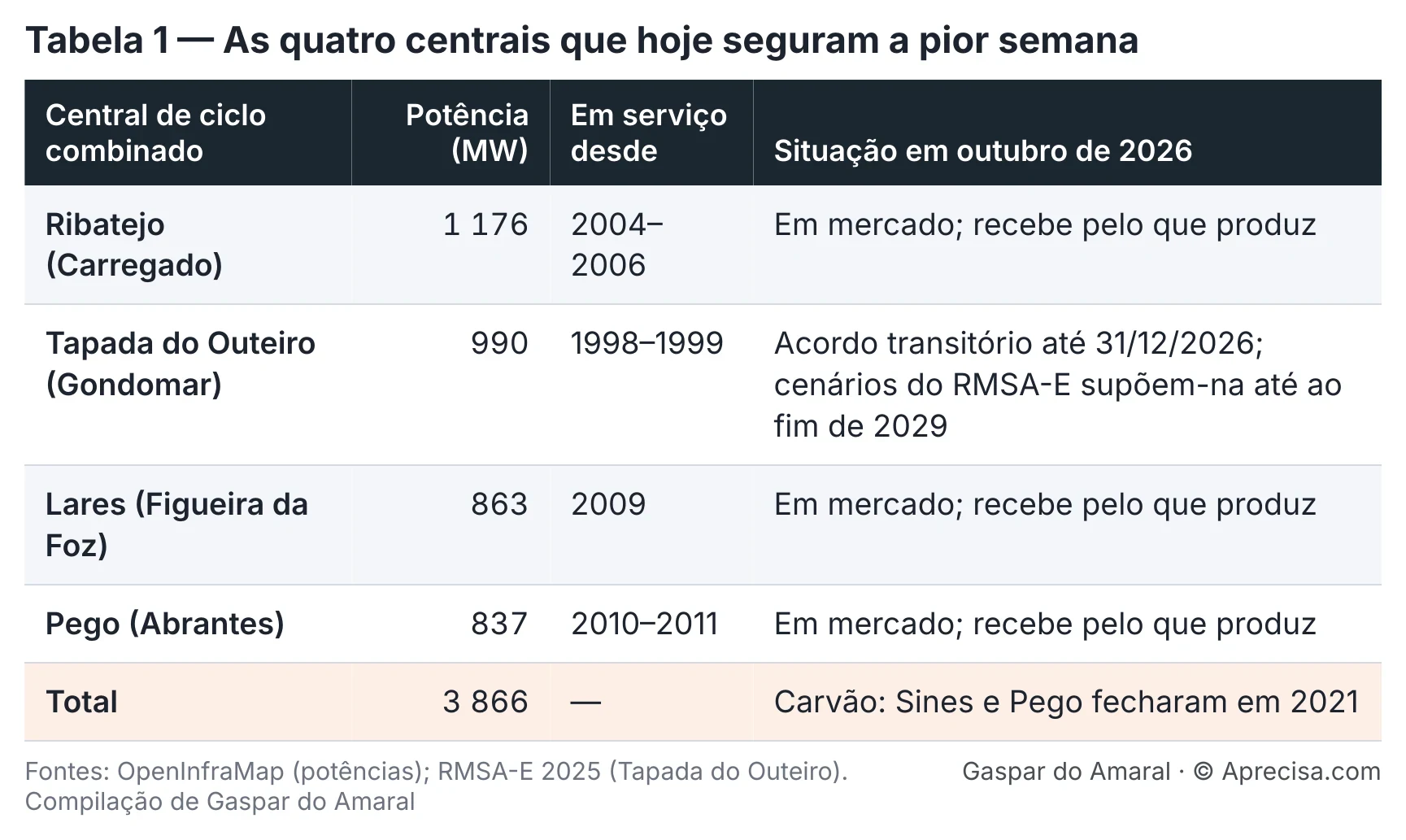
How to read Table 1. These are the four power stations that, in a prolonged calm, can supply power for days on end without depending on the weather. Together they add up to 3,866 MW, almost double the 2 GW we used as the measure of the worst week. The last column is the one that matters: three of these power stations are there because, for now, it pays them to be; the fourth has a set deadline. The total capacity comes from OpenInfraMap; the situation of Tapada do Outeiro, from RMSA-E 2025.
R3 Installed capacity is not guaranteed capacity. The 3,866 MW are what the four power stations deliver when they are all working well. On any given day, one may be under maintenance, another broken down, and the gas may not reach all of them. The same applies, in another way, to everything else: a 100 MW wind farm does not deliver 100 MW on a calm night, and a 100 MW battery runs empty after four hours. Engineers measure this with the equivalent firm capacity (ELCC, Effective Load Carrying Capability): how many megawatts of consumption each power station can really guarantee in the hours of risk. Think of a football team: what matters is less how many players are registered than how many are fit on match day. It is that number, and not the grid-connection capacity, that should guide what is contracted. A note on the numbers: ENTSO-E records 4.4 GW of gas capacity in 2026 because it includes about 0.5 GW of cogeneration; this article counts the 3.9 GW of the four combined-cycle power stations, the ones that can hold up for days on end.
II. The engine that covers the week works less and less
A power station only stays open if its revenues pay its fixed costs: staff, maintenance, insurance, licences, grid connection. Those revenues come, above all, from the hours in which it produces. Figure 1 shows what has happened to those hours.
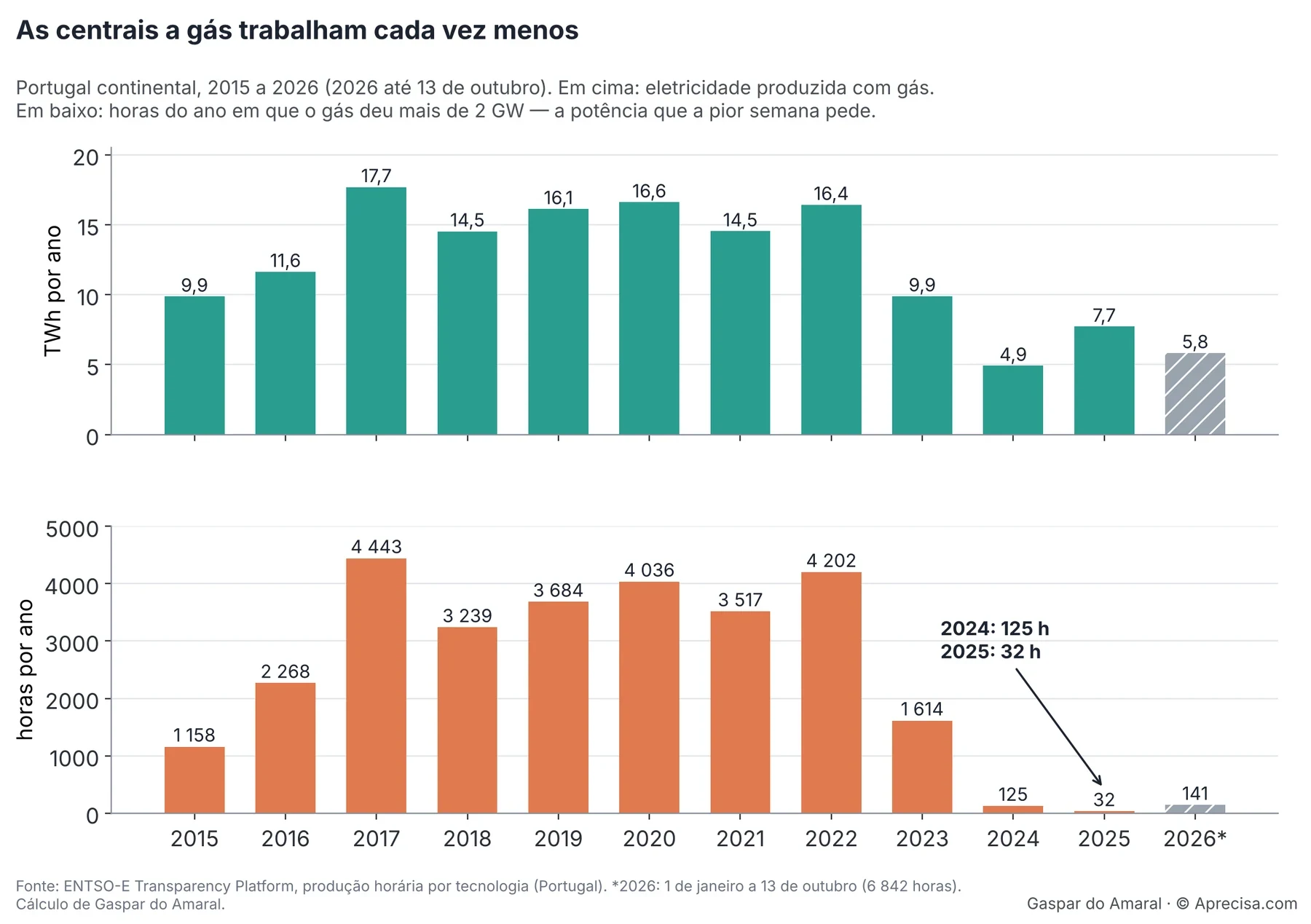
How to read Figure 1. The top panel shows how much electricity the gas power stations produced each year: it ranged between 15 and 18 TWh from 2017 to 2022 and fell to 4.9 TWh in 2024. The bottom panel counts the hours of the year in which gas delivered more than 2 GW, the capacity the worst week needs: they went from more than 4,000 in 2020 and 2022 to 125 in 2024 and 32 in 2025. The 2026 bar, hatched, only goes up to 13 October. The two measures are in separate panels because they have different units.
The power stations still exist, but they spend the year almost idle. It is like a taxi that only has customers three weeks a year: the owner keeps the car for as long as he can, but in the end the sums do not add up. The official report is not unanimous on this: in one of its analyses it accepts that, in 2028, some units of these power stations may not be economically viable; in another, with more consumption and fewer renewables, it concludes that they all are. Viability depends on what the future brings — and it is that uncertainty that an insurance policy should cover.
R4 Economists have a name for this: missing money. The power stations produce less, but the fixed costs of keeping them ready do not fall in the same proportion. The market pays well for energy on normal days and does not pay, through the same mechanisms, for availability on exceptional days. A capacity mechanism can solve this — provided that its size and its cost come from an independent and rigorous assessment, and not from a rough estimate.
In practice. Whoever covers the worst week is paid by the good weeks. If the good weeks disappear — because wind and sun produce more cheaply — the insurance no longer has anyone to pay for it, even though it is still needed.
III. Who covered the windless weeks
The ENTSO-E hourly series makes it possible to see who supplied the country in the lulls from 2015 to 2026. I used the same criterion as in “As piores semanas que já tivemos” (The worst weeks we have ever had): I counted as a lull four or more days in a row with wind below 10% of installed wind capacity. There are twenty such episodes in twelve years. Figure 2 groups them into three periods.
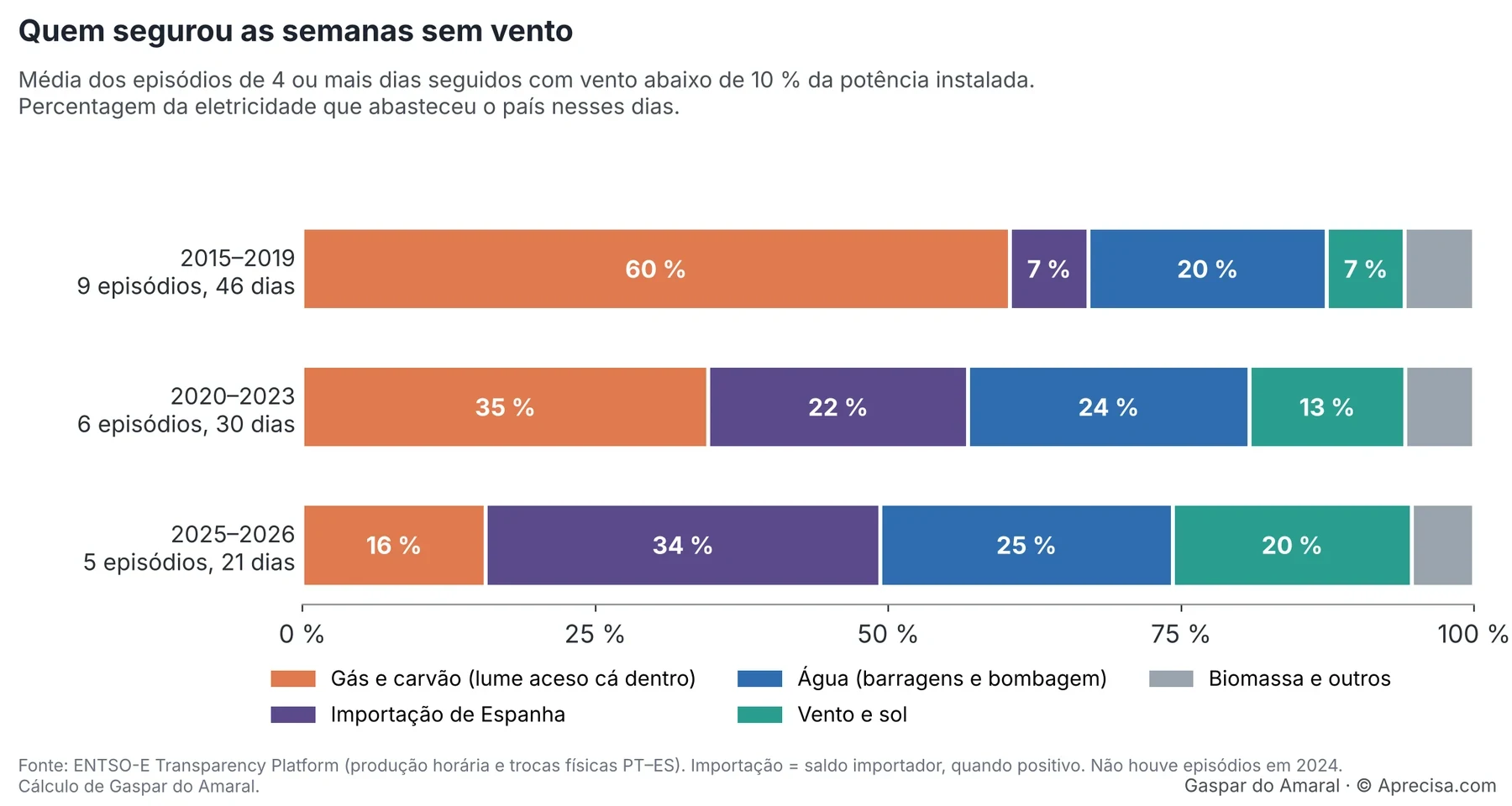
How to read Figure 2. Each bar is the sum of 100% of the electricity that supplied the country, on average, in the lulls of that period. Orange is the fire lit here at home, gas and coal: it was 60% in 2015–2019, fell to 35% in 2020–2023 and to 16% in 2025–2026. Purple is imports from Spain: they rose from 7% to 22% and then to 34%. Water stayed almost the same, between 20% and 25%. In 2024 there were no episodes that met the criterion.
The reading is simple: the insurance changed hands without anyone deciding it. It passed from the Portuguese power stations to the interconnection with Spain. As long as Spain has electricity to spare in those hours, it works and it is cheap. The risk lies in the hours when the same high pressure stops the wind on both sides of the border. That is why the official report also runs the numbers with only 10% of the interconnection available, and that is why Spain, which covers part of our worst week, is paying to cover its own. A wider interconnection helps adequacy, but it does not solve the hours when both sides fail at the same time; I developed that point in “400 kV de Comércio, Zero de Inércia Garantida” (400 kV of Trade, Zero Guaranteed Inertia).
R5 Importing is not the same as having a guarantee. An import is a purchase: it only happens if there is electricity to sell on the other side and if the cable has room. And the cable is starting to fill up. When the interconnection is free, Portugal and Spain pay the same price; when it fills up, the prices split. Up to 2024, this happened in between 2% and 8% of the hours of the year; in 2026, up to 17 October, it has already happened in 14%. In the hours when Portugal imports more than 3 GW, prices split in almost one hour in five. In the week of 10 to 12 October, Portugal paid, on average, €157/MWh and Spain €148/MWh. The interconnection is a valuable resource, but it does not, on its own, replace firm capacity at home: the assessment has to consider the lulls that catch both countries at the same time, power stations that break down, dry years and an interconnection that is partly unavailable.
IV. First change: the yardstick got shorter
To know whether an electricity system is secure, you count the expected number of hours per year in which the available generation is not enough for consumption. In technical language it is called LOLE (Loss of Load Expectation). These are not hours of certain blackout: they are hours in which the operator has to resort to emergency measures, such as asking Spain for help or cutting consumers who have agreed to be cut. Nor is it the problem of the blackout of 28 April 2025, which was one of stability — voltage and control of the grid second by second — and not of a lack of power stations. The distinction between the two is in “Tensão, não adjetivos” (Voltage, not adjectives).
Until 2024, the national criterion accepted up to 5 hours per year. In February 2026, the DGEG (Directorate-General for Energy and Geology) set, on a proposal from ERSE (the energy services regulator) and following the European rules, a reliability standard of 1.46 hours per year. The standard is the result of an economic calculation: the point at which paying for one more reserve power station starts to cost more than the electricity that, without it, would go unsupplied. The yardstick became more than three times stricter.
R6 The 1.46 hours are not hours of power cuts that are accepted. They are an expected value, calculated in a model with many scenarios. And LOLE only says how many hours; it does not say how much is missing. For that a second indicator is used, the expected energy not served (EENS, Expected Energy Not Served), in MWh per year. Together, the two say whether the risk is one of many hours with a small shortfall or of few hours with a large one — and that decides what should be contracted: capacity for two hours or for five days.
In practice. It is like starting to require that the bus fails at most one and a half times a year, instead of five. The buses are the same; what changed was the requirement. And, with the new requirement, the fleet there was becomes too small.
V. Second change: the official measurement says it is not enough
On 5 June 2026, the DGEG published the Report on Monitoring the Security of Supply of the National Electricity System for 2026–2040 (RMSA-E 2025), prepared with REN (the national grid operator). Figure 3 puts the yardstick and the measurements side by side.
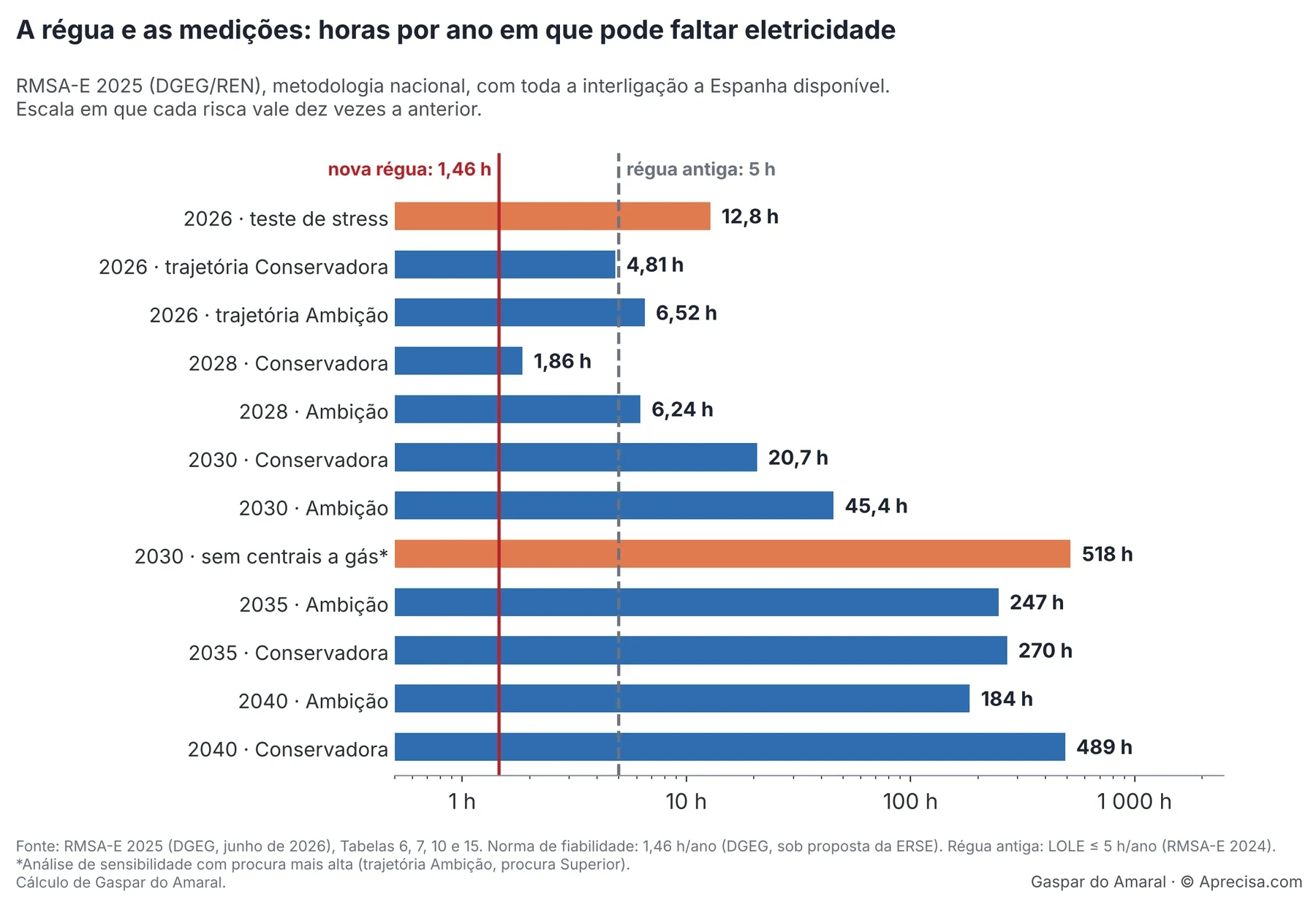
How to read Figure 3. Each bar is the expected number of hours per year with insufficient electricity in one scenario of the report. The red line is the new yardstick (1.46 h); the dashed one, the old one (5 h). The horizontal scale grows in jumps of ten times so that values of 1.86 h and of 518 h fit in the same drawing. All the bars lie to the right of the red line. The two orange scenarios are tests at the limit: the 2026 stress test and the hypothesis of closing all the gas power stations in 2030 with high consumption.
Four conclusions of the report deserve to be read in its own words:
- In 2026, already. The stress test, which assumes Tapada do Outeiro running all year, gives 12.8 h per year. The report calls it «Estádio de Rutura» (breaking stage): the point at which the system stops being adequate for demand. The central scenarios for 2026 give 4.8 and 6.5 h, also above the yardstick.
- In 2030 between 1,240 and 1,690 MW of guaranteed capacity are missing, on top of the whole interconnection, to meet the standard. The worsening from 2028 to 2030 is explained by the exit of Tapada do Outeiro at the end of 2029 and by the growth in consumption.
- Without the gas power stations, more than 500 h per year. In the hypothesis of all of them closing in 2030, the expected number of hours with insufficient electricity goes above 500. The report concludes that it is necessary to keep them «de forma a garantir potência firme e backup» (so as to guarantee firm capacity and backup).
- R7 The short-term insurance failed. For 2026, the report identified the need for 850 to 1,550 additional MW. The 7th reserve band auction, in December 2025, was intended to cover a large part of that need, but not all of the capacity put up for auction was awarded. In the words of the report, the deficit «acarreta riscos de falha de abastecimento» (entails risks of supply failure).
There is a note of honesty to be made. The values for 2035 and 2040, between 184 and 489 h, assume that consumption grows a great deal — data centres, electrolysers, industry — and that supply does not keep up. They are warnings, not forecasts. But the report leaves no doubt on the essential point: by the national methodology, no scenario meets the standard, neither today nor ten years from now, without new capacity or without keeping the capacity that exists.
There is a second note, equally necessary. The report also runs the numbers using the European methodology (ERAA), and that gives much lower values: it only exceeds the standard in the trajectory with more consumption and fewer renewables, from 2028 to 2035. The report itself explains the difference. The national methodology represents the dams in more detail, allows for breakdowns in the hydro units and checks, hour by hour, whether there is reserve and flexibility for the rapid rises and falls in net consumption. This disagreement between the two yardsticks was the subject of “Oito avisos” (Eight warnings); what changed in 2026 is that there is now a single standard and the national measurement has been published against it.
R8 The disagreement is not academic. Under the European rules (Regulation (EU) 2019/943, Articles 21 and 24), a country may not create a capacity mechanism if neither the European nor the national assessment sees a problem; and, when only the national one sees it, it has to explain the difference and consult the European regulator, ACER. The decision to contract cannot, therefore, come from choosing the most pessimistic yardstick. It has to come from assumptions that are explained and reproducible: how the dams, the breakdowns, the reserves and the interconnection are represented.
VI. Third change: the Government announces a mechanism
On 15 June 2026, ten days after the report, the Government announced the creation of a capacity mechanism: a scheme that pays whoever guarantees to be available when the system needs it, and not only whoever produces. The mechanism will be open to generation, storage and demand management, will be awarded through competitive procedures, and began with a pre-notification to the European Commission, because it is State aid. I argued for the creation of a mechanism of this kind in March 2026, in “Transição Energética em Portugal: O Fim das Rendas Excessivas e o Início da Responsabilidade Integral” (Energy Transition in Portugal: The End of Excessive Rents and the Beginning of Full Responsibility).
The announcement does not say how many megawatts, how much it costs, for how many years or who pays. It says only that the aim is «o menor custo possível para as famílias e empresas» (the lowest possible cost for families and businesses). In the same month, the Government scheduled for 14 September a grid-connection auction for 1,050 MVA of batteries. On 14 September, the auction was postponed. At the time this article was closed I found no new public date.
R9 A grid-connection auction for batteries is not, on its own, a contract for guaranteed capacity. Batteries are excellent for the day: they regulate frequency, store the midday sun for the late afternoon, respond in milliseconds. But what they deliver in a windless week depends on the energy stored and on there being something to recharge them with. Guaranteeing 2 GW for 120 hours in a row requires 240 GWh; guaranteeing 2 GW for four hours requires 8 GWh. The megawatts are the same; the service is thirty times larger. Technological neutrality does not mean buying different things as if they were the same.
Meanwhile, from 29 August to 30 September, the National Energy Storage Strategy, prepared with studies by INESC TEC, was in public consultation. It proposes 6.9 GW of storage in 2030 — 3.9 GW of pumped storage and 3 GW of batteries — and states clearly what is essential for this article: four-hour batteries solve the day well, but each additional battery yields less, because they all compete for the same hours; for long periods without wind or sun, pumped storage, the interconnection and demand flexibility are still needed. It is the first time that a State document separates, in black and white, the insurance for the day from the insurance for the week.
Next door, Spain has already decided. At the end of May 2026, the European Commission approved the Spanish capacity mechanism: 9 billion euros over ten years. The comparison between the two countries and the mechanisms of other European countries was dealt with in chapter VIII of “Oito avisos”; here it is enough to note the difference in timing. Table 2 puts in order everything that has happened since December 2025.
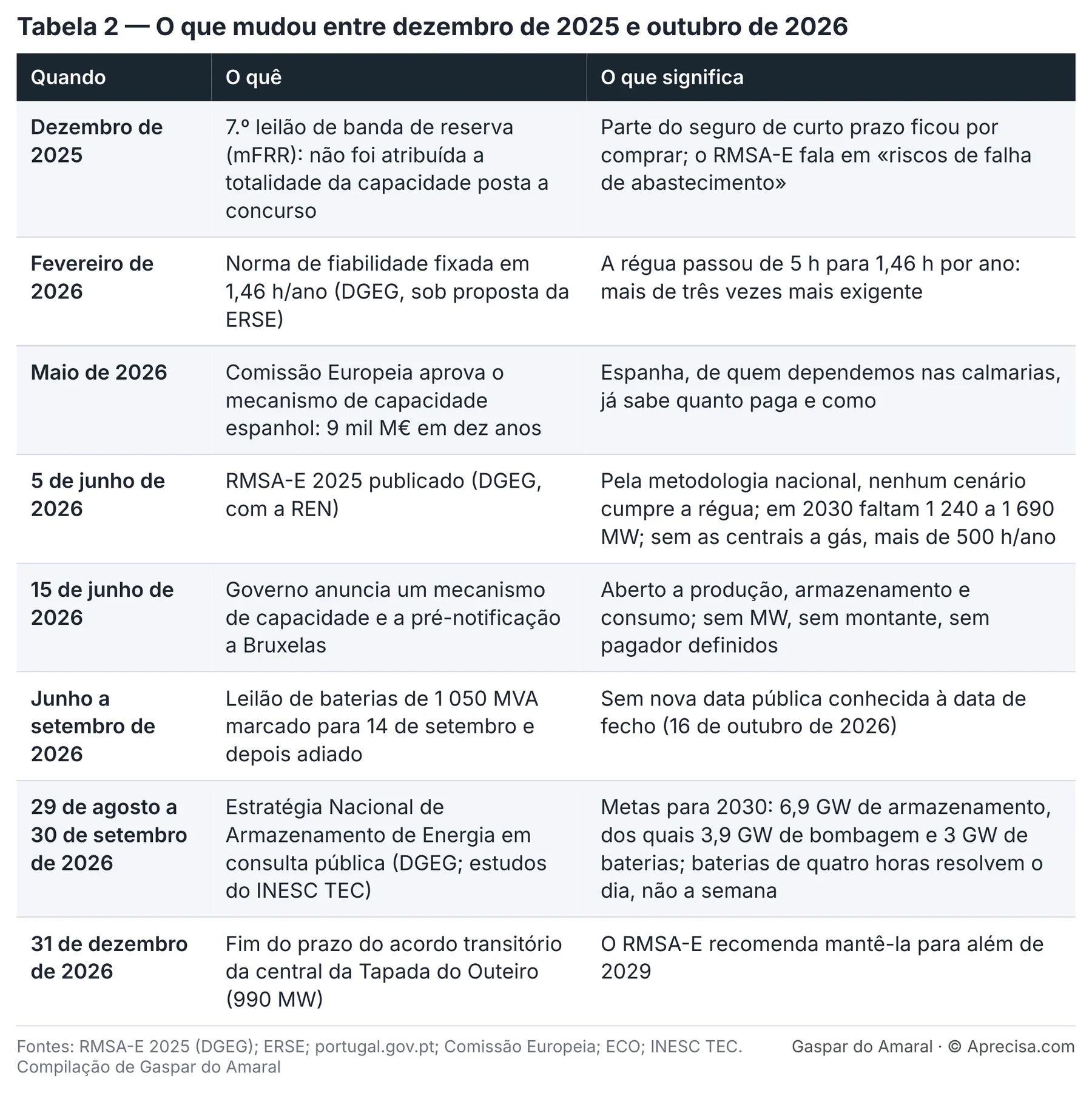
How to read Table 2. The rows are in date order. The middle column says what happened; the right-hand one, what that changes for whoever pays the bill. Read from top to bottom, the table tells a story in three stages: the short-term insurance was left unbought, the yardstick became stricter and the official measurement says it is not enough; then came the announcement of a mechanism still without figures.
VII. What has already been paid for the insurance
Guaranteeing electricity in the difficult hours is not a new expense. Portugal has already paid, in several ways, for consumers who agree to stop and for power stations that stay on standby. Table 3 brings together the orders of magnitude that can be confirmed in public sources.
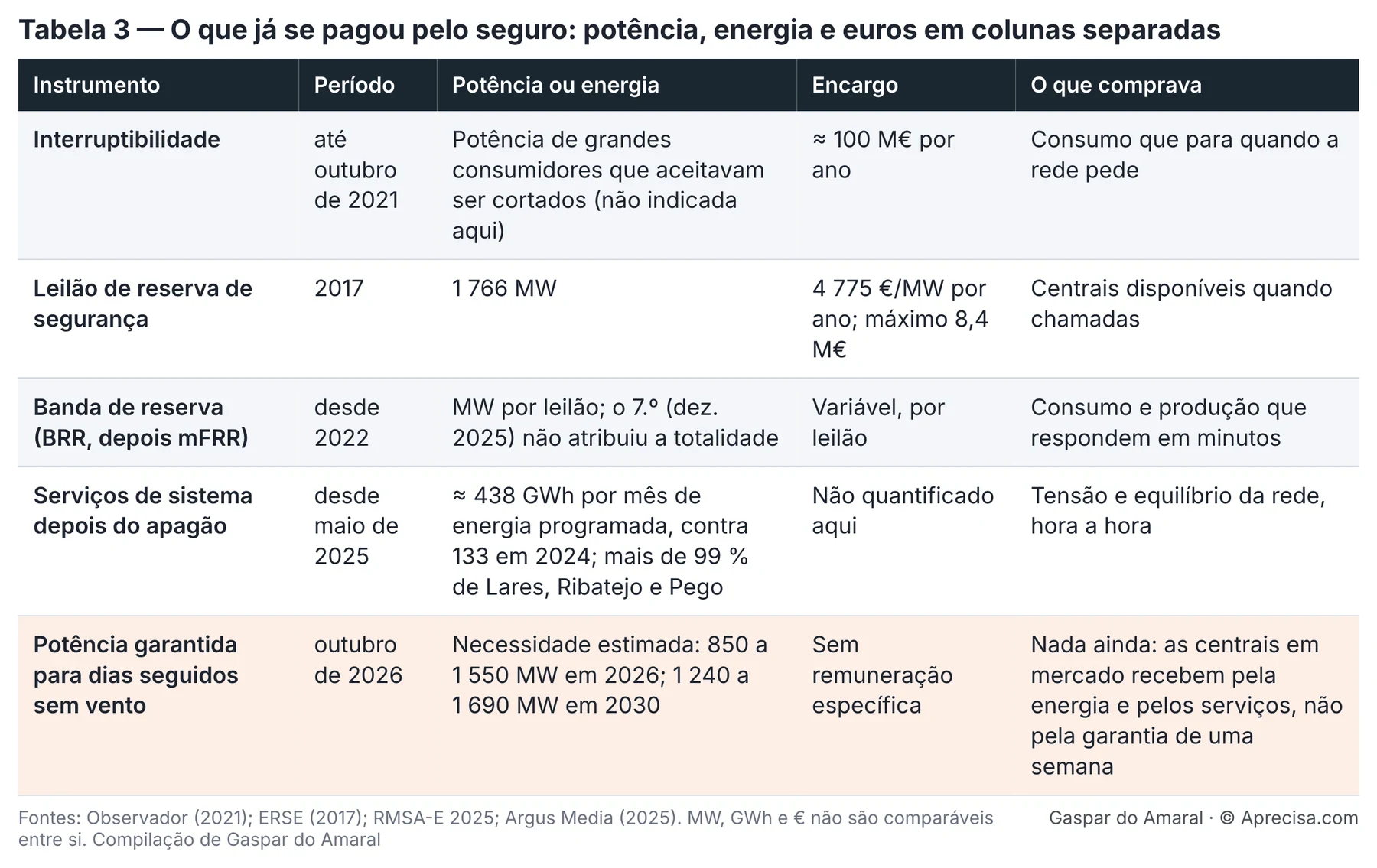
R10 How to read Table 3. Each row is an instrument that paid, or pays, part of the insurance. Interruptibility cost the system about €100 million a year and ended in 2021 by European requirement. The 2017 security reserve auction contracted 1,766 MW for a maximum of €8.4 million. Since 2022, the reserve band buys from whoever responds within minutes, but the December 2025 auction did not award all of the capacity. After the blackout of 28 April 2025, the services provided to the grid almost tripled and were delivered, almost all of them, by three gas power stations. These last are scheduled energy, not euros. The columns are separate because megawatts, gigawatt-hours and euros cannot be added together or compared with one another: each instrument buys a different service. The last row, highlighted, is the one this article wants to underline: there is today no specific payment for having guaranteed capacity for a whole week.
In practice. We paid for the two-minute fire extinguisher — whoever cuts consumption for two hours, whoever balances the grid minute by minute. We have no contract with the fire brigade for the fire that lasts five days.
There are countries that have already made that contract. In the German calm of November 2024, 263 hours with almost no wind or sun, Germany held out because it keeps about 90 GW of power stations that do not depend on the weather, and about 11 GW of them are outside the market, paid separately as a security reserve. It is an explicit insurance, with a known price and payer — the case was dealt with in “Cinquenta hertz” (Fifty hertz), in Observador.
VIII. What remains to be decided
The diagnosis has been made, and it is official. The yardstick exists, so does the measurement, and the mechanism has been announced. What is missing are the decisions that give all this content. Table 4 sums them up.
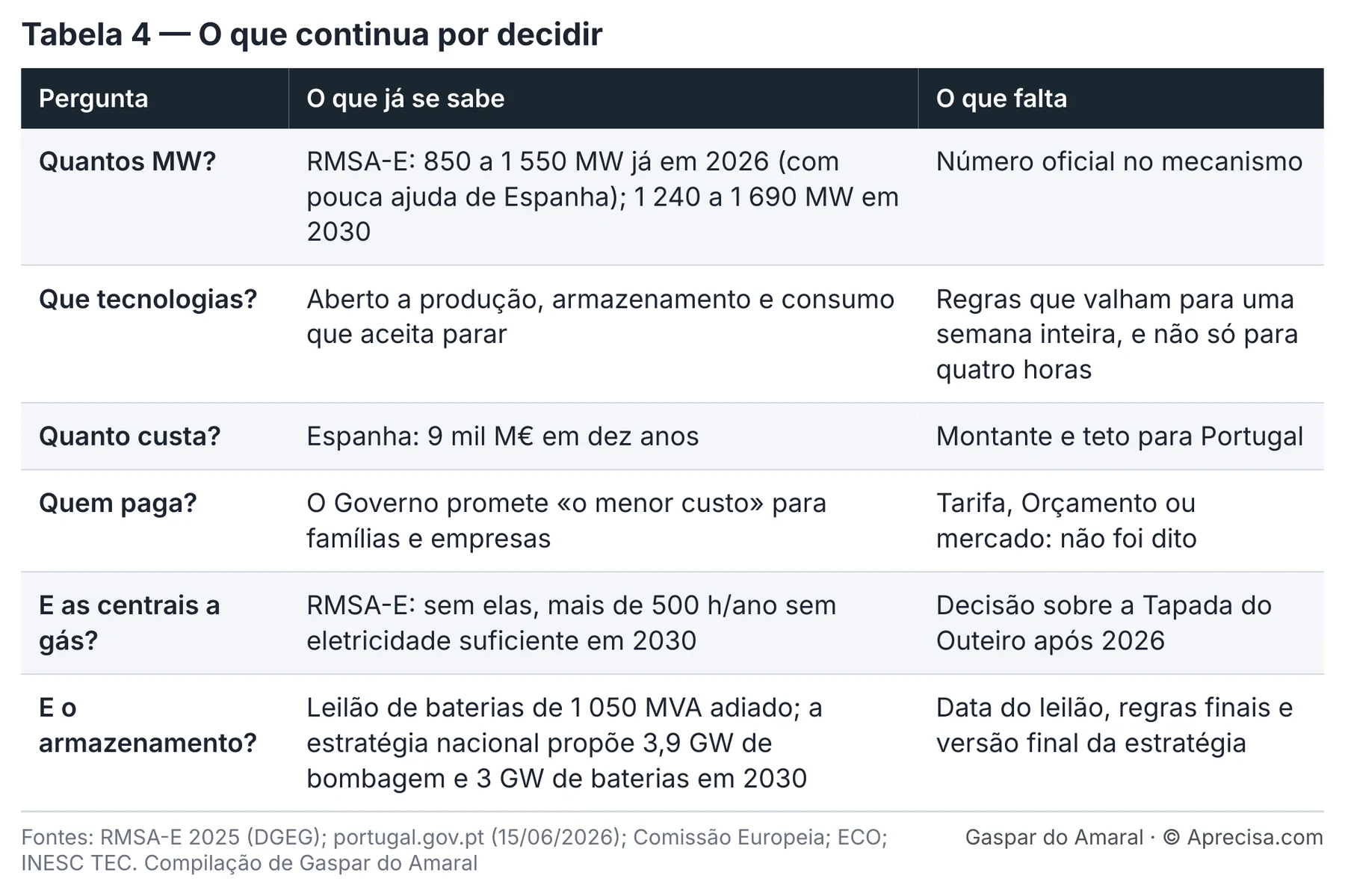
How to read Table 4. Each row is a question the mechanism will have to answer. The middle column brings together what the official documents already say; the right-hand one, what is missing. The question in the second row is technical and decisive: an auction that pays whoever guarantees four hours does not buy the same as an auction that pays whoever guarantees five days. The question in the fourth row — who pays — is the one no public document has answered so far.
There is one decision that cannot wait for the mechanism: the Tapada do Outeiro agreement ends on 31 December 2026. The official report assumes it in service until the end of 2029 and recommends providing for its continuity beyond that date. That is 990 MW, about a quarter of the country’s gas capacity.
IX. What this diagnosis leaves us with
- Today, the worst week is covered by power stations that nobody pays to be available and by Spanish electricity that arrives as long as there is some to spare on the other side. On 10 to 12 October, Spain supplied more than half of consumption.
- The gas power stations work less and less. The hours above 2 GW fell from more than 4,000 a year to a few dozen or a few hundred. The official report accepts, in one of its analyses, that some units may stop being viable in 2028.
- In 2026 the yardstick became stricter and the official measurement says it is not enough. By the national methodology, no scenario of RMSA-E 2025 meets the standard of 1.46 h per year; the European one is less severe, and the difference between the two remains to be resolved.
- The Government announced a mechanism, but without figures. What is missing are the megawatts, the amount, the required duration and the answer to the usual question: who pays.
- There is a deadline at the door: 31 December 2026, the end of the Tapada do Outeiro agreement.
R11 The worst week is not only an engineering problem. It is a test of the quality of energy planning and of the responsibility of those who decide on investments.
The next article, written with João de Jesus Ferreira, will start from here: how many megawatts, from which technologies, in what order, and how to share the bill fairly between families, businesses and the State.
Gaspar do Amaral
Revision log
On 17 October 2026, João de Jesus Ferreira sent a critical review of the article with twelve proposals. Nine went into this edition, rewritten in the register of the text; three are kept for the second article, which will deal with what to do and with who pays. A factual correction was added, together with the reservoir and price data collected after the first version. Table 5 records everything.
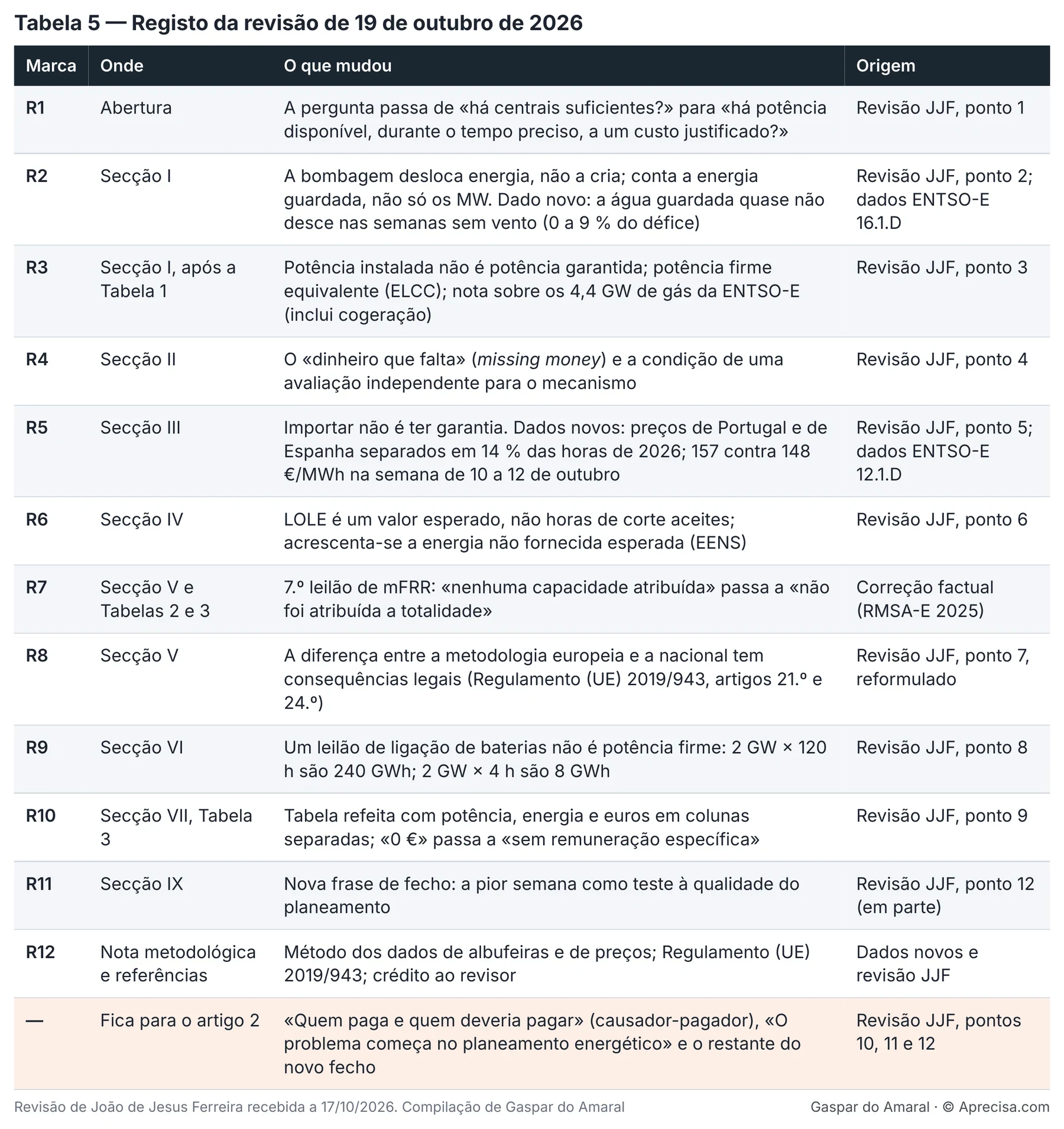
How to read Table 5. Each row corresponds to a mark in the margin of the text (R1 to R12). The «Origem» (origin) column says whether the change came from the review by Professor João de Jesus Ferreira, from a factual correction or from new data. The last row records what did not go in and where it went. Correction R7 deserves a note: the 1st edition said that the 7th mFRR auction awarded no capacity at all; RMSA-E 2025 itself uses two wordings, «nenhuma da capacidade colocada a leilão foi atribuída» (none of the capacity put up for auction was awarded) and «não atribuição da totalidade» (not all of it awarded), and this edition adopts the second, which is true under either reading.
What the review taught me
I wrote this article to tell what changed in 2026. Professor João de Jesus Ferreira read it asking what had not yet been proved. They are two different readings, and the article needed both.
Three things changed in the way I see the problem. I was counting megawatts; he made me count the megawatts that are there on the right day. I wrote «0 €»; he wrote «sem remuneração específica» (no specific remuneration). His sentence is less eye-catching and more true: rigour sometimes loses in impact and always gains in trust. And he corrected a fact of mine. When checking it, I found that the official report itself describes it in two different ways. The lesson is simple: citing the source does not exempt you from reading all of it.
I did not follow him to the letter in everything. I write for people who are not engineers, so I rewrote his proposals in the register of this text, at the risk of losing nuances; if I lost any, the responsibility is mine. And I kept for the next article the proposals on who pays and on planning. It was not because I disagreed: they deserve a whole article, which the Professor agreed to analyse with me, with the necessary technical and economic depth.
At a time when people publish without reviewing and review without signing, an engineer with decades in the profession read this text, disagreed in writing, proposed alternatives and chose to be named as the reviewer of this text. This too is a form of security: that of knowing that someone has checked.
Gaspar do Amaral
Methodological note
About this translation. A translation of the 2nd edition (25 October 2026) of the article the author published on LinkedIn on 16 October 2026; the full Portuguese version is on this site. The three figures and five tables of the original are reproduced as they are, with their texts in Portuguese and a translated caption. Quotations from official documents stay in Portuguese, with a translation in brackets. The numbered lists of the original appear as bullet points; the marks R1 to R12 are kept as in the original.
Hourly data. Generation by technology, consumption and physical exchanges Portugal–Spain from the ENTSO-E Transparency Platform, from 1 January 2015 to 13 October 2026, in UTC time. Imports are the net import balance, when positive; in export hours they count as zero in Figure 2. Installed capacity by technology is the capacity declared to ENTSO-E for each year; it includes gas cogeneration units and therefore exceeds the sum of the four combined-cycle power stations.
Lulls. A lull day is one on which average wind generation stayed below 10% of the wind capacity installed in that year. An episode is a sequence of four or more lull days. The percentages in Figure 2 are averages weighted by the duration of each episode, over the sum of the sources that supplied the country.
R12 Reservoirs and prices (added in the 2nd edition). Energy stored in reservoirs and pumped-storage plants: ENTSO-E 16.1.D (weekly values, BZN|PT and BZN|ES), interpolated to the day for the lull episodes. «Water covered» is the fall in the stock during the episode divided by consumption minus wind and solar in that episode. Prices: ENTSO-E 12.1.D (day-ahead market, BZN|PT and BZN|ES), converted from Madrid time to UTC; «prices split» when the difference exceeds €0.01/MWh.
Official indicators. The LOLE values in Figure 3 are from RMSA-E 2025 (national methodology, PS-MORA model, 100% of the interconnection capacity available for commercial exchanges), Tables 6, 7, 10 and 15. The old criterion of 5 h per year is the one used in RMSA-E 2024.
Limits. The episodes observed depend on the criterion chosen; with 8% or 12% the number changes, but not the trend. Imports in those hours were the result of the market and do not prove a lack of national capacity; they show who supplied, not who could have supplied. The capacities of the power stations were rounded to the sources indicated.
Editions. 1st edition: 16 October 2026. 2nd edition: 25 October 2026, with the review of 19 October (Table 5) and the preliminary note.
Authorship. Data collection, calculations, figures and tables by Gaspar do Amaral, AI-assisted for programming and checking; critical review and technical contributions by João de Jesus Ferreira. The numbers were checked against the original sources listed below.
References
- DGEG (2026), Relatório de Monitorização da Segurança de Abastecimento do Sistema Elétrico Nacional 2026–2040 (RMSA-E 2025) — A. Official documents · Subject: the State’s annual report on whether there will be enough electricity in Portugal from 2026 to 2040, with demand and supply scenarios, a stress test and an analysis without the gas power stations. Used in: Figure 3; section V (12.8 h/year in the stress test, 1,240 to 1,690 MW missing in 2030, more than 500 h/year without gas power stations, 7th mFRR band auction without all the capacity awarded); Tables 1, 2 and 4 (Tapada do Outeiro deadlines).
- ERSE (2026), ConvERSE sobre a norma de fiabilidade para Portugal continental — A. Official documents · Subject: public session in which ERSE presented the method and the value of the reliability standard, that is, the maximum number of hours per year in which a shortage of electricity is accepted. Used in: section IV (the new yardstick of 1.46 h/year).
- Governo de Portugal (15/06/2026), Governo reforça segurança do sistema elétrico com novo mecanismo de capacidade — A. Official documents · Subject: Government press release announcing the creation of a capacity mechanism, open to generation, storage and demand management, with the stated aim of «menor custo possível» (lowest possible cost). Used in: section VI and Table 4 (what was announced and what was left unsaid: MW, amount, payer).
- Governo de Portugal (2026), Governo prepara mecanismo de capacidade … em diálogo com a Comissão Europeia — A. Official documents · Subject: press release on the dialogue with the European Commission and the pre-notification of the mechanism, required because it is State aid. Used in: section VI and Table 2 (timetable of the mechanism).
- ERSE (30/03/2017), Leilão de reserva de segurança de 2017 permite poupança de 7,2 M€ — A. Official documents · Subject: result of the 2017 security reserve auction: 1,766 MW contracted at €4,775/MW, with a maximum cost of €8,433 thousand. Used in: Table 3 (what has already been paid for the insurance).
- Regulamento (UE) 2019/943 do Parlamento Europeu e do Conselho, de 5 de junho de 2019, relativo ao mercado interno da eletricidade — A. Official documents · Subject: European rules for the assessment of resource adequacy and for capacity mechanisms, including the relationship between the European assessment and the national assessments. Used in: section V (Articles 21 and 24).
- Observador/Lusa (15/06/2026), Governo cria mecanismo de capacidade para reforçar segurança do sistema elétrico — B. Press and analysis · Subject: news report on the announcement of the capacity mechanism, with the reference to the Spanish mechanism of €9 billion approved in May. Used in: section VI (comparison of timing with Spain).
- ECO (29/06/2026), Leilão de baterias marcado para 14 de setembro — B. Press and analysis · Subject: scheduling for 14 September 2026 of the grid-connection auction for 1,050 MVA of battery storage. Used in: section VI and Tables 2 and 4.
- ECO (14/09/2026), Governo adia leilão de capacidade para armazenamento de energia — B. Press and analysis · Subject: postponement of the storage auction on the very day it was due to take place. Used in: section VI and Tables 2 and 4 (auction with no new public date).
- INESC TEC (30/09/2026), INESC TEC contribui para a definição da Estratégia Nacional de Armazenamento de Energia — B. Press and analysis · Subject: news report on the National Energy Storage Strategy, in public consultation from 29 August to 30 September 2026, with targets of 6.9 GW in 2030 (3.9 GW of pumped storage and 3 GW of batteries) and 9.76 GW in 2040, and the conclusion that four-hour batteries serve the day but not long periods. Used in: section VI and Tables 2 and 4.
- ESS News (01/06/2026), EU approves capacity market for Spain — B. Press and analysis · Subject: approval by the European Commission of the Spanish capacity mechanism: €9 billion over ten years. Used in: section VI and Tables 2 and 4 (Spain has already decided how much it pays).
- Observador (13/10/2021) — B. Press and analysis · Subject: end of the interruptibility scheme, imposed by the European Commission, which relieved the costs of the electricity system «em 100 milhões de euros» (by 100 million euros). Used in: Table 3 (order of magnitude of what was paid to those who accepted cuts).
- Argus Media (2025), Portuguese ancillary services rise following blackout — B. Press and analysis · Subject: increase in system services in Portugal after the blackout of 28 April 2025: 438 GWh per month, against an average of 133 GWh in 2024, more than 99% provided by the Lares, Ribatejo and Pego power stations. Used in: Table 3 and section VII (the gas power stations are paid for services to the grid, not for guaranteeing a week).
- Gaspar do Amaral (27/03/2026), Transição Energética em Portugal: O Fim das Rendas Excessivas e o Início da Responsabilidade Integral — C. Articles by the author · Subject: article by the author on the end of excessive rents and full responsibility in the electricity system, in which in March 2026 he argued for the creation of a capacity mechanism. Used in: section VI (how early the proposal came compared with the Government’s announcement).
- Gaspar do Amaral (14/06/2026), Tensão, não adjetivos: o que o relatório final do apagão ibérico exige que a engenharia diga em voz alta — C. Articles by the author · Subject: article by the author on the final report on the Iberian blackout, which distinguishes adequacy (having enough power stations, measured in LOLE and EENS) from stability (voltage and control of the grid second by second). Used in: section IV (the worst week is a problem of adequacy, not of stability).
- Gaspar do Amaral (02/07/2026), 400 kV de Comércio, Zero de Inércia Garantida — O que a nova interligação Minho–Galiza transporta, e o que não dispensa — C. Articles by the author · Subject: article by the author on the new 400 kV Minho–Galicia interconnection: it increases exchanges and helps adequacy, but does not protect when both sides of the border fail at the same time. Used in: section III (the limits of the insurance that passed to Spain).
- Gaspar do Amaral e João de Jesus Ferreira (15/10/2026), A pior semana — Quanto custa não ficar às escuras quando faltam o vento e o sol — C. Articles by the author · Subject: article by the author with João de Jesus Ferreira that calculates how much it costs to guarantee 2 GW for 120 hours, three times a year, with gas turbines, demand that agrees to stop, pumped storage or batteries. Used in: introduction and section I (the 2 GW measure of the worst week).
- Gaspar do Amaral (13/10/2026), As piores semanas que já tivemos — C. Articles by the author · Subject: article by the author that identifies, with ENTSO-E hourly data from 2015 to 2026, the real weeks with little wind in Portugal and who supplied the country on those days. Used in: Figure 2 and methodological note (same series and same lull criterion).
- Gaspar do Amaral (01/10/2026), Cinquenta hertz: o que o interruptor esconde enquanto o país dorme, Observador — C. Articles by the author · Subject: opinion article by the author on the cost of the electricity system beyond the price of the MWh, with the case of the 263-hour German calm in November 2024 and the roughly 11 GW of reserve outside the market. Used in: section VII (example of an explicit insurance, with a known price and payer).
- Gaspar do Amaral (outubro de 2026), Oito avisos — O que os relatórios oficiais dizem desde 2018 sobre a segurança de abastecimento — C. Articles by the author · Subject: article by the author that brings together what the official security-of-supply reports said from 2018 to 2025, the divergence between the national and the European methodology and, in chapter VIII, the capacity mechanisms in Portugal, Spain and other countries. Used in: section V (divergence between the two methodologies) and section VI (international comparison, not repeated here).
- Gaspar do Amaral (outubro de 2026), Duas horas ao fim da tarde — C. Articles by the author · Subject: article by the author on the activations of the Spanish active demand response service in the late afternoon, when Spain asks industry to cut consumption for lack of generation. Used in: section III (Spain’s help depends on Spain having electricity to spare).
- ENTSO-E Transparency Platform — D. Data · Subject: European database with hourly generation by technology, consumption, physical exchanges and installed capacity for Portugal, from 2015 to 2026; in the 2nd edition, the energy stored in reservoirs (16.1.D) and day-ahead market prices (12.1.D) for Portugal and Spain were added. Used in: Figures 1 and 2, opening of the article (10 to 12 October 2026) and sections I and III (reservoirs and price splitting).
- OpenInfraMap — D. Data · Subject: open map of electricity infrastructure, with the capacity of the Ribatejo, Tapada do Outeiro, Lares and Pego combined-cycle power stations. Used in: Table 1 (capacity of the four power stations).
The discussion is on LinkedIn (in Portuguese)
Comments on this text are made on LinkedIn, where the article was shared in Portuguese. You are welcome to write in English. Agree, disagree or add data: every well-founded objection receives a reply.
Gaspar do Amaral · Original in Portuguese of 16 October 2026, published on this site; translation issued on 27 October 2026 · Figures and tables © Aprecisa.com · AI-assisted