 ← Grupo Aprecisa · Connecting those who know with those who need
Resilience · Newsletter «A Porta Estreita» (“The Narrow Door”)
Day 234: The illusion of having two
Why two suppliers, two routes or two networks are not always worth two
Gaspar do Amaral · 20 October 2026
Translated from the Portuguese original. This version was issued on 27 October 2026.
On this site, this article has been
Episode 4 of the series «A Porta Estreita» (“The Narrow Door”). For 234 days the door of Hormuz has been almost closed. Those who had a plan B breathed a sigh of relief. This episode is about what happens when plan B depends on the same thing as plan A.
Before you read, count in your head: how many “plan Bs” do you have at home? A second mobile phone, a torch, a card from another bank, a spare gas bottle. Keep the number. At the end of the article, you will put three questions to it, and the number may shrink.
Sunday night, in a house in Guimarães. Dona Lurdes has two mobile phones: the work one and the personal one. She says, rightly, that she is never out of contact.
At nine in the evening, a storm brings down the line that supplies the street. The power goes.
At midnight, both phones are at 10%. They had spent the afternoon plugged into the same charger, in the same kitchen socket. At two in the morning, both switch off almost at the same minute.
Dona Lurdes had two mobile phones. She had one socket.
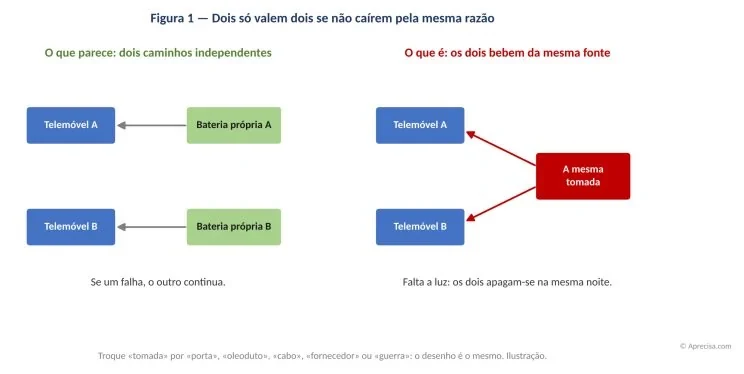
On the left is what Dona Lurdes thought she had: two separate paths, where the failure of one does not touch the other. On the right is what she actually had: the two phones hanging from the same source, the red box. When that box fails, both fail together. In engineering this is called a common-cause failure. Swap “socket” for “door”, “pipeline”, “cable” or “supplier” and the drawing is still right.
Having two is not having a plan B. Plan B is having two that do not fail for the same reason.
Today, day 234
Today, 20 October, is day 234. In the week that ended on 16 October, UKMTO, the British maritime trade operations centre, recorded at least 12 ships attacked in the strait, the highest number since the start of the war. One of them, the container ship GFS Pride, sank while being towed to shore. That day, a barrel of Brent touched 110 dollars, the highest value since May. Yesterday, it closed at 108.09 dollars.
In Portugal, the 5th wave, that of more expensive food, keeps arriving slowly. On 14 October, the DECO PROteste basket of 63 essential goods rose for the second week running and reached 256.26 euros, 14.43 euros more than in January. Fresh hake rose 17% in one week.
Episodes 2 and 3 explained why misfortunes come together and why they arrive late. This episode looks at the other side: at the defences. At the second supplier, the second route, the second network. At what lets us rest easy.
1. Your test, again: zero
In episode 3 I asked for a letter, A, B, C or D: which is the next wave to reach your home. I received likes, I received seven new subscribers this week. I did not receive a single letter. In episode 2 I had asked for a number from 0 to 5 and the result was the same.
I will not read this as lack of interest again. I read it as a piece of data: answering forces you to look at your own home, and that costs more than reading about other people’s homes. That is why, in this episode, the final question asks for just one word: yes or no.
2. The plan B that Saudi Arabia built in 1981
Saudi Arabia has known for more than forty years that Hormuz is a narrow door. That is why, in 1981, it built a plan B: the East–West pipeline, 1200 kilometres long, which carries oil from the Gulf wells to Yanbu, on the Red Sea, without passing through the strait. It can carry 7 million barrels a day.
During this crisis, plan B worked. It diverted about 4 million barrels a day, close to 4% of all the oil in the world. According to MEES, a specialist publication cited by OilPrice, it allowed Saudi Arabia to keep about 65% of its pre-war exports. It is a good plan B. But it is not an independent plan B.
Look where it was hit:
- On the way. From 11 to 22 September, the pipeline was stopped for about 11 days, after attacks with drones launched from Iraq. On 4 October, a new attack, claimed by the Houthis, hit a pumping station near Khurais, which had never been a target, and the pipeline stopped again.
- At the exit. The Houthis claimed attacks on Aramco’s facilities in Yanbu on 16 and 19 September. War-risk insurance for tankers loading in Yanbu tripled to about 3% of the value of the ship: 3 million dollars per voyage, on a 100-million tanker.
- After the exit. To reach Asia, oil from Yanbu has to pass through Bab el-Mandeb, another narrow door, at the south of the Red Sea. About 30 ships a day now pass through there. Before, 80 did.
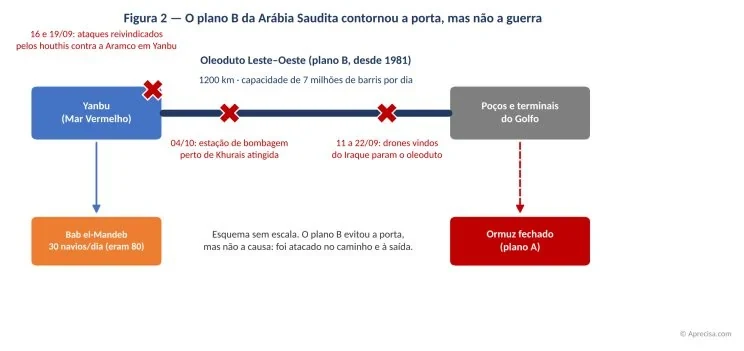
The dark blue line is the pipeline: plan B. The dashed red arrow, on the right, is plan A, the exit through Hormuz, which closed. The red crosses mark where plan B was attacked: halfway along, in September and in October, and at the exit, in Yanbu. The orange box is a reminder that, even after the exit, there is another narrow door. Plan B was designed to avoid a door. It was not designed to avoid the cause that closed the door: the war.
On 6 October, the Saudi energy minister gave assurances that the pipeline was once again pumping 5.8 million barrels a day. Plan B came back. But what this episode sets out to show had been proven: when the cause is the same, the second path is also in the line of fire.
The pipeline went around the door. It did not go around the war.
3. The sum that deceives
Let us do the sums, at Year 10 maths level. Imagine two suppliers. Each one fails 10% of the time, that is, 1 time in every 10 crises. If they are independent, if one has nothing to do with the other, the probability of both failing at the same time is the multiplication of the two:

With 10% each: 0.1 × 0.1 = 0.01. The two fail together 1 time in 100. It is this sum that lets us rest easy when we have two.
Now add the common cause. Imagine that half of the failures of each supplier come from the same cause: the same strait, the same war, the same winter. When that cause appears, it takes both at once. Engineers who deal with nuclear power stations and aircraft use for this a simple model, the β (beta) factor model: β is the part of the failures that is common to both.
The first part of the equation, β × p, is the failures that take both at once. The second part is the old multiplication, but only with the failures that are left, the independent ones. With β = 50% and p = 10%: 0.5 × 0.1 = 0.05, plus (0.5 × 0.1)² = 0.0025. Total: 0.0525. The two fail together about 5 times in 100, and not 1.
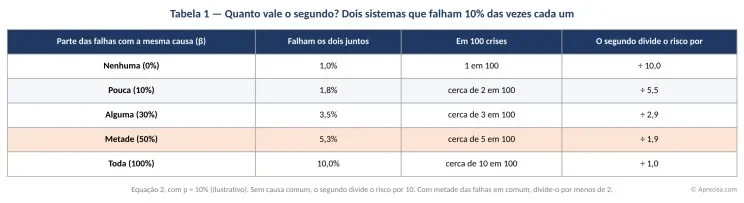
Read the table from top to bottom. In the first row, the two are independent: the second supplier divides the risk by 10. That is what we pay for when we take on a second one. Row by row, the share of failures with the same cause increases. In the highlighted row, with half the failures in common, the second one now divides the risk by less than 2. In the last one, when everything comes from the same cause, the second divides nothing: having two is the same as having one.
Without common cause, the second one divides the risk by 10. With half the failures in common, it divides it by less than 2. You pay for two and get little more than one.
4. The same illusion, on four continents
Asia: two suppliers, one door. Japan buys its oil mainly from two countries: the United Arab Emirates, with 44%, and Saudi Arabia, with 40%. They look like two. But 96% of Japanese oil comes from the Middle East and about 90% passes through Hormuz. In April, purchases from the Middle East fell 67.2% compared with April 2025, the lowest value since 1979. Example: it is like having two favourite shops on the same street, supplied by the same warehouse. If the lorry does not arrive, both have empty shelves on the same day.
Europe: changing supplier is not changing door. After 2022, Italy swapped part of its Russian gas for liquefied natural gas. In 2025, about 30% of the liquefied gas it bought came from Qatar, which exports through the same strait. QatarEnergy extended force majeure until the beginning of December 2026: the Italian company Edison alone was left without 35 cargoes and has already had to replace 23. Portugal made a different choice: it has received no gas from the Middle East since 2020 and buys mainly from Nigeria and the United States. This time, Portugal really did have two. Example: changing petrol station does not protect you from a rise in the price of oil; changing to an electric car does.
South America: the alternative depended on the same war. Brazil imports all the urea it uses, 7.7 million tonnes in 2025, and about 41% passed through Hormuz. The obvious alternative was Egypt, a major exporter. But Egyptian urea is made with gas, and Israel suspended its gas exports to Egypt when the war with Iran began. The emergency exit depended on the same cause that had closed the door. Example: it is like asking your neighbour for a lift when your car breaks down, and discovering that your neighbour fills up at the same petrol station, which has run out of fuel.
North America: two systems that held each other up. In February 2021, a cold snap paralysed Texas. According to the final report of the American regulators, 75.6% of the breakdowns in power stations came from ice and lack of fuel, mainly gas. And 21.5% of the drop in gas production was due to power cuts at the wells and stations themselves. Electricity needed gas; gas needed electricity. They fell together. 20,000 megawatts were cut, the largest manual load shedding in the history of the United States. Example: it is the gas boiler that will not start without electricity. It has gas and no heating.
And at the bottom of the sea. On 6 September 2025, two submarine cables, SMW4 and IMEWE, were cut near Jeddah, in the Red Sea, and the internet slowed down in the Emirates, India and Pakistan. They were different cables, from different consortia, but they ran through the same corridor. Example: two parallel roads that cross the river by the same bridge are, on the day of the flood, a single road.
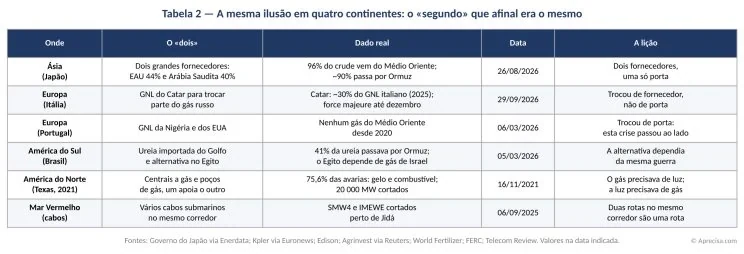
Each row is a “two” that, when the crisis came, behaved like “one”. The “Real data” column shows the fact that proves it, with the source and the date. The “Lesson” column sums up the mistake in one sentence. The Portugal row is the exception: it is the case where changing supplier was also changing door, and that is why this gas wave passed it by.
5. The independence test: three questions
The good news is that common cause can be found with three questions. You do not need software or consultants. Take each “plan B” you have, at home or at work, and ask:
1. Do they drink from the same source? The same energy, the same fuel, the same money, the same person. Dona Lurdes’s two phones drank from the same socket.
2. Do they pass through the same door? The same route, the same warehouse, the same cable, the same road, the same bridge. Japanese oil had two sellers and one door.
3. Do they fall for the same reason? The same weather, the same war, the same price. Urea from the Gulf and urea from Egypt fell because of the same war.
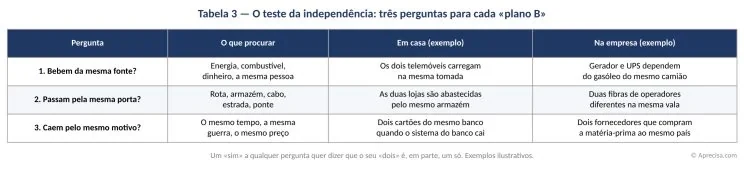
The table puts the three questions together with examples from home and from business. Read it by rows: each row is a different way for two to become one. A “yes” in any row does not mean you should throw away your plan B. It means it is worth less than you think, and that it is worth separating what is together: a portable charger already charged, a card from another bank and some cash at home, a second fibre that enters the building from another side, a supplier that buys on another continent.
For Dona Lurdes, the solution cost 20 euros: a portable battery, charged and kept in the drawer. It was not a third phone. It was a second source.
You do not need to have more things. You need to have things that do not fail for the same reason.
6. What this means for the next wave
In episode 3 we saw that the 5th wave, that of more expensive food, is reaching Portugal. On the shelves there are ten brands of pasta, but almost all of them use wheat bought on the same world market, and they arrive by lorry, on diesel. Having many brands does not protect us from a rise in wheat or in diesel. Having in the larder what we eat every week, bought in good time, protects a little more.
For businesses, the exercise is the same, with more zeros. How many of your “alternative” suppliers buy the raw material from the same country? How many of your two internet connections enter the building through the same trench? How many of your “two” people who know how to do what the business depends on go on holiday in the same week?
Your turn
Reply in the comments with just one word, yes or no: do your two phones, or your phone and your family’s, charge at the same socket?
If you have another minute: name a “two” that, after reading, you discovered was a “one”. In the next episode I will publish the examples, without names.
Send this article to whoever looks after the contingency plan at your company, in your residents’ association or in your parish council. The three questions fit on a Post-it.
This is episode 4 of the series «A Porta Estreita». Episode 1 measured how long we can hold out. Episode 2 showed why misfortunes come together. Episode 3 showed why they arrive late. This one showed why plan B does not always save us. Next Tuesday, 27 October, episode 5 comes out.
Subscribe to the newsletter to receive each episode on Tuesdays.
Kind regards, Gaspar do Amaral
#Resilience #RiskManagement #SupplyChains #Energy #Infrastructure #Portugal
Methodological note
(1) “Day” means the full days since 28/02/2026, the date the strait closed; 20/10/2026 is day 234. (2) Equation 2 is the simplified form of the β-factor model, used in the analysis of common-cause failures (NUREG/CR-5485): it considers two identical components, with probability of failure p in a crisis, and a fraction β of those failures common to both; it ignores repairs and higher-order effects. (3) The values p = 10% and β = 0% to 100% in Table 1 are illustrative and do not measure any real case; they serve to show the shape of the relationship. The sums in Table 1 are: P = β × 0.1 + [(1 − β) × 0.1]²; “divides the risk by” is 0.1 / P. (4) Insurance of 3% on a 100-million-dollar tanker gives 3 million per voyage (100 × 0.03). (5) The data for Japan, Italy, Portugal, Brazil, Egypt, Texas and the cables are those of the sources indicated, on the date of each one. (6) Dona Lurdes, the shops, the neighbour, the boiler and the roads are illustrative examples. Text, figures and tables by the author, AI-assisted.
About this translation. A translation of episode 4 of the newsletter «A Porta Estreita» (“The Narrow Door”), which the author published on LinkedIn on 20 October 2026; the full Portuguese version is on this site. The two figures, the equation and the three tables are the original images, with their texts in Portuguese, and a translated caption that gives their content. Equation 2 is not shown as an image in the original; its formula is the one in point (3) above. The decorative symbols (emoji) of the LinkedIn version were left out, and the three points marked with them in section 2 appear as a list. The links to the previous episodes lead to the Portuguese originals on this site. The titles of the sources stay in their original language; only their annotations are translated.
References
- Gaspar do Amaral (27/09/2026). Dia 211: A Porta Estreita por onde passa a nossa resiliência — episode 1 (in Portuguese); LinkedIn.
- Gaspar do Amaral (06/10/2026). Dia 220: O azar nunca vem só — episode 2 (in Portuguese); LinkedIn.
- Gaspar do Amaral (14/10/2026). Dia 228: O efeito dominó — episode 3 (in Portuguese); LinkedIn.
- Gaspar do Amaral (19/10/2026). As ondas pelo mundo e o seu plano — supplement to episode 3 (in Portuguese); LinkedIn.
- Al Jazeera (17/10/2026) — USA and Iran both claim control of Hormuz: at least 12 ships attacked in the week to 16/10 (UKMTO); sinking of the GFS Pride; Brent at 110 dollars.
- Straits.live — daily brief (19/10/2026) — situation in the Strait of Hormuz: Brent at 108.09 dollars; attacks and negotiations.
- DECO PROteste, via Folha Nacional / Lusa (14/10/2026) — basket of 63 essential goods: 256.26 euros; +0.70 euros in one week; +14.43 euros since January (in Portuguese).
- Al Jazeera (06/10/2026) — Saudi Arabia: East–West pipeline pumping 5.8 million barrels a day; 1200 km, capacity of 7 million, built in 1981.
- Türkiye Today / AFP (05/10/2026) — East–West pipeline stops again after attack on a pumping station near Khurais; stoppage from 11 to 22/09 (Kpler).
- OilPrice.com (25/09/2026) — Aramco restores the East–West pipeline; attacks claimed against Yanbu; war-risk insurance at about 3%; Bab el-Mandeb with 30 ships a day.
- Enerdata (31/08/2026) — Japan: energy resilience plan; 96% of oil from the Middle East; UAE 44%, Saudi Arabia 40%.
- Tank Terminals (22/05/2026) — Japan: crude imports from the Middle East in April −67.2%, lowest since 1979.
- Euronews (06/03/2026) — EU countries most exposed to the LNG disruption: Italy (~30% from Qatar), Belgium, Poland; Portugal without gas from the Middle East since 2020.
- Euro-Petrole / Edison (29/09/2026) — QatarEnergy extends force majeure until the beginning of December 2026; 35 cargoes affected.
- Reuters, via Baird Maritime (05/03/2026) — Brazil: 7.7 million tonnes of urea imported in 2025; about 41% passed through Hormuz (Agrinvest).
- World Fertilizer (25/03/2026) — Egyptian urea keeps producing despite the gas shortage; Israel suspended gas exports.
- FERC — Federal Energy Regulatory Commission (16/11/2021) — final report on the February 2021 freeze: 75.6% of breakdowns from ice and fuel; 20,000 MW of load shedding.
- Telecom Review (08/09/2025) — cuts to the SMW4 and IMEWE cables near Jeddah increase latency in Asia and the Gulf.
- U.S. NRC / INL (1998). NUREG/CR-5485 — Guidelines on Modeling Common-Cause Failures in Probabilistic Risk Assessment — β-factor model.
The discussion is on LinkedIn (in Portuguese)
Comments on this text are made on LinkedIn, where the article was shared in Portuguese. You are welcome to write in English. Agree, disagree or add data: every well-founded objection receives a reply.
Gaspar do Amaral · Original in Portuguese of 20 October 2026, published on this site; translation issued on 27 October 2026 · Figures and tables © Aprecisa.com · AI-assisted