 ← Grupo Aprecisa · Connecting those who know with those who need
Energy and the electricity system
Onde, Rápido, Empurrão (Where, Fast, Push)
Three questions that explain energy, money and scarcity
Gaspar do Amaral · 1 October 2026
Translated from the Portuguese original. This version was issued on 27 October 2026.
On this site, this article has been
A story to tell your children tonight, which explains what formulas hide
A few days ago, a fellow engineer shared with me a reflection on a seemingly simple question: how much is one MWh of intermittent energy really worth?
The technical answer is well known. A wind MWh is physically the same as any other, but it does not guarantee power when the system needs it. To secure that power, the back-up power station still has to be kept, and the cost of that reserve has to be added.
I then wanted to explain the same reasoning to a 16-year-old. And I realised he would trip over the very first question he would ask:
“What is a MWh for?”
That was when I began to see that the problem was not the MWh. It was a much deeper confusion, and not one confined to young people: the confusion between how much you have and at what rate you get it.
Why this concerns you
The electricity bill shows two numbers that hardly anyone tells apart: the kWh consumed and the contracted power in kVA. One is a quantity; the other is a maximum rate. The circuit breaker trips because of the second, not the first.
In the energy debate, people compare the cost per MWh of each technology and forget that the grid does not only need energy: it needs guaranteed power at the right moment.
In managing a budget, a team or an infrastructure, the same thing happens: stock is confused with flow, the balance with the rate, the accumulated total with the pace.
This confusion is not a school problem. It is a decision-makers’ problem. And it is solved with three questions, which in this story have names.
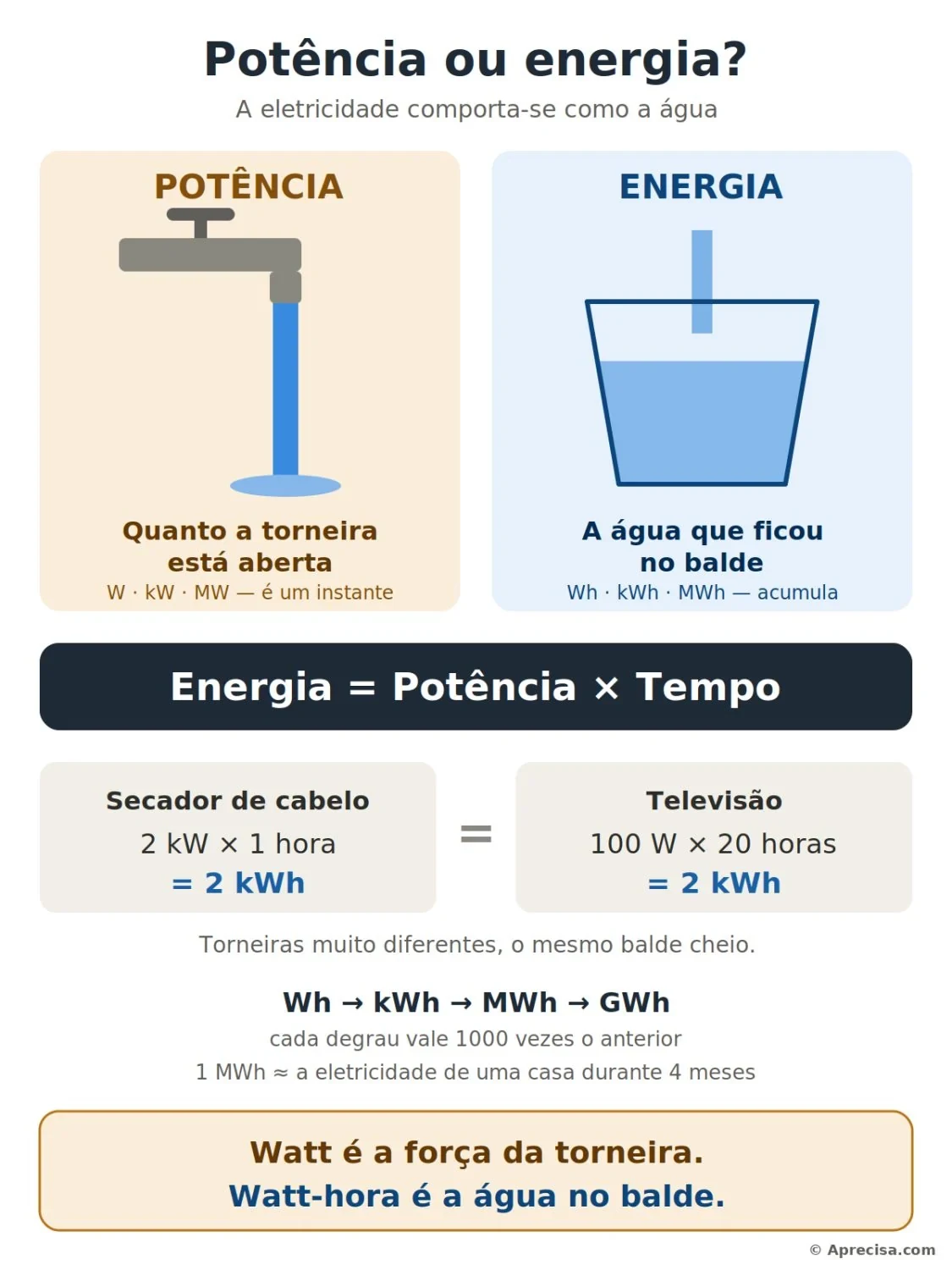
This story is about your child. Tell it to them tonight.
1. The journey home
You come out of school and your mum picks you up in the car. You are heading home, where your dad is waiting for you.
On the back seat, next to you, travel three invisible brothers that only you can see.
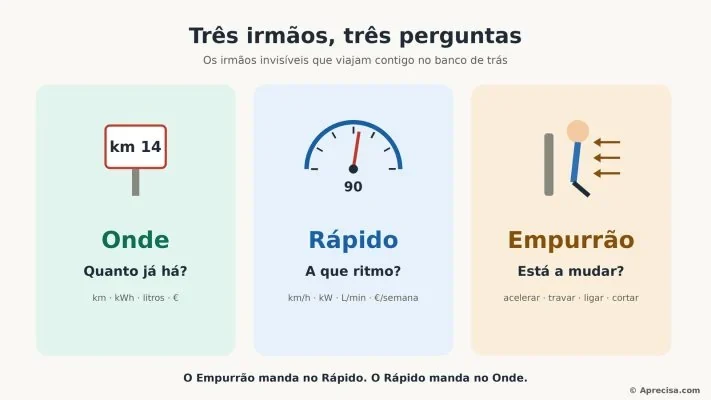
Onde (“Where”) only wants to know one thing: where are we? He reads the numbers on the signs: kilometre 12, 13, 14.
Rápido (“Fast”) never takes his eyes off the speedometer: we’re doing 90! He is the one who gives Onde orders: at 90, Onde moves forward 90 kilometres an hour.
Empurrão (“Push”) cannot be seen; he is felt in the body. When your mum speeds up, the seat pushes against your back. When she brakes, the seat belt grabs you. He is the one who gives Rápido orders.
On the motorway, always at 120, you close your eyes… and you feel nothing. It seems as if the car is standing still. You are going very fast, but the speed does not change, and the body only feels Empurrão, never Rápido.
▶ At this point, the original article has a video, hosted on LinkedIn: watch the video on LinkedIn.
Three brothers, three questions: how much?, at what rate?, is it changing? That is all we are going to need.
2. The three brothers are everywhere
The surprising discovery is that the three brothers do not live only in the car. They live in every system we use every day:
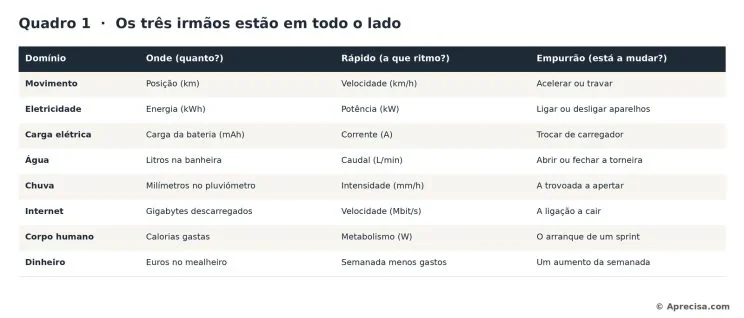
In all of them, the relationship is the same: Onde is the sum of Rápido over time. Anyone who understands why 90 km/h for 2 hours gives 180 km understands why 2 kW for 1 hour gives 2 kWh.
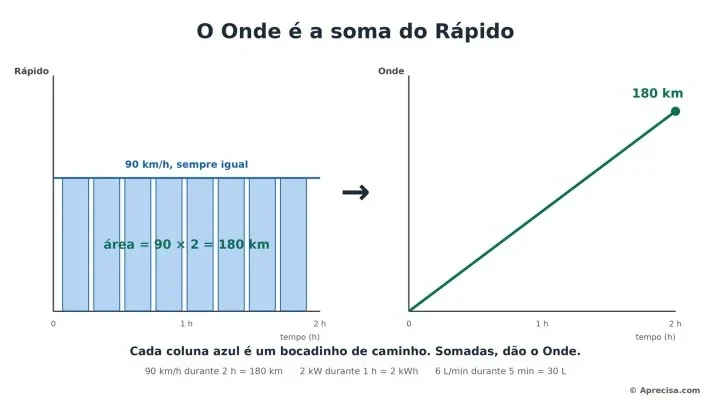
An example any child can see live: the electricity meter at home has a light that blinks. Each blink is a small dose of energy. With the oven on, the light blinks much faster: it is Rápido appearing before our very eyes.
▶ At this point, the original article has a video, hosted on LinkedIn: watch the video on LinkedIn.
▶ At this point, the original article has a video, hosted on LinkedIn: watch the video on LinkedIn.
▶ At this point, the original article has a video, hosted on LinkedIn: watch the video on LinkedIn.
▶ At this point, the original article has a video, hosted on LinkedIn: watch the video on LinkedIn.
▶ At this point, the original article has a video, hosted on LinkedIn: watch the video on LinkedIn.
▶ At this point, the original article has a video, hosted on LinkedIn: watch the video on LinkedIn.
▶ At this point, the original article has a video, hosted on LinkedIn: watch the video on LinkedIn.
In every video, the three brothers always sit in the same place and always have the same colour: Onde in green, Rápido in blue, Empurrão in orange. By the third video, the viewer no longer needs to read: they recognise.
3. What you feel is always Empurrão
Watching the videos together, a pattern appears that hardly any textbook underlines: systems do not react to what they have, nor to the rate at which they are going. They react to change.
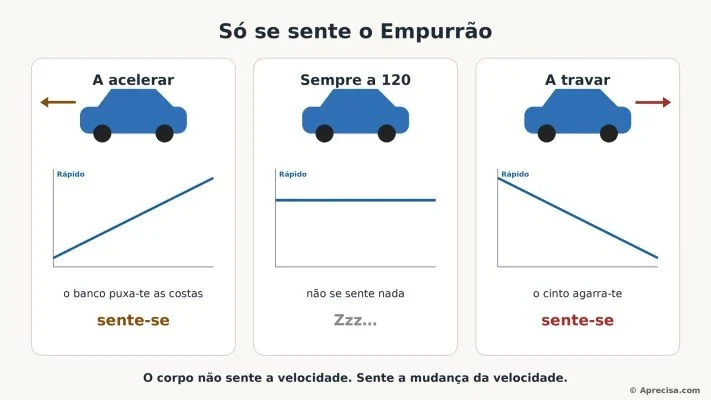
- In the car, you feel the acceleration, not the speed.
- In the electricity grid, the turbines at 50 Hz do not feel consumption; they feel the change in consumption, as at half-time in a football match, when thousands of kettles are switched on at the same time.
- In a vacuum cleaner unplugged by force, the current that stops suddenly makes a spark.
- In a tap shut violently, the water thrown forward bangs and the pipes go BANG: water hammer.
- In the body, breathlessness comes at the start of a run, not at a steady pace.
- In a video on your phone, the spinning wheel appears when the internet speed drops.
That is why inertia is so decisive in an electricity grid: it does not prevent Empurrão, but it makes it gentler. And that is why, in engineering, transitions cost more than steady states.
4. When Onde starts to give orders
Until now, Empurrão gave orders to Rápido, and Rápido gave orders to Onde. But there are systems in which something new happens: Onde also starts to give orders to Rápido. The rope closes into a circle, and this is called feedback.
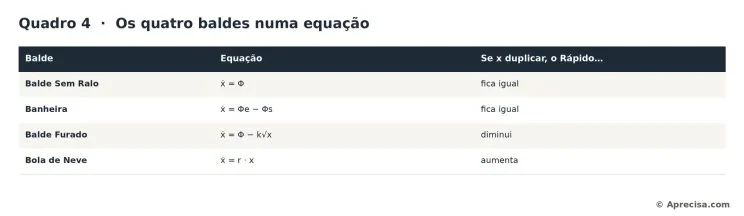
To understand them all, one bucket set up in four ways is enough:
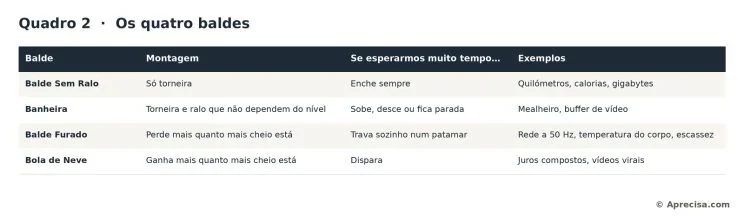
And to classify any system, a single question is enough:
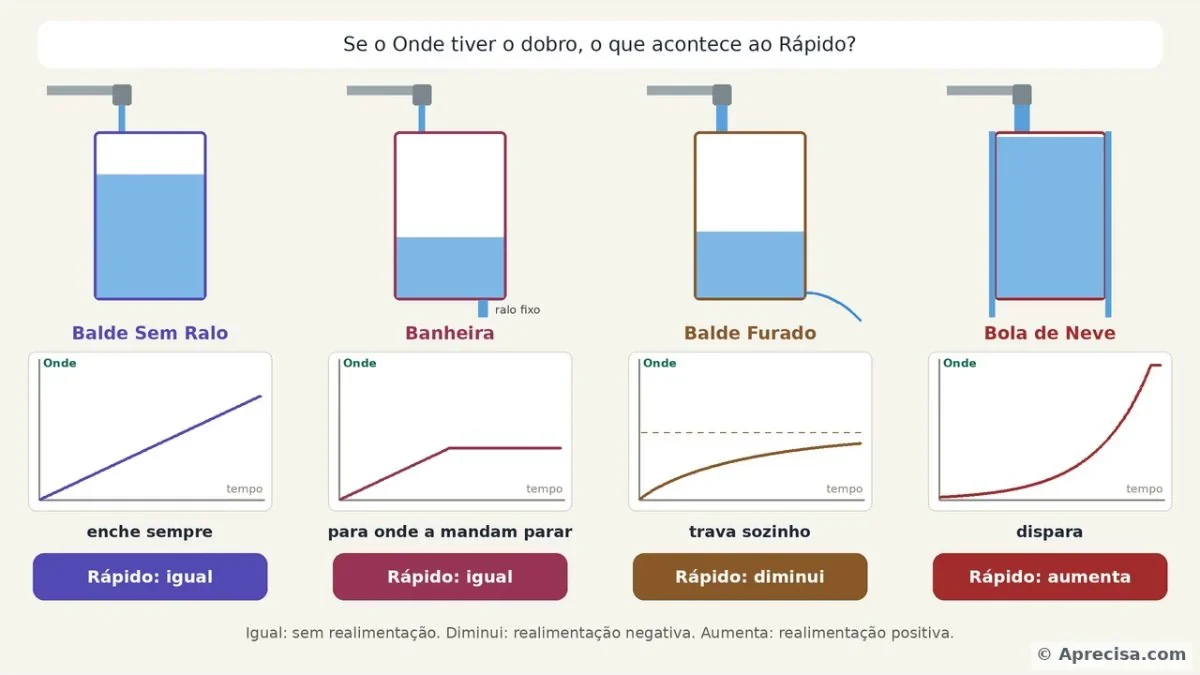
“If Onde had twice as much, what would happen to Rápido?”
It does not change: Balde Sem Ralo (Bucket Without a Drain) or Banheira (Bathtub). It goes down: Balde Furado (Leaky Bucket). It goes up: Bola de Neve (Snowball).
▶ At this point, the original article has a video, hosted on LinkedIn: watch the video on LinkedIn.
5. The leaky bucket: scarcity and prosperity
The third bucket deserves a story of its own, because it hides the most important lesson.
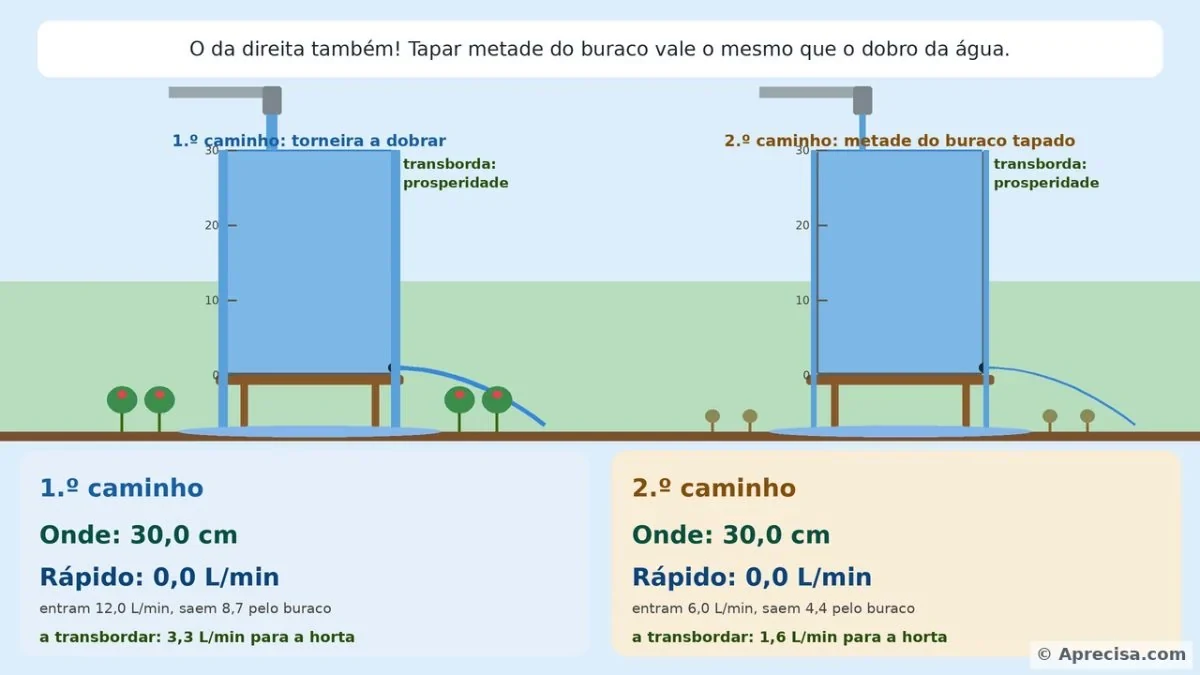
In the back garden at home there is a bucket with a hole in the bottom, under the vegetable-patch tap. Your dad turns on the tap. The water rises… 10 centimetres… 14… and stops. The tap is still on, but the level no longer rises.
Why? Because the more water there is in the bucket, the harder it comes out through the hole. There comes a moment when as much goes out as comes in.
Scarcity is not an empty bucket. It is a bucket that works non-stop and never manages to fill up.
Your dad suggests two ways. In the first, he opens the tap to twice as much: the bucket fills and overflows. In the second, he keeps the tap as it was and covers half the hole: the bucket fills and overflows too. And the water that overflows waters the vegetable patch around it.
When you lift the bucket, you discover a second hole, neatly made, with a little pipe running to the neighbour’s garden. When your dad plugs it, the bucket overflows again, with the same tap as always.
Prosperity is not the full bucket: it is the water left over that reaches others.
▶ At this point, the original article has a video, hosted on LinkedIn: watch the video on LinkedIn.
For those who want the maths. By Torricelli’s law:
- Balance: A · dh/dt = Q − Cd · a · √(2gh)
- Scarcity level: h* = (Q / (Cd · a))² / (2g)
- There is overflow if, and only if: Q > Cd · a · √(2gH)
Since the equilibrium level depends on (Q/a)², cutting losses by half is exactly equivalent to doubling the inflow. With one difference that the video shows: the efficiency route takes longer to overflow and produces less surplus, but it uses half the water. A sound policy combines both levers, and chooses the order by the cost of each.
And the lesson of the second hole remains: before asking the tap for more water, first check who made a hole in the bucket.
6. The equations, at the end
Only now, after the three brothers have been seen, felt and recognised in nine situations, is it worth writing them in mathematical language. The order is deliberate: first the meaning, then the symbol.
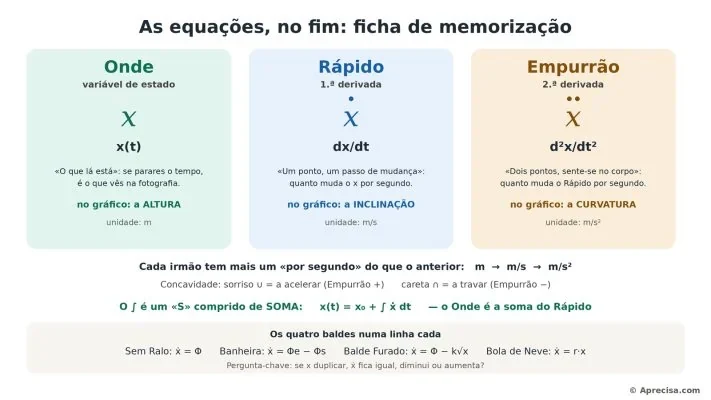
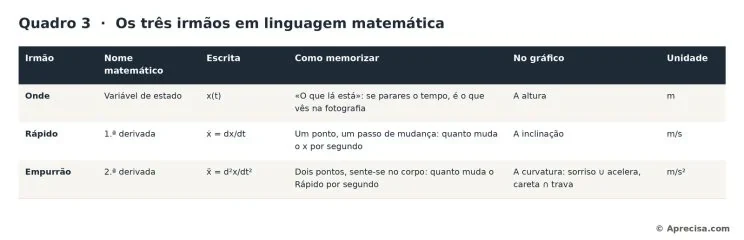
Three rules of thumb wrap up the essentials:
- Count the dots. No dot over the x: where I am. One dot: at what rate. Two dots: it is changing.
- Count the “per seconds”. Each brother has one more than the one before: m, m/s, m/s². The same goes for kWh, kW and kW/s.
- ∫ is a long S for Sum. That is why x(t) = x₀ + ∫ ẋ dt: Onde is the sum of Rápido. Differentiating is going down one brother; integrating is going up one brother.
And the four buckets fit in one line each:
Where school teaches this, and where it does not
This is the point that worries me most as an engineer. In Portuguese schools, the formal language of derivatives arrives late and reaches few:
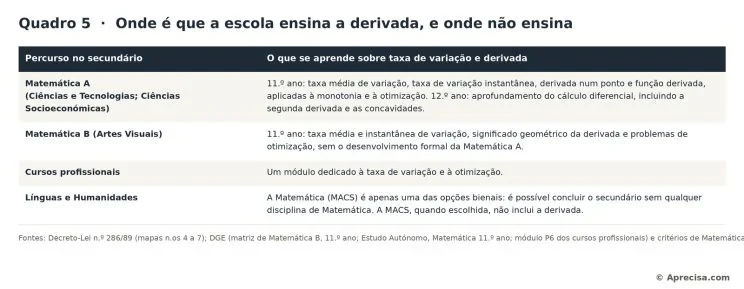
The conclusion is uncomfortable: a significant share of pupils finish secondary school without ever having put a name to Rápido and Empurrão, even though they feel them every day, in the car, in the electricity bill and on the phone.
And the problem does not stay in secondary school. Lawyers, policy-makers, local authority leaders, public administrators, regulators and journalists deal every day with rates of change: inflation, interest rates, contracted power, deadlines, deficits, the pace at which a budget is spent. Many got there through tracks on which Mathematics was optional from the 10th year: law faculties, for example, admit their students with exams in Portuguese, Philosophy or History. Economists are a different, and subtler, case: they studied derivatives, because Economics degrees require Matemática A (the most demanding secondary-school mathematics course). But the Ciências Socioeconómicas (socio-economic sciences) course does not include Physics or Chemistry. They know how to differentiate a demand curve; rarely has anyone explained to them the inertia of an electricity grid.
In 1989, I sat down to take the Prova Geral de Acesso (the general entrance examination for higher education). The essay topic was “O Analfabeto do Século XXI” (“The Illiterate of the 21st Century”). In the same year, Decreto-Lei n.º 286/89 (Decree-Law No. 286/89) of 29 August approved the new curricula; the secondary-school curriculum is set out in maps nos. 4 to 7 annexed to the decree, applied experimentally until 1993-1994 and then extended to all schools. And it was in the annexes, not in the articles, that it was decided that Mathematics would not be common to everyone. In Map no. 5, the general-education component of secondary school (Portuguese, Introduction to Philosophy, Foreign Language, Physical Education) does not include Mathematics. In Map no. 6, Mathematics is just one of the subjects of the specific-education component, of which the pupil chooses three. Note (d) of that map even refers to “pupils with Mathematics in their curriculum”, admitting, by exclusion, those who do not have it. In 2012, Annex IV of Decreto-Lei n.º 139/2012 again set the general education of the science-humanities courses without Mathematics (Portuguese, Foreign Language, Philosophy, Physical Education), leaving it to the specific education of each course. And Portaria n.º 243/2012 (a ministerial order), in Annex V, set the plan for Languages and Humanities: the only Mathematics subject, Matemática Aplicada às Ciências Sociais (Mathematics Applied to the Social Sciences), is one of five two-year options, and none of the year-long subjects of the 12th year is Mathematics. And the result still holds today: it is possible to finish secondary school without any Mathematics subject at all. The State foresaw the illiterate of the 21st century and, straight afterwards, legislated the path towards him. It is this silent amputation that I analyse in the first chapter of O Abismo do Rigor — Da Engenharia da Auditoria ao Resgate da Nação (“The Abyss of Rigour — From the Engineering of Auditing to the Rescue of the Nation”): the illiterate of our time is not the one who cannot read words, it is the decision-maker who governs without understanding a rate of change.
That is also why this story begins with the parents. The concept does not need to wait for the 11th year; only the formal notation does.
7. Tonight, at dinner
Ask your child the three questions about anything in their day: the phone charging, the bath, the way to school, the piggy bank.
- Onde: what builds up?
- Rápido: at what rate?
- Empurrão: what makes that rate change?
And, if they are already in lower secondary school (the 3rd cycle, years 7 to 9), the fourth: if Onde had twice as much, would Rápido go up, go down or stay the same?
Then do the same exercise for yourself, with three systems from your work: the email inbox, the client portfolio, the budget of a project. Leave in the comments the system you chose and the bucket you put it in. The hardest cases are, almost always, the most revealing.
It was not necessary to write a single derivative to get here. A child does not need to know what an integral is to understand that Onde is the sum of Rápido, that you only feel Empurrão, and that there are buckets that never fill up as long as nobody looks at the hole.
Mathematics comes afterwards, as confirmation of something already understood. That is the right order: first the meaning, then the formula. It is the principle that, in A Fundação da Verticalidade: Da Engenharia da Soberania à Construção do Futuro (“The Foundation of Verticality: From the Engineering of Sovereignty to the Building of the Future”), I call the passage from Know-How to Know-Why: before knowing how it is calculated, knowing why.
To go further. The curricular origin of this problem, the “Quilómetro Zero da Negligência” (“Kilometre Zero of Negligence”), and its consequences for energy, infrastructure and public decision-making are the subject of O Abismo do Rigor — Da Engenharia da Auditoria ao Resgate da Nação, available as an e-book.
Gaspar do Amaral
Sources consulted:
- Decreto-Lei n.º 286/89, de 29 de agosto, no Diário da República: approves the curricula for basic and secondary education; the secondary-school curriculum is set out in maps nos. 4 to 7 annexed to it. In the original publication (Diário da República, Series I, no. 198, of 29-8-1989, pp. 3643-3644), Map no. 5 sets general education without Mathematics and Map no. 6 places Mathematics among the elective subjects of specific education.
- Portaria n.º 590/93, de 12 de junho: timetable for the trial, consolidation and extension to all schools of the syllabuses of the curricula of Decree-Law No. 286/89.
- Decreto-Lei n.º 139/2012, de 5 de julho (Diário da República, 1.ª série, n.º 129, pp. 3476-3491): Annex IV, pp. 3487-3488, framework of the science-humanities courses, with general education made up of Portuguese, Foreign Language, Philosophy and Physical Education.
- Portaria n.º 243/2012, de 10 de agosto (PDF · DGE): PDF of the original publication on the DGE website; corrected by Declaração de Retificação n.º 51/2012 (correction notice): Annex V, study plan for the Languages and Humanities course.
- DGE, Curso de Línguas e Humanidades: subjects of the specific-education component, in which Mathematics Applied to the Social Sciences appears as one option among several.
- Critérios de avaliação de Matemática A, 11.º ano, 2025/2026: assessment criteria for Mathematics A, 11th year, 2025/2026: an example of how the Essential Learning outcomes are applied, with the average rate of change, the instantaneous rate, the derivative at a point and the derivative function.
- DGE, Estudo Autónomo, Matemática 11.º ano, bloco 53: DGE (Directorate-General for Education), Independent Study, Mathematics 11th year, block 53: official tasks on rate of change, derivative and tangent lines.
- DGE, matriz de exame de Matemática B, 11.º ano: DGE exam framework for Mathematics B, 11th year: average and instantaneous rate of change, geometric meaning of the derivative and optimisation.
- DGE, coletânea de tarefas do módulo P6 dos cursos profissionais: DGE collection of tasks for module P6 of vocational courses: the module “Rate of Change and Optimisation”, under the new syllabuses whose extension to all schools began in 2024/2025.
- Gaspar do Amaral, O Abismo do Rigor — Da Engenharia da Auditoria ao Resgate da Nação (e-book): chapter 1, “Kilometre Zero of Negligence”.
- Gaspar do Amaral, A Fundação da Verticalidade: Da Engenharia da Soberania à Construção do Futuro: chapter 6, “Education (The Paideia)”, on the passage from Know-How to Know-Why and the Pedagogy of Wonder.
Illustrations, tables, videos and cover: © Aprecisa.com
Methodological note
What this page is. A translation of the article the author published on LinkedIn on 1 October 2026; the full Portuguese version is on this site.
Names kept in Portuguese. The three brothers (Onde, Rápido, Empurrão) and the four buckets (Balde Sem Ralo, Banheira, Balde Furado, Bola de Neve) keep their Portuguese names, which are the ones in the illustrations and tables, with a translation in brackets the first time. Portuguese laws, school courses and exams keep their names, with an explanation in brackets; the titles of the sources stay in Portuguese and only the annotations are translated.
Changes of form, not of content. The illustrations and tables are reproduced as in the original, with their texts in Portuguese, and with translated captions. The ten videos of the original are hosted on LinkedIn; in their place there is a note with a link to the publication. The separator lines and the decorative symbol (emoji) of the LinkedIn version were left out.
The discussion is on LinkedIn (in Portuguese)
Comments on this text are made on LinkedIn, where the article was shared in Portuguese. You are welcome to write in English. Agree, disagree or add data: every well-founded objection receives a reply.
Gaspar do Amaral · Original in Portuguese of 1 October 2026, published on this site; translation issued on 27 October 2026 · Figures and tables © Aprecisa.com · AI-assisted