 ← Grupo Aprecisa · Connecting those who know with those who need
People and society · Article published on LinkedIn on 15 June 2026
The Sword I Won and the Freedom I Found
“Meu Coronel”: a form of address, a sword won and a freedom found
Gaspar do Amaral · 15 June 2026
Translated from the Portuguese original. This version was issued on 30 October 2026.
On this site, this article has been
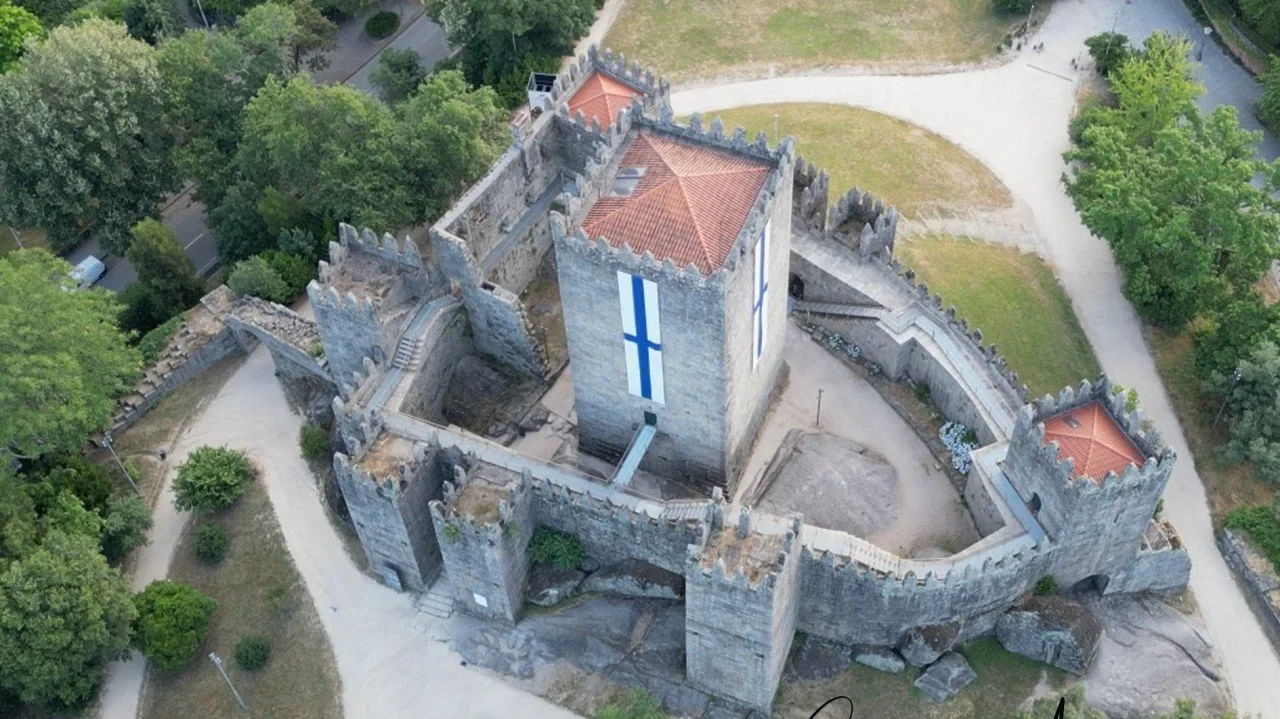
“Senhor Coronel” — The Sword I Won and the Freedom I Found
Some forms of address are no more than convention. Others are condensations of centuries — of sovereignty, of character and of a certain idea of belonging. The “Meu” (“my”) with which, in the Portuguese Army, a soldier addresses a superior — Meu Coronel, Meu Capitão, Meu General (my Colonel, my Captain, my General) — belongs, without hesitation, to the second category. It is not a courtesy of circumstance: it is the phonetic survival of a mandate of sovereignty.
I. The origin: from Guimarães to direct audience
Barracks historiography usually explains the “Meu” by the comradeship of the trench — the officer belongs to his host, and his men claim him as theirs. That is true, but it is the short reading. The long reading takes us back to Guimarães, the cradle of the County of Portugal, and to the umbilical relationship between Afonso Henriques and the Collegiate Church of Our Lady of the Olive Tree.
To exist as a Kingdom, the young sovereign needed validation from the Holy See — validation that would only be formally consolidated, in 1179, with the bull Manifestis Probatum. In that architecture of power, securing a channel of direct audience with Rome, without the mediation of competing ecclesiastical spheres, was an act of shielding sovereignty itself. The dignitary with the right of proximity to the summit of power was the Monsignor — from the French Monseigneur, literally my lord: the one who goes up to the audience without an intermediary.
From this follows the thesis on which this article rests: the Army’s “Meu” is the contraction of that noble status — my lord [rank]. It does not mean possession from above; it means direct fealty to the sovereign who represents the Nation, without intermediaries. The Army was the force born with Afonso Henriques — who would only be recognised as my King by the Holy See, the supreme authority to which the Monsignor carried the audience, when he was already old and weary, in 1179. Without crown or title, he founded the territory first, against all the odds of the age. His officers therefore inherited a right of nobility shared by the sword — and the address “Meu” is the protocol echo of the knighthood of those times.
II. The contrast: the “Senhor” of the Navy and the Air Force
The choice of term distinguishes genealogies. The Navy — which holds protocol precedence in military ceremonies, but which was not the first military force to exist in Portugal — cultivates Senhor Comandante, Senhor Almirante (Sir Commander, Sir Admiral). The distinction is essential, not merely learned: ceremonial precedence and hierarchical seniority are not to be confused with the time of existence. The land host that asserted itself with Afonso Henriques at the Battle of São Mamede, on 24 June 1128, predates the formal organisation of the Navy; what the Navy holds is precedence in protocol, not primogeniture in the order of time. On board, in a confined space, the hierarchy has to be absolute and the authority of command unquestionable. The “Senhor” establishes the protocol distance of the ship as floating national territory and embassy of the State — the courtly formality of those who always represented the Nation before foreign courts.
The Air Force, created in 1952 from the merger of Military Aeronautics and Naval Aviation, largely inherited the formal and technical matrix of the Navy, moving away from the infantry culture. Hence the “Senhor”.
Where “Meu” evokes union by the sword and proximity to the sovereign, “Senhor” evokes respect for the office and the distance of command that the ship and the mission impose.
III. Alexandre Júlio and Gaspar do Amaral
It is within this framework that the way Alexandre Júlio addresses me as Meu Coronel gains depth. Note the protocol detail, which is not incidental: the rank I reached was Lieutenant-Colonel — a promotion of 2015 — and Portuguese military tradition drops the prefix in spoken address, calling a Lieutenant-Colonel simply Colonel. And when, by habit or training, his lips say Senhor Coronel, what he truly says is Meu Coronel: he is not merely complying with a regulation — he is claiming the Afonsine lineage of the form of address, the recognition of a mutual belonging that precedes the hierarchy and transcends it.
The “Meu” is, here, a profession of faith in a school of character. It is not about administrative subordination; it is about accepting a genealogy of verticality — the same one that was born when human will and the force of arms dictated, in Guimarães, the birth of Portugal at the Battle of São Mamede.
And yet it is exactly here that I owe my readers the greatest honesty — which I leave for the end.
IV. Unlimited leave: my freedom according to Agostinho da Silva
And it is here that my own situation becomes relevant. On 25 October 2018 I went on unlimited leave — by a choice that still surprises many of those who served with me. Not out of lack of interest, but by a personal choice, perhaps at times aligned with the philosophy of Agostinho da Silva, who theorised with rare lucidity what I practise every day. I call that moment my 25th of April — the day of my freedom, which has nothing to do with 1974: my personal liberation, that moment for which I needed courage and in which I exchanged a career for sovereignty over my own time and over myself.
I waited fifty years, and it happened.
The freedom the thinker defended is not the absence of duty; it is the refusal to live subordinated to accumulation. Agostinho da Silva celebrated creative leisure, gratuitousness, the primacy of being over having — the conviction that the truly free man is the one who does not let himself be captured by the utilitarian logic of piling up. To live free, in that sense, is to dispose of one’s own life as an act of creation and not as an accounting of possessions or of stripes.
It was also by that criterion that I decided not to go on accumulating military service time. The accounting of time — the sum of years that makes up the formal career — is not, for me, the measure of what matters. I chose not to have it.
V. What is not accumulated is lived
But there is a decisive distinction, and everything else rests on it: not having the service time is not the same as not having the school. I had it, I have it and I develop it every day — the school of the “Meu Coronel”, practised in the Portuguese Army since Afonso Henriques. It is a school of belonging and of responsibility: invested by the commission of the Crown, the Colonel answers for the Authority he receives from it and becomes its representative on the field of battle — before the enemy, but also before his own men, and today women too.
That school is not measured in service time; it is measured in verticality. It is inner discipline, the refusal of superficiality, the sense of belonging to something greater than oneself and transcendent. It is what I call The Foundation of Verticality (A Fundação da Verticalidade) — the exact opposite of the Abismo do Rigor (Abyss of Rigour) into which those who confuse career with character plunge.
The freedom of Agostinho da Silva and the knighthood of the “Meu Coronel” converge. Both affirm that a man’s worth lies not in what he accumulates — neither years nor goods — but in what he is able to be with uprightness. I gave up the accounting of time precisely so that I could live, without intermediaries and without reservations, what the “Meu Coronel” means: free fealty to what is just, direct proximity to the essential, the nobility that is exercised standing up.
That is the inheritance I have chosen to serve. I do not have it recorded in years of service. I have it inscribed in my way of being.
VI. Simply Gaspar do Amaral
There remains the honesty I announced. I am grateful for the deference of those who call me Colonel or Senhor Coronel — but that is not what I am. I am not a Colonel: I was a Lieutenant-Colonel, a Colonel in the Lieutenant’s place, and I no longer am. I am an engineer for now — but only because I practise it; on the day I stop practising it, I shall equally stop being addressed as such, and I do not need it in order to Be. That is the rule I have learned to respect: a function exists only while there is an act that sustains it. Rank, post and profession are ways of doing — contingent, perishable, dependent on practice — never substance. What I practised is not what I am; nor am I what I was. Beneath all those functions, and even when they have all faded, one thing alone remains that depends on no practice: I go on Being Gaspar do Amaral.
And the substance of praise rarely moves me, for praise is, more often than not, an impostor who sits down at the table of character without having been invited.
That is why I do without the title. Not out of disdain for the uniform — I owe it my whole schooling — but because the school of the “Meu Coronel”, taken to its ultimate consequences, teaches precisely this: that verticality does not need stripes to stay standing. Agostinho da Silva’s free man does not carry honours; he carries himself.
I felt it while still a recruit under instruction, when I dreamed of becoming a General; but on understanding that I was already a General inside, I realised that what I felt went beyond any rank — and it was as a Lieutenant-Colonel that I put it into verse:
Largo medalhas, não quero honrarias,
prefiro migalhas que se chamam alegrias.
(I let go of medals, I want no honours; I prefer crumbs whose name is joy.)
That is the economy of my freedom. I traded medals for crumbs — and discovered that crumbs, when their name is joy, are the whole loaf. Call me what you will; I shall go on signing, without rank and without prefix, simply as what I am and always was, as I shall be.
VII. The Name that is not exercised
And yet even Gaspar do Amaral was given to me by my Mother — at the baptismal font, by human hands, exactly the same as my Father’s, and with that love I learned to love it. I have shed the names that are exercised; what remains is the one that depends on no practice and that I did not even choose: the Name by which the One who made me calls me. I would like to know it, because that one, and that one alone, will be my true Name.
The tradition that best answers this intuition keeps it secret. The Book of Revelation speaks of a white stone on which a new name is written, which no one knows except the one who receives it — not because it is hidden, but because it cannot be passed on: it coincides so perfectly with each person’s being that it does not fit in another’s mouth. And the prophet hears the voice that says to each man: I have called you by your name; you are mine. There the name is neither a label nor a rank — it is an act of love and of election.
Note the coherence with everything that precedes. The names that are exercised — rank, profession — depend on the act and perish with it. The Name by which God calls is the only one that is not exercised: it is received. It is pure Being, without doing. It is not won like a medal — and whoever has let go of medals knows it for certain —; it is welcomed.
And because we are made in His image and likeness — and all of us are —, that Name is at once the most singular and the most shared thing there is. Singular, because it names what in each person, and in that person alone, reflects the Creator. Shared, because the source is one and the Voice that speaks it is the same for all: many irreducibly personal names, a single mouth that says them.
It is here that the arc closes. We set out from distinction and hierarchy — the “Meu” and the “Senhor”, the genealogy of sovereignty, the knighthood shared by the law won by the sword. And we arrive at the only knighthood that excludes no one: the one shared in the image. Stripes distinguish; the image makes equal. What makes a man noble is not the rank he gave up — it is the same thing that makes any man noble: to have been called by name, and to be loved in that calling.
As for knowing what that Name is, I believe it is in its nature not to let itself be anticipated. It is not deciphered from a distance; it is heard in the encounter. And perhaps I already hear it, without yet knowing how to say it, in those crumbs I called joys — because it is in what cannot be bought, and not in what is exercised, that the image speaks most softly and most truly.
The rest is silence. And silence, here, is not the absence of an answer: it is the place where the answer is spoken.
Gaspar do Amaral
The Foundation of Verticality
Methodological note
What this page is. An English translation of the article the author published on LinkedIn on 15 June 2026; the full Portuguese version is on this site. It is an opinion and reflection text; the dates (1128, 1179, 1952, 2015, 25 October 2018) are those of the original.
Changes of form, not substance. The Portuguese forms of address are kept, with their meaning, because the argument rests on the difference between “Meu” and “Senhor”. The verse is given in Portuguese with an English rendering. The biblical allusions (Revelation 2:17 and Isaiah 43:1) are paraphrased, as in the original. The tracking parameter LinkedIn added to the video link has been removed.
The discussion is on LinkedIn (in Portuguese)
Comments on this text are made on LinkedIn, where the article was shared in Portuguese. You are welcome to write in English. Agree, disagree or add data: every well-founded objection receives a reply.
Gaspar do Amaral · Original in Portuguese of 15 June 2026, published on this site; translation issued on 30 October 2026 · Figures and tables © Aprecisa.com · AI-assisted
How to cite: Gaspar do Amaral (2026). A Espada que conquistei e a Liberdade que encontrei. Zenodo. https://doi.org/10.5281/zenodo.23814394 · Permanent archive on Zenodo.