 ← Grupo Aprecisa · Connecting those who know with those who need
Energy and the power system · Article published on LinkedIn on 18 May 2026
The Transposition of the Energy Efficiency Directive: the “Abismo do Rigor” and the Penalisation of Electrification
The delayed transposition of the Energy Efficiency Directive and the penalisation of electrification
Gaspar do Amaral · 18 May 2026
Translated from the Portuguese original. This version was issued on 27 October 2026.
On this site, this article has been
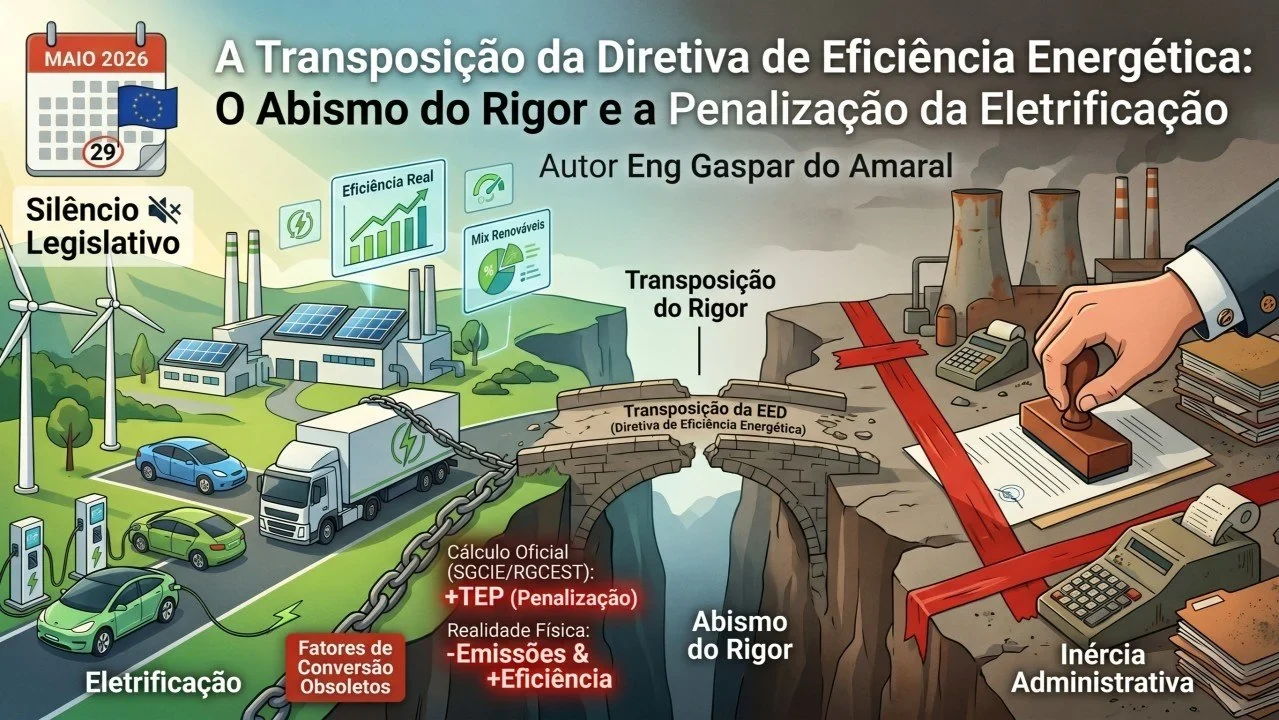
We are roughly two weeks from the deadline set by the European Union (29 May 2026) for the entry into force of the core provisions of the new Energy Efficiency Directive (EED). However, in Portugal, the process whose public consultation closed on 5 December 2025 remains sunk in legislative silence.
In my practice in engineering and the integration of complex systems, I have been warning about what I call the «Abismo do Rigor» (“Abyss of Rigour”) — that critical point where the political and administrative decision becomes completely divorced from the physical, thermodynamic and mathematical reality that governs the infrastructure we intend to manage. The current impasse in the transposition of the EED is the paradigmatic example of this systemic failure.
The Associação dos Engenheiros Eletrotécnicos de Portugal (EEP) (Association of Electrical Engineers of Portugal) rightly warned of the dangers of the proposed decree. Today, in mid-May 2026, the stocktake shows that we continue to operate under a paradigm of deep administrative inefficiency:
1. The Paradox of Obsolete Mathematics
The State demands and promotes electrification as the great pillar of decarbonisation, but continues to impose, by law, benchmarks that are manifestly obsolete.
At present, the transport sector (via RGCEST) and industry (via SGCIE) operate, respectively, under energy conversion factors of 290 × 10−6 toe/kWh and 215 × 10−6 toe/kWh.
These values, inherited from a fossil paradigm, completely ignore the strong penetration of renewable energy in the current national electricity generation mix.
The practical consequence of this regulatory inertia is a technical and systemic absurdity: if a company modernises and electrifies its operation today, the State’s outdated mathematics will dictate that its energy efficiency has got worse.
In practice, through the regulations we are penalising precisely those who invest in decarbonisation.
2. The Lack of Systemic “Verticalidade” (Verticality)
The «Verticalidade» (Verticality) of any governmental macro-structure requires coherence from the strategic intention down to the calculation algorithm. The legislator intended to superimpose the new EED rules (measured in final energy — terajoules) on the decrees in force (measured in primary energy — toe). If this intention is kept in the final decree, companies and engineers will be forced to duplicate technical and bureaucratic work, producing parallel and contradictory reports that contribute nothing to the effective saving of a single watt of energy.
The Practical Case of Legislative Entropy: Let us imagine a company that consumes 5,000 MWh of electricity a year. How does the State assess this very same consumption in 2026, depending on the form?
- In the eyes of the new EED: it reports 18 TJ of final energy.
- In the eyes of Industry (SGCIE): it reports 1,075 toe of primary energy.
- In the eyes of Transport (RGCEST): it reports 1,450 toe of primary energy.
It is the same physical consumption of electrons, on the same national electricity grid, but in the eyes of the law it generates three different mathematical realities and obligations. It is the institutionalisation of technical chaos.
3. A Light at the End of the Tunnel (Still without a Guiding Thread)
The only tangible institutional development in this first half of 2026 was the creation of the Agência de Geologia e Energia, I. P. (AGE, I. P., Agency for Geology and Energy), formalised by Decreto-Lei n.º 58/2026, de 20 de fevereiro (Decree-Law No 58/2026 of 20 February), whose provisional statutes have just been approved by Portaria n.º 218/2026/1, de 12 de maio (Ministerial Order No 218/2026/1 of 12 May). I recognise that this is a positive structural step towards bringing sectoral competences together. However, from the standpoint of systems integration, the warning is clear: without the urgent migration to a unified and neutral «Energy Efficiency Portal», and without the publication of a decree that eliminates the current metric chaos, the new Agency will be born already straitjacketed, condemned to manage an inherited bureaucratic entropy instead of promoting real efficiency.
In short: systems engineering takes no comfort in half-measures. The transposition of a European directive of this magnitude cannot be a mere secretarial exercise to meet the calendar. The supervising ministry is required to harmonise immediately the technical benchmarks of the SGCIE, RGCEST and SCE before the final publication of the EED.
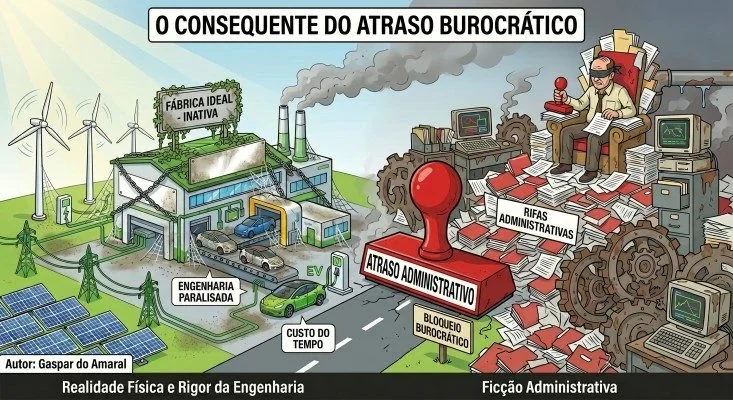
Legislative Timeline
1982: Decreto-Lei n.º 58/82, de 26 de fevereiro (Decree-Law No 58/82 of 26 February; it established the initial regulation for energy efficiency in the industrial sector.)
1990: RGCEST - Portaria n.º 228/90, de 27 de março (Ministerial Order No 228/90 of 27 March; it approved the Regulation on Energy Consumption Management for the Transport Sector. Although largely repealed, it remains in force as regards the basis of the technical obligation and the conversion factors, imposing the factor of 290 × 10−6 toe/kWh for electrical energy.)
2008: SGCIE - Decreto-Lei n.º 71/2008, de 15 de abril (Decree-Law No 71/2008 of 15 April; it updated the 1982 industrial regulation and approved the System for the Management of Intensive Energy Consumption. Under Despacho n.º 17313/2008 (Order No 17313/2008), it uses a conversion factor from electrical to primary energy of 215 × 10−6 toe/kWh.)
2013: Decreto-Lei n.º 118/2013, de 20 de agosto (Decree-Law No 118/2013 of 20 August; it aims to ensure and promote the improvement of the energy performance of buildings through the Energy Certification System for Buildings (SCE), which includes the Regulation on the Energy Performance of Residential Buildings (REH) and the Regulation on the Energy Performance of Commercial and Service Buildings (RECS). This decree transposes into national law Directive 2010/31/EU of the European Parliament and of the Council of 19 May 2010 on the energy performance of buildings.)
2020: SCE - Decreto-Lei n.º 101-D/2020 de 7 de dezembro (Decree-Law No 101-D/2020 of 7 December; it approved the current Energy Certification System for Buildings, repealing the 2013 decree.)
2023: EED Directive - (EU) 2023/1791 - Directive (EU) 2023/1791 (EED) is the new European Energy Efficiency Directive. This directive sets targets and obligations for the Member States, using metrics based on final energy in terajoules (TJ).
2025: Public consultation process - the submission of the EEP - Associação de Engenheiros Eletrotécnicos de Portugal (The Ministry of Environment and Energy launched the public consultation on the transposition of the EED Directive between 7 November and 5 December 2025. On 3 December, the EEP took part, warning that the existing schemes (SGCIE, RGCEST, SCE) had not been updated and of technical incompatibilities with the PNEC 2030 (Portugal’s National Energy and Climate Plan).)
2026: AGE, I.P. - Decreto-Lei n.º 58/2026 & Portaria n.º 218/2026/1 (The Agência de Geologia e Energia, I. P. was officially created on 20 February by Decreto-Lei n.º 58/2026. Portaria n.º 218/2026/1, of 12 May, approved its provisional statutes.)
2026 (14 May): Current state of play: at that date, the final decree transposing the EED Directive (EU) 2023/1791 had not yet been published.
Reflection
We cannot go on legislating with our backs turned to physics. The true energy transition demands rigour, precision and, above all, the courage to align the law with the reality of our engineering.
How do colleagues in energy, transport and industry view this prolonged impasse and the weight of redundant obligations on day-to-day operations? Share your view!
I make a direct appeal to the competent bodies:
- Ministry of Environment and Energy
- DGEG – Direção-Geral de Energia e Geologia (Directorate-General for Energy and Geology)
- Ordem dos Engenheiros (the Portuguese Order of Engineers)
- Agência de Geologia e Energia (Agency for Geology and Energy)
Do not allow administrative inertia to sabotage the effort and the verticality of Engineering in Portugal.
Methodological note
What this page is. A translation of the article the author published on LinkedIn on 18 May 2026; the full Portuguese version is on this site.
Names of laws and concepts. The EU directive is cited by its official English name, Directive (EU) 2023/1791 (EED). Portuguese instruments and bodies with no official English translation (decrees-law, ministerial orders, AGE, I. P., the Ordem dos Engenheiros) are kept in Portuguese with an explanation in brackets; RGCEST, SGCIE, SCE, REH and RECS are the Portuguese acronyms of the schemes described in the timeline. “toe” is the tonne of oil equivalent (in Portuguese, tep). The author’s own concepts keep their Portuguese name, with a translation in brackets: «Abismo do Rigor» (Abyss of Rigour) and «Verticalidade» (Verticality).
Corrections of form, not of content. On the Portuguese page, which reproduces the LinkedIn text, the introduction and points 1 and 2 appear twice, with the title stuck to the end of point 2 (a pasting error); this translation gives them once. The powers of ten, which LinkedIn had flattened into “290x10^(-6)”, are written as 290 × 10−6. Typing slips in the timeline (“2023/1791O”, “218/2026/1O”, “amp;”, brackets left open, a link to the directive ending in a full stop) are corrected. The decorative symbols (emoji) were left out. The two original illustrations are reproduced with their texts in Portuguese and a translated caption; the second keeps the original number, “Figure No 2”. The links to sources are those of the original (the link to the EEP post without the sharing parameters).
The discussion is on LinkedIn (in Portuguese)
Comments on this text are made on LinkedIn, where the article was shared in Portuguese. You are welcome to write in English. Agree, disagree or add data: every well-founded objection receives a reply.
Gaspar do Amaral · Original in Portuguese of 18 May 2026, published on this site; translation issued on 27 October 2026 · Figures and tables © Aprecisa.com · AI-assisted