 ← Grupo Aprecisa · Connecting those who know with those who need
People and society · Article published on LinkedIn on 17 June 2026
Retirement at 60? The Sum Almost Nobody Does — and the One We Should Do
How Portugal’s Social Security really works, explained with simple numbers
Gaspar do Amaral · 17 June 2026
Translated from the Portuguese original. This version was issued on 30 October 2026.
On this site, this article has been
When someone promises to lower the retirement age to 60, it sounds very good. To whom would it not? The problem is that it rests on a wrong idea of how Social Security works. Many people think it is like a safe where our money waits for us. It is not. And once you understand how it really works, the whole conversation changes.
First: what, after all, is Social Security?
Social Security is the public system that pays retirement pensions (and also sickness benefit, unemployment benefit, and so on). Every month, a part of each salary goes to Social Security. We call that part contributions: money that the worker and the company hand to the State to sustain this system. It appears on the payslip, and many people do not even notice it.
The big question is: where does that money go?
How it works in practice: the bucket with two taps
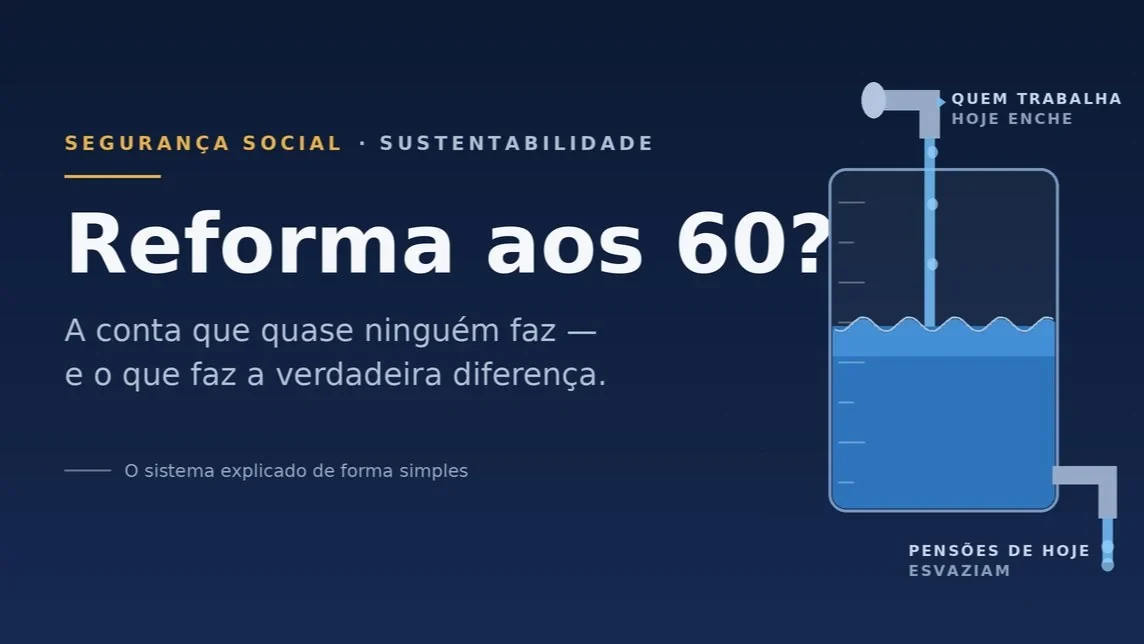
Imagine a bucket with two taps.
The top tap fills the bucket: it is the money coming in, from the contributions of those working today.
The bottom tap empties the bucket: it is the money going out, to pay the pensions of those already retired today.
Here is the point almost nobody knows: the money you paid in this month was not kept in an account with your name on it. It went almost immediately to pay the pension of someone already retired. When your turn comes to receive, it will not be your money coming back — it will be the contributions of those working at that time paying your pension.
This method has a technical name: pay-as-you-go. Translated into ordinary language, it simply means this: each generation pays the retirement of the previous generation. It is not individual savings — it is an agreement between generations. That is why it is called a “contract between generations”: children pay their parents, in the hope that, later, their own children will pay them.
As long as a lot of money comes in through the top tap (many people working) and it leaves slowly through the bottom one (few retirees, and for few years), the bucket keeps its level. The balance holds.
The problem is what is happening in Portugal: fewer children are born and we live longer. In simple language, fewer and fewer young people are entering the labour market (less filling from the top) and more and more retirees are living longer (more emptying from the bottom, for more years). The top tap loses strength and the bottom one opens wider and wider.
Why lowering the age to 60 “breaks” the system
Lowering the retirement age to 60 does two things at once — and both make the bucket problem exactly worse:
It partly closes the top tap. It takes 6 to 7 years of people out of work who, instead of continuing to pay in, start receiving. And worse: these are usually the years in which people earn the most in their lives — that is, the years in which those people were paying in the most.
It opens the bottom tap wider. Those same people start receiving a pension earlier. And, since we live longer, they will receive it for longer.
Result: less comes in, more goes out, and the bucket empties faster.
And here is the part that is rarely said clearly: this does not pay for itself. The bill does not disappear — it is just pushed forward. Whoever decides the measure today reaps the immediate benefit; those left with the bill are the young people of the coming decades. For them, only three options remain, all bad: pay in even more, receive lower pensions, or see the retirement age rise even further later on.
Put bluntly: retirement at 60 today is a promise paid for with our children’s money.
What already exists today (and works better than people think)
Before inventing new solutions, it is worth looking at two things the country already has — and that few people know about:
1. A “cushion” of more than 40 billion euros. There is a reserve fund called the Social Security Financial Stabilisation Fund (Fundo de Estabilização Financeira da Segurança Social, FEFSS) — a complicated name for a simple idea: it is a nest egg kept aside for emergencies. At the end of 2025 it was worth about 42 billion euros, enough to pay more than two years of pensions even if, absurdly, money stopped coming in through the top tap. It is a safety cushion that has even exceeded the target for which it was created. Many people do not even know it exists.
2. A retirement age that adjusts itself. The retirement age is not a fixed number: it follows life expectancy (that is, how many years, on average, people live). In 2026 it stands at 66 years and 9 months. The logic is not to punish anyone — it is just arithmetic. If people live longer, the pension has to be paid for more years; so people work a little longer to balance it. That automatic adjustment is already happening today.
In short: the system already has defence mechanisms in operation. The mistake of those who promise retirement at 60 is to pretend they do not exist.
What really makes the difference for sustainability
Saving Social Security in the long term is not done with promises. It is done with four changes — and I will explain each one with a simple example.
1. An automatic rule, instead of a political war every time a decision is needed. Today, every time the system has to be adjusted (changing the age, the formulas, the amounts), there is a political argument that drags on for years. The proposal is to install a kind of thermostat. Just as the home thermostat switches the heating on and off by itself to keep the right temperature, without anyone having to argue about it every day, the system would have a fixed rule that rebalances it automatically when the accounts begin to drift — without depending on who is in power or on election promises.
2. Not depending only on wages to fund pensions. Today, almost all the money that fills the bucket comes from a single source: wages. But as machines and computer programs do more and more of the work, there are fewer wages paying in. It makes sense, then, to draw part of the funding from elsewhere — from taxes the country already collects and knows how to measure well. Two concrete examples:
- VAT is the tax we all pay when we buy anything (it is added to the price of goods).
- Corporate income tax (IRC) is the tax companies pay on their profits.
The idea is to channel a slice of these taxes to pensions. That way, even if human work decreases, the system continues to be fed by the wealth the economy generates as a whole. (Some propose, as an alternative, a “robot tax”. It sounds good, but it is almost impossible to calculate in practice — nobody can measure, within a company’s profit, what part came “from the robot”. That is why using taxes that already exist is fairer and easier to apply.)
3. Saving with new money — and never by taking from what already exists. This is perhaps the most important part, and where almost all proposals stumble.
Some suggest: “let us put 15% of the contribution into an individual savings account, in each person’s name”. At first sight it seems great — everyone would have their own savings. But there is a trap: that 15% is precisely the money that, today, is paying the pensions of those already retired. If we divert it into individual savings, we open an immediate hole in the present. It is like deciding not to pay the rent this month in order to start saving to buy a house 30 years from now — the future may be sorted, but tomorrow you are left without a home.
The right way is the opposite: create those savings with new money, without touching what already pays today’s pensions. For example, a retirement savings plan in which all workers are enrolled automatically (but can opt out if they wish), with the company helping to put in a share. That way, over a career, each person builds up extra savings for the future — without taking a cent from the money that sustains current pensions.
4. The fastest lever of all: more people working. No fund and no formula solves the problem if there are not enough people paying in. The three things that balance the bucket fastest are simple: more people working (including workers from abroad with the qualifications we need), more people active (young people, women and also those who, being older, want to keep working), and less work “on the side”, outside the system (that is, people who work but do not pay in). Interestingly, it is largely thanks to this — above all to the arrival of new workers — that the accounts have held up in recent years. And almost nobody talks about it.
The central idea, in one sentence
There is no need to destroy the system to save it. It needs to be reinforced where it is already standing: an automatic rule that balances it by itself, more than one source of money, savings that grow with new money, and more people working.
Retirement at 60 sells a promise today and sends the bill to our children. True sustainability does the opposite: it ensures that the wealth generated today sustains everyone’s stability tomorrow.
The future is not secured by promising the impossible. It is secured by doing the right sums — and having the courage to explain them.
In simple words (this article’s glossary)
- Contributions: the part of the salary that goes to Social Security every month.
- Social Security: the public system that pays pensions and other support.
- Pay-as-you-go: the current method — each generation pays the retirement of the previous one; your money is not kept, it is used straight away.
- Contract between generations: the idea that those working today pay today’s retirees, and will be paid by those who come next.
- Life expectancy: how many years, on average, people live. If it rises, pensions have to be paid for longer.
- Reserve fund (FEFSS): the system’s “nest egg”, kept for emergencies; today it covers more than two years of pensions.
- VAT: the tax we pay when buying goods and services (it is included in the price).
- IRC: the tax companies pay on their profits.
- Retirement savings: extra savings, separate from the State pension, that grow over a lifetime to supplement retirement income.
Which change do you think would make the most difference? The discussion belongs to everyone — because the contract between generations does too.
Gaspar do Amaral
Methodological note
What this page is. An English translation of the article the author published on LinkedIn on 17 June 2026; the full Portuguese version is on this site. The article contains no calculations of its own; the figures (about 42 billion euros in the FEFSS at the end of 2025, more than two years of pensions, a statutory retirement age of 66 years and 9 months in 2026, 15% of the contribution) are those of the original and refer to Portugal.
Changes of form, not substance. “Repartição” is rendered by the usual English term, pay-as-you-go. The Portuguese tax names are kept in the glossary (IVA = VAT; IRC = corporate income tax). The original has no links.
The discussion is on LinkedIn (in Portuguese)
Comments on this text are made on LinkedIn, where the article was shared in Portuguese. You are welcome to write in English. Agree, disagree or add data: every well-founded objection receives a reply.
Gaspar do Amaral · Original in Portuguese of 17 June 2026, published on this site; translation issued on 30 October 2026 · Figures and tables © Aprecisa.com · AI-assisted
How to cite: Gaspar do Amaral (2026). Reforma aos 60? A conta que quase ninguém faz — e a que devíamos fazer. Zenodo. https://doi.org/10.5281/zenodo.23814396 · Permanent archive on Zenodo.