 ← Grupo Aprecisa · Connecting those who know with those who need
Energy and the power system · Article published on LinkedIn on 29 March 2026
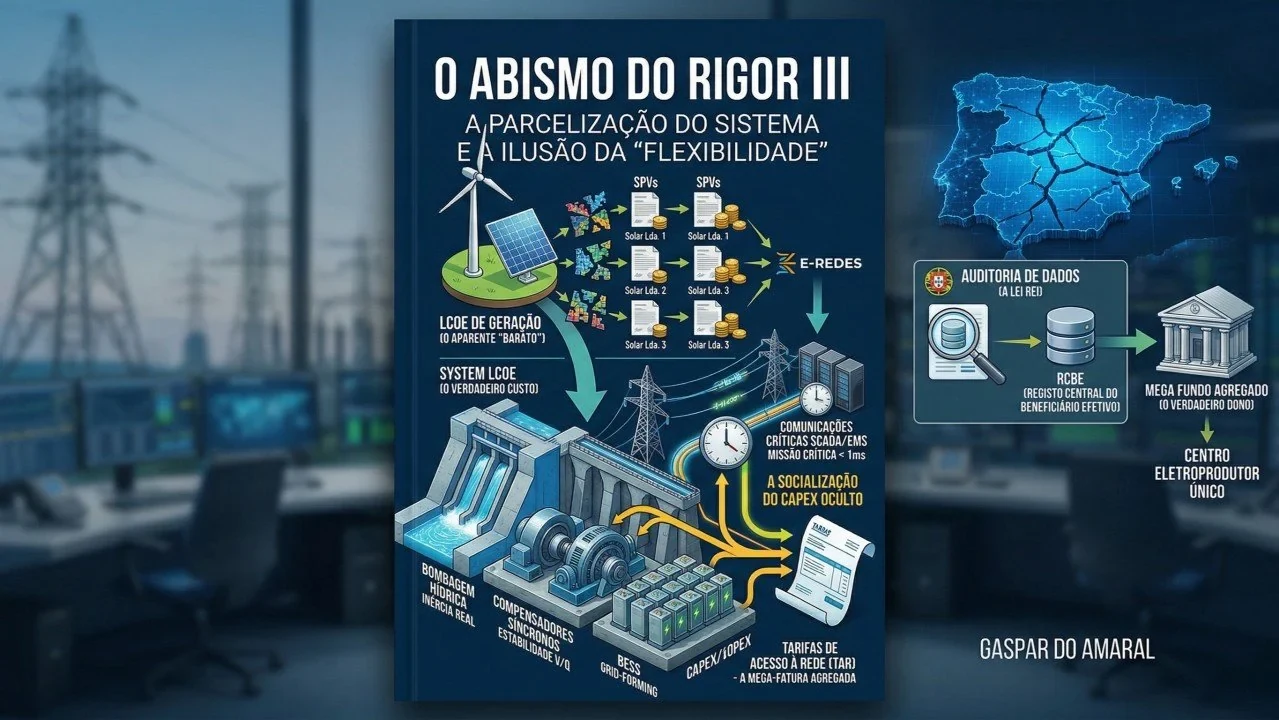
The Abyss of Rigour III: The Parcelling of the System and the Illusion of “Flexibility”
Splitting the system into parcels hides the costs: “flexibility” as the financial cosmetics of the transition
Gaspar do Amaral · 29 March 2026
Translated from the Portuguese original. This version was issued on 30 October 2026.
On this site, this article has been
By: Gaspar do Amaral
In the public debate on the energy transition, political economy tends to overshadow systems architecture. Following my earlier manifestos — notably The Abyss of Rigour: The Illusion of Cheap Energy and the Death of Synchronous Inertia and Energy Transition in Portugal: The End of Excessive Rents —, the healthy public exchange of arguments I had with an economist has shed light on the epicentre of the problem: the institutional acceptance of parcelling as a tool of financial and regulatory cosmetics.
When confronted with the brutal capital costs (CAPEX) required to stabilise the grid in the face of intermittency (such as synchronous compensators and batteries), the economic argument put to me was revealing: “Batteries are not regulated assets, so it makes no sense to add up the CAPEX; only the cost per service provided should be taken into account.”
For Systems Engineering, this statement is the absolute confession of the model in force. It is the Financial Parcelling of the system. The cost of generation (the solar panel, which is cheap) is isolated from the cost of stabilisation and robustness (the grid-forming battery, which is extremely expensive), and the burden of the latter is thrown onto the System Services paid for by all of us. It is a dangerous accounting illusion that finds its exact mirror in the physical reality on the ground: Regulatory Parcelling (or Fragmentation).
The State’s Acceptance of the Subterfuge: Real Cases in Portugal
The fragmentation of large renewable projects is not a corporate myth; it is a widely documented modus operandi. The premise is simple: the law requires solar projects above a certain threshold to undergo a rigorous Environmental Impact Assessment (EIA, AIA in Portuguese) and to bear the high cost of building dedicated substations for injection into the National Transmission Grid (REN). To get around this responsibility, the project is sliced into artificial contiguous parcels (e.g. 10 MW), conveniently connected to the local distribution grid (E-Redes).
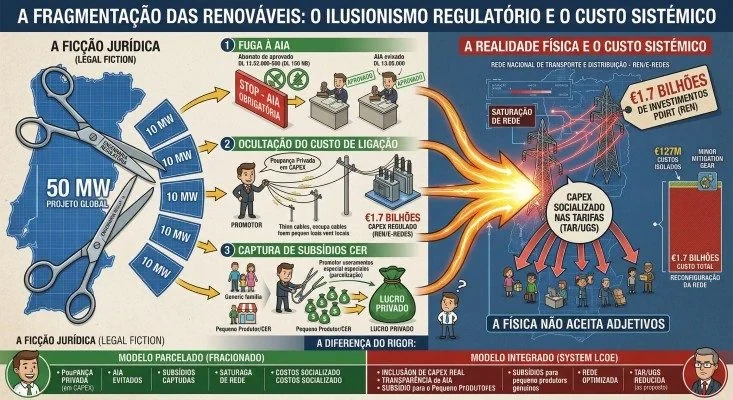
The evidence for this device is on the State’s own record:
1. The Official Warning from CCDR Algarve
In a strategic spatial-planning document, CCDR Algarve (the Algarve Regional Coordination and Development Commission) expressly identified the “fragmentation of energy production installations, in particular photovoltaic” as the main tactic for keeping projects below the mandatory EIA threshold, subverting the State’s capacity to assess the true cumulative impact of these power plants.
This is the official presentation entitled “Tendências para o sucesso da Avaliação de Impacte Ambiental na região do Algarve — novos desafios e dinâmicas perspetivas de futuro” (trends for the success of environmental impact assessment in the Algarve region — new challenges and dynamic future prospects). It was the basis for a webinar held on 15 June 2021 and was written by Maria José Nunes and Ricardo Canas, of the CCDR Algarve Environmental Services Directorate.
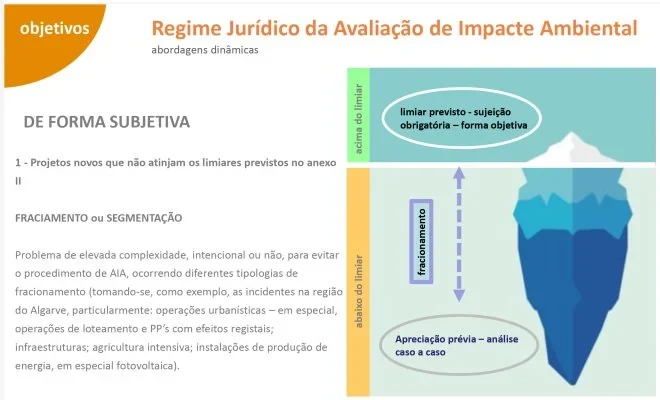
In this document (specifically on slide 29), when analysing the scope and dynamics of EIA in the Algarve (under “preliminary appraisal — case-by-case analysis”), the authors explicitly refer to the fragmentation of operations — highlighting intensive agriculture and “energy production installations, in particular photovoltaic” — as one of the main challenges in getting around the threshold for mandatory assessment, thereby subverting the proper weighing of cumulative impacts on the territory.
The full original document can be consulted and downloaded from the CCDR Algarve portal: PDF document: Tendências para o sucesso da Avaliação de Impacte Ambiental na região do Algarve.
2. The Complaint on the Ground (the Assessment Device)
A recent paradigmatic case involved the large Lagoa Salgada mine project and its complementary infrastructure. Associations such as ZERO formally objected to the use of an “artificial fragmentation of the project that makes no sense in an EIA context”. The tactic is plain: the production centre is assessed, but the high-voltage line that serves it is left out; parcel “A” is approved, pretending that parcel “B”, belonging to the same owner a few metres away, does not exist. 🔗 Ref.: Official position of the ZERO association — Lagoa Salgada.
The Cost of the Illusion: SPVs and Auditing the Register
What political economy describes as “streamlining licensing”, engineering recognises as a topological dysfunction driven by the interest of a single entity: the promoter. This ecosystem is concentrated in financial giants: large historical utilities, Independent Power Producers (IPPs) and massive investment funds.
The real conjuring trick lies in the way these giants present themselves for licensing. The “legal fiction” operates through the creation of multiple Special Purpose Vehicles (SPVs). Instead of “Mega Fund X” submitting a 50 MW park, it creates five separate limited companies (e.g. Solar Parcela 1, Lda.).
Setting up an SPV is a legal practice in project finance. The abuse arises when the regulator accepts the “front” of the Permanent Certificate of the Commercial Register (where the SPV shows a minimum share capital of €5,000) and ignores reality. The lethal tool for auditing this fragmentation already exists in the Portuguese State: the Central Register of Beneficial Ownership (RCBE). It is the RCBE that proves, mathematically and irrefutably, that the various SPVs scattered across a municipality share the same financial owner who captures the profits.
By not cross-checking these data, the State allows the promoter to privatise the saving on its CAPEX. The stochastic saturation of the grid does not disappear; it accumulates. And this is why REN submitted to ERSE a PDIRT-E (the transmission grid development plan) requiring a colossal injection of 1,691.5 million euros (about 1.7 billion). This is the true regulated CAPEX. It is the bill for the “cheap electron”, relentlessly socialised through the Network Access Tariffs (TAR). The promoter fragmented its legal responsibility; the Portuguese consumer pays for the whole infrastructure. 🔗 Ref.: ERSE Public Consultation 128 — PDIRT-E 2024 (REN).
(Note: within the documentation submitted for consultation, the amount is quantified exactly in the Framework Document for the PDIRT-E 2024 proposal. Specifically, on page 11 of that document the following fact is established: “Thus, in this Public Consultation, all the investments included in the PDIRT-E 2024 proposal are under discussion, for the 2025–2034 horizon, totalling 1,691.5 million euros, at total cost.” The exact figure of 1,691.5 million euros corresponds to the overall technical investment projected by REN for the national electricity infrastructure over the next decade, and it is the figure that, rounded, is commonly referred to as 1.7 billion euros in the economic analyses and opinions on this dossier.)
Conclusion: The Mathematics of the System LCOE and Legislative Disruption
The complexity of a cyber-physical power grid does not allow fractions. It is imperative to move to the System LCOE (System Levelized Cost of Energy) metric, ensuring that the systemic cost includes not only generation, but also the monumental grid reinforcement and stabilisation infrastructure inherent in the loss of inertia.
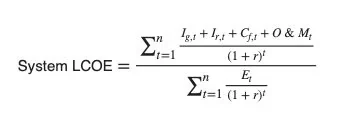
Caption of the System LCOE — The Mathematics of Resilience (System LCOE). The equation that destroys the fallacy of “cheap energy”. The numerator shows that the true cost of the transition requires adding to the cost of the solar panel (Ig) the monumental bill for the back-up, telecommunications and grid-reinforcement infrastructure (Ir) needed to prevent the collapse of the system.
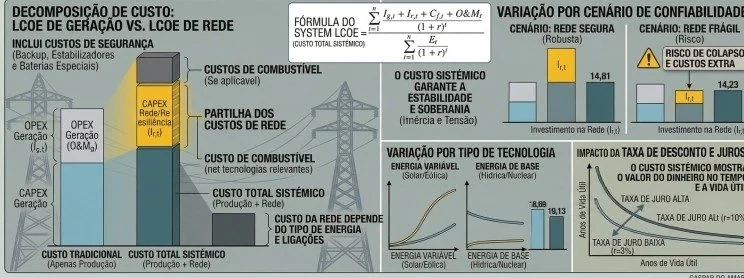
To explain the image simply and directly, we can divide it into its four main quadrants:
1. The Hidden Cost (top left)
- What it shows: the difference between “illusion” and “reality”.
- What it means: the first bar (light blue) shows how the cost is calculated today: only the price of building and operating the solar or wind park is counted. The second bar shows the thesis (the Total Systemic Cost): to the cost of the panel we have to add the yellow block (Ir,t). This block represents the colossal cost of the power lines, batteries and stabilisers needed so that intermittent energy does not bring the grid down. It is the invisible bill that promoters do not pay.
2. The Price of Security (top right)
- What it shows: the risk of skimping on infrastructure.
- What it means: it compares a “robust” grid with a “fragile” one. Having a secure grid requires a large up-front investment (the yellow bar is bigger). If we try to get around that investment (fragile grid), the danger sign appears: the system is on the brink of collapse and ends up spending fortunes on extra system-service costs (as happened in the blackout we discussed). Security is never free.
3. The Impact of Different Energy Sources (bottom left)
- What it shows: unstable energy costs much more to integrate than stable energy.
- What it means: in the line charts we see that, as we inject more “variable energy” (wind and sun), the grid-cost line shoots up, because the system comes under stress managing intermittency. By contrast, with “baseload energy” (pumped hydro or nuclear), the inertia is already there, so the extra cost on the grid stays flat and under control.
4. The Weight of Time and Interest (bottom right)
- What it shows: how interest rates and the lifetime of equipment set the final bill.
- What it means: because stabilising the grid requires heavy, expensive infrastructure (CAPEX), the cost of money is crucial. If interest rates are very high (top line, at 10%), the systemic bill soars. If the equipment lasts many years (horizontal axis), the cost falls as the investment is spread over time.
The figure proves that producing a solar electron can be very cheap, but building and maintaining the “digital and physical motorway” so that it reaches our homes without causing a blackout costs a fortune — and that fortune (the Systemic Cost) has to be accounted for.
Proposal for an Integral Energy Responsibility Law (LREI)
To bring about this change, I propose the creation of the Integral Energy Responsibility Law (Lei REI). This law does not need to prohibit the use of SPVs, which are legitimate financing instruments; it need only impose physics and data auditing on the licensing process.
I therefore present the braking rule that should inaugurate this new paradigm:
Article 1 — Principle of Topological and Financial Aggregation
- For the purposes of subjection to Environmental Impact Assessment (EIA), allocation of grid injection capacity and calculation of systemic charges, all Special Purpose Vehicles (SPVs) or electricity production units located within a contiguous topological radius that share the same financial ownership — established by mandatory cross-checking of data with the Central Register of Beneficial Ownership (RCBE) — shall be compulsorily aggregated and classified as a Single Generating Centre.
- The Single Generating Centre assumes full responsibility for internalising the capital costs (CAPEX) associated with reinforcing the National Transmission Grid (RNT) and its respective share of the grid-stabilisation infrastructure (grid-forming and synchronous compensation), in strict proportion to its aggregated injection capacity.
- Proof of artificial fragmentation of installed capacity with the aim of evading regulatory thresholds or shifting charges onto the Network Access Tariffs (TAR) entails the immediate review of the operating licence and the retroactive attribution of the systemic costs to the Beneficial Owner.
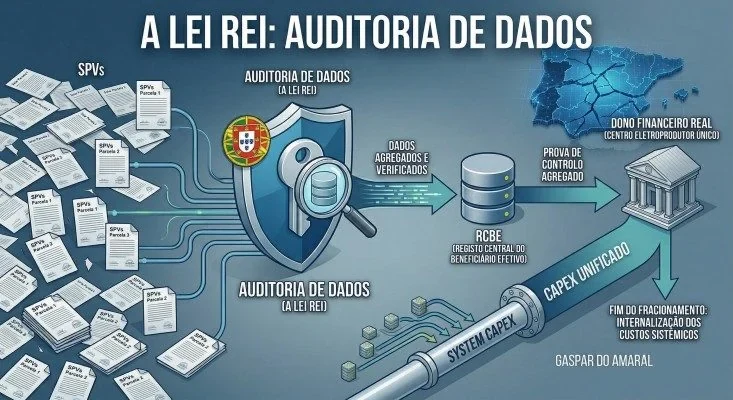
The diagram illustrates the data-audit flow designed to stop the evasion of grid CAPEX. On the left, the proliferation of Special Purpose Vehicles (SPVs) represents the artificial parcelling of photovoltaic projects. The REI Law, operating as an audit and data-intelligence filter, requires these entities to be cross-checked against the Central Register of Beneficial Ownership (RCBE). This scrutiny crystallises the “Proof of Aggregated Control”, collapsing the multiple SPVs into a Single Generating Centre under the authority of its true financial owner. The output of the process (on the right) is the unification of the Systemic CAPEX, obliging the promoter to internalise the costs of the stabilisation infrastructure and thus dictating the end of regulatory fragmentation.
Ideology projects intentions and creative accounting parcels out bills but, faced with the reality on the ground, it is engineering and rigorous auditing that keep the circuit breakers closed.
The time has come to stop financing regulatory illusionism and to accept that the resilience of our electricity system demands Verticality, transparency and integral responsibility.
Documentary Evidence and Scientific Grounding
So that this debate transcends rhetoric and rests on the rigour of data and of the law, I make available the documentary evidence supporting the urgency of the System LCOE metric and of Article 1 of the REI Law:
[1] The Institutional Confession of Fragmentation (CCDR Algarve)
- Document: Nunes, M. J., & Canas, R. (2021). Tendências para o sucesso da Avaliação de Impacte Ambiental na região do Algarve — novos desafios e dinâmicas perspetivas de futuro [slide 29]. Environmental Services Directorate, CCDR Algarve.
- Access/link: available in the public archives of the CCDR Algarve portal (Environment/EIA section) or through government repositories of spatial-planning webinars (June 2021).
- Why does it prove our article? Because it destroys the argument that “parcelling” is a myth. This document is proof that the State itself (through the Coordination Commissions) has official knowledge that promoters artificially slice photovoltaic installations to escape EIA thresholds and, consequently, the heavy costs of grid infrastructure. It is the institutional validation of the “legal fiction” I denounce.
[2] The Denunciation of the Device on the Ground (the Lagoa Salgada Case)
- Document: ZERO Association (public position on the Lagoa Salgada mine project and complementary infrastructure).
- Access/link: Official ZERO portal — press releases.
- Why does it prove our article? It transposes the theory of “topological parcelling” to physical reality. It proves how the system allows the consumption/production centre to be licensed while deliberately ignoring the high-voltage line that serves it, concealing the true cumulative impact and the systemic CAPEX. It is the perfect mirror of how the cost of the “cheap” asset is isolated and the “expensive” infrastructure is hidden.
[3] The Hidden Bill for Grid CAPEX (REN’s 1.7 Billion)
- Document: REN — Rede Elétrica Nacional (2024). Proposal for the Transmission Grid Development and Investment Plan (PDIRT-E 2024). Framework Document, p. 11.
- Access/link: ERSE portal — Public Consultation No. 128.
- Why does it prove our article? It is the “smoking gun” of the financial argument. Economists claim that solar energy is the cheapest (low LCOE). This document proves that, to connect that intermittent “cheap electron”, the transmission grid requires an injection of 1,691.5 million euros. Because the parcelled SPVs escape this cost, the bill lands entirely on the Network Access Tariffs (TAR), paid by the consumer. It is the System LCOE showing itself on the electricity bill.
[4] The Audit Tool (the Legal Basis of the REI Law)
- Document: Assembleia da República. Law No. 89/2017, of 21 August (approving the Legal Regime of the Central Register of Beneficial Ownership, RCBE).
- Access/link: Diário da República Eletrónico (DRE).
- Why does it prove our article? Opponents of the proposal will argue that it is “impossible” or “illegal” to aggregate the SPVs and hold the financial owner responsible. This law proves exactly the opposite. The legal tool for tearing the “corporate veil” of the small €5,000 limited companies already exists in the Portuguese State (for the purpose of combating money laundering). Article 1 of the REI Law merely proposes that Systems Engineering use this same database to audit the topology of the power grid.
[5] The International Scientific Grounding of the System LCOE
- Document: Ueckerdt, F., Hirth, L., Luderer, G., & Edenhofer, O. (2013). System LCOE: What are the costs of variable renewables? Energy, 63, 61–75.
- Access/link: scientific article (DOI: 10.1016/j.energy.2013.10.051).
- Why does it prove our article? It raises our argument to an irrefutable academic level. This is the founding scientific article that proves mathematically that the traditional LCOE is a misleading metric in grids with a high penetration of variable renewables. It shows that the loss of inertia and the need for back-up generate a non-linear systemic cost that has to be accounted for in planning equations, fully legitimising the formula shared in the infographic.
Methodological note
What this page is. An English translation of the article the author published on LinkedIn on 29 March 2026; the full Portuguese version is on this site. The article contains no calculations of its own; the amount of 1,691.5 million euros is the one the author quotes from the ERSE consultation. The Lei REI article is the author’s proposal and is translated here for information; it is not law.
Changes of form, not substance. The two earlier manifestos mentioned in the first paragraph now link to their English versions on this site (in the original, the second linked to a LinkedIn post). Tracking parameters have been removed from the links. In reference [5], the DOI, which the original split into three links (one of them to a non-existent address, “j.energy”), is now a single link. Figure 3 is an image of the equation; the formula is also written out in its caption. In the original, the infographic after the second paragraph of “The State’s Acceptance of the Subterfuge” has no number. EIA is AIA in Portuguese; CCDR, a Regional Coordination and Development Commission; REN and ERSE, the Portuguese transmission system operator and energy regulator; E-Redes, the distribution system operator; RCBE, the Central Register of Beneficial Ownership.
The discussion is on LinkedIn (in Portuguese)
Comments on this text are made on LinkedIn, where the article was shared in Portuguese. You are welcome to write in English. Agree, disagree or add data: every well-founded objection receives a reply.
Gaspar do Amaral · Original in Portuguese of 29 March 2026, published on this site; translation issued on 30 October 2026 · Figures and tables © Aprecisa.com · AI-assisted
How to cite: Gaspar do Amaral (2026). O Abismo do Rigor III: A Parcelização do Sistema e a Ilusão da "Flexibilidade". Zenodo. https://doi.org/10.5281/zenodo.23814355 · Permanent archive on Zenodo.